All stories · Article
15% off can cost nearly 30% of profit: raise AOV instead
In a worked example from Josh Chin (@JoshuaChronos), 15% off a $100 order cuts its contribution margin from $50.80 to $35.80, a drop of almost 30%.
Share: WhatsApp · Telegram · X · Facebook · LinkedIn · Email

Black Friday falls on November 27, 2026, so price out one order before you pick a discount, then grow the cart.

Per-order costs stay put, so the discount comes straight out of profit
| What does one order actually make? |
|---|
| Contribution margin = Price − Product cost (COGS) − Shipping − Fulfillment − Returns − Payment processing |
| Profit after ads = Contribution margin − Ad cost per order |
If you run ads, profit after ads is the number to check before you pick a discount. It still leaves out fixed costs such as staff, apps and your Shopify plan, so it isn't what you finally keep.
Chin, who writes for DTC brands on X, works through a hypothetical $100 order, before ad costs:
| Full price | 15% off | |
|---|---|---|
| Price | $100 | $85 |
| Product cost | −$35 | −$35 |
| Shipping, fulfillment, returns, processing | −$14.20 | −$14.20 |
| Contribution margin | $50.80 | $35.80 |
Josh Chin@JoshuaChronosDTC brands: check your margin before you run your next discount.
Ask yourself two questions first:
1) What does this offer do to my margin?
2) What is it training my customers to do?
Start with the first one, because a discount costs more than the number on the banner.
Take a $100 order. COGS is $35, and shipping, fulfillment, returns, and processing come to $14.20.
At full price, that order contributes $50.80.…Oct 26, 2026 · View on X
The discount comes off the price, but none of the per-order costs get any cheaper. Chin sums it up: "You took 15% off the price and gave away almost 30% of what the order makes you."
His example treats every product as if it had the same margin, and most catalogs don't. A bag at a 65% margin and a care kit at 30% can sit in the same store, so a sitewide 20% off works on the bag and loses money on the care kit.
The same discount hurts your thinnest-margin products first.
Does your profit number include ad costs and every product's cost?
Chin's math stops before ad costs, and ads are getting more expensive.
For stores that buy traffic from Meta, the ad cost inside each order may be heavier than before.
The second gap sits in your own data. The Shopify Help Center page on profit reports says profit is reported only for products and variants that had a cost recorded at the time they were sold. If a bestseller has an empty cost per item field, its sales are missing from your profit numbers, so you can't see how much the discount takes from it.
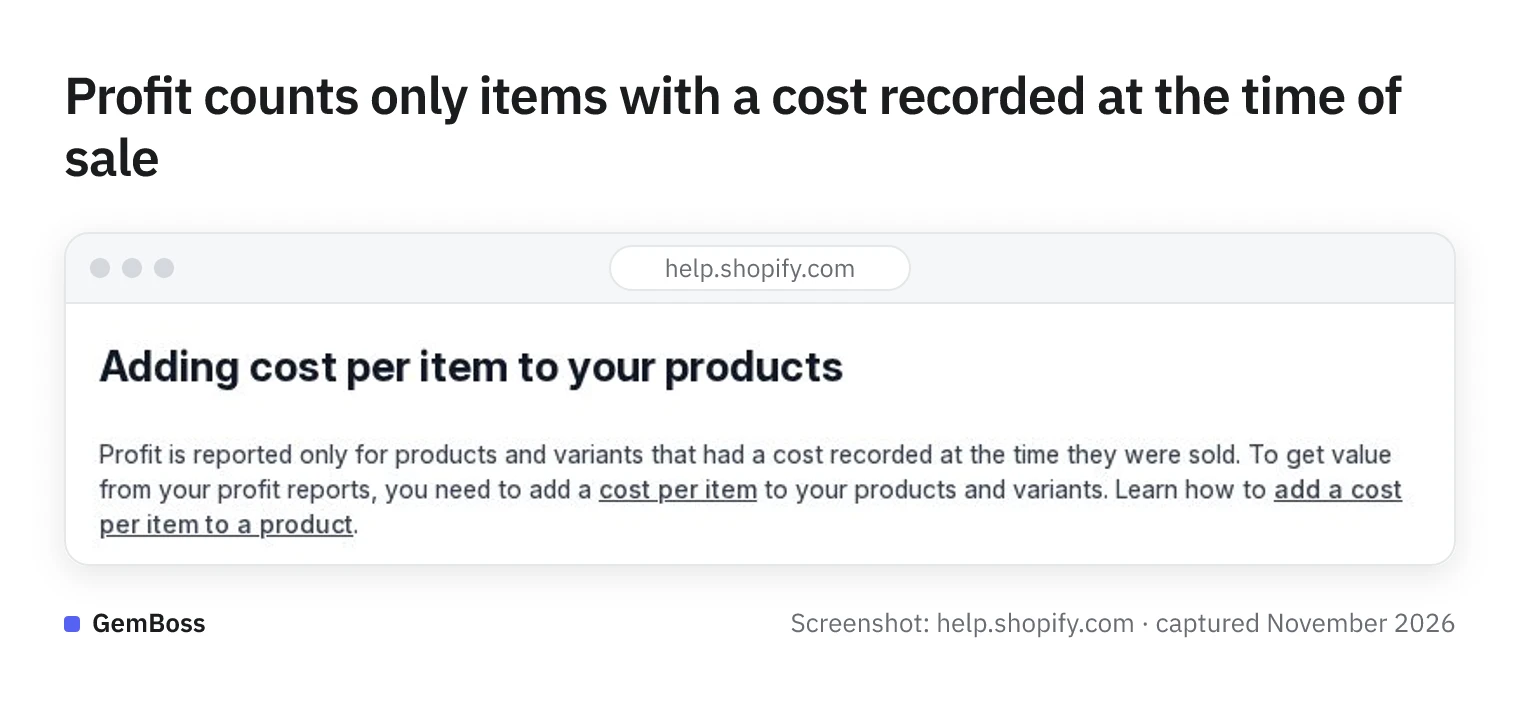
Shopify Help Center: profit is only reported once a cost is recorded before the sale. Captured November 2026.
If you aren't running a sale and don't buy traffic, neither gap matters much for your store.
An extra $50 off added only 7.4% in revenue: try raising AOV
How deep to go has numbers behind it too. Chin describes one account that tested $100 off against $150 off: the bigger discount won on revenue by only 7.4%, while $100 off came out 1.1% ahead on revenue per delivery. Giving away an extra $50 per order bought almost nothing, so they went back to $100.
Instead of cutting deeper, you can get shoppers to buy more in one order. Matt Beswick (@matt-beswick), who runs shopping ads for ecommerce stores, often finds the free shipping threshold set below the store's AOV (average order value): "So they are giving a less than average customer the benefit of free delivery." His fix is to move it just above AOV.
How to test a higher threshold
Zohaib Rattu (@zohaibrattu) lays out a test to run before BFCM. It is a proposal, with no results yet:
- With a $48 AOV, try free shipping at $60.
- Offer a $12–20 add-on, bundle or sampler that fits naturally with your bestsellers.
- Add a cart progress bar that shows how much more someone needs to spend to get free shipping.
- Track AOV, conversion rate, revenue per visitor and shipping cost.
If AOV rises but conversion drops sharply, the threshold may be too high. Rattu also notes that your BFCM discount changes how fast shoppers reach it. One reader asked under the post whether the bar should show dollars or items left, a detail worth settling before you install it.
When to leave the threshold alone
A commenter under Beswick's post argued that free delivery helps first-time buyers try a brand they don't know yet, while for existing customers who would buy anyway, a low threshold can be a problem because they may end up ordering less often.
If you need new customers right now, hold off on moving the threshold.
What to do before November 27
Ordered from lowest to highest risk, each with when to skip it:
- Fill in cost per item for your bestsellers. Do it for every product and variant before the sale starts, since profit is only reported for items with a cost recorded when they sell. Skip it if every product already has a cost.
- Work out profit after ads for one order at the discount you plan to run. Take the contribution margin at the discounted price, then subtract ad cost per order, and do it separately for your thinnest-margin product. If little is left, lower the discount or pull that product out of the sitewide sale. Skip it if you aren't running a sitewide discount.
- Test a free shipping threshold just above your AOV. Pair it with an add-on and a cart progress bar, then track the four numbers above. Skip it if most of your sale traffic is first-time buyers.
Work out profit after ads on one order before you put a number on the banner.
Sources
- Josh Chin (@JoshuaChronos) · x.com
- released on October 21, 2026 · prnewswire.com
- Shopify Help Center page on profit reports · help.shopify.com
- Matt Beswick (@matt-beswick) · linkedin.com
- Zohaib Rattu (@zohaibrattu) · linkedin.com