All stories · Case study
$229K/month on 8 products: What Thermafits gets right about product page offers
A crossed-out price, a multi-buy deal and a scarcity label can all help sell a product. But when the numbers on a product page contradict each other, the same tactics can create doubt instead.
Share: WhatsApp · Telegram · X · Facebook · LinkedIn · Email

Two Shopify store teardowns from November 2026 offer a useful comparison: Thermafits, estimated to generate $229K in monthly revenue, and LIVFRESH, estimated at $1.3M–$2.4M per month.
The difference is not simply which store uses more pricing tactics. It is how consistently each offer is presented.
1. Two stores, similar pricing tactics
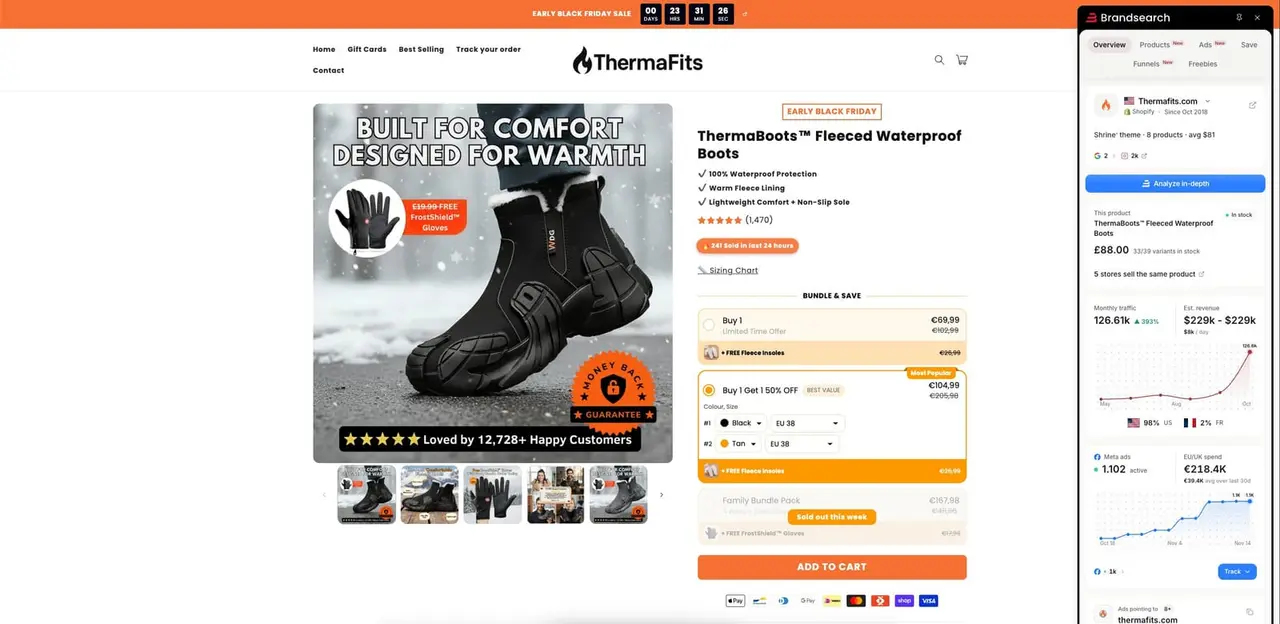
According to TheEcomDaddy's teardown, Thermafits had just eight products and an estimated $229K in revenue the previous month. Its traffic was up 393%.
The store sells a fleece-lined waterproof boot priced at €69.99. Five other stores reportedly sell the exact same product.
Instead of relying on product exclusivity, Thermafits builds a pricing structure around one hero product:
- Buy 1: €69.99, reduced from €102.99, with free insoles.
- Buy 1, Get 1 50% Off: €104.99, marked as Best Value and preselected.
- Family Pack: €167.98, marked as Sold Out This Week.
Each option is anchored against a crossed-out reference price. The three tiers give shoppers different purchase quantities and price points to consider.
The offer itself becomes part of the product.
2. The difference: Do all the numbers tell the same story?
Now compare that with LIVFRESH.
In a teardown, David Victor (@davezyne), a Shopify engineer, estimated the store's monthly revenue at $1.3M–$2.4M, with traffic up 60%. The teardown identified six conversion issues.
David Victor ✦ | Shopify Engineer@davezyneLIVFRESH is doing an estimated $1.3M–$2.4M/month.
I tore down their store with Brandsearch + the live site. Found 6 conversion gaps.
The numbers (est.):
→ ~455K visits/mo (+60%)
→ 559 active Meta ads
→ 94% US traffic
The gaps:
1. Two different "savings" on the same $59.99
2. Three subscription cadences: 4 months / 12 weeks / 3 months
3. "Risk-free" guarantee with strict fine print
4. Study count changes by page…Nov 17, 2026 · View on X
One of the most noticeable was pricing inconsistency.
The product page displayed two different savings claims against the same $59.99 price. Other details, including subscription intervals and research figures, also appeared inconsistently across the site.
That creates a problem beyond visual presentation.
At Thermafits, the pricing tiers follow a consistent structure. At LIVFRESH, multiple figures describing the same offer do not always agree.
The lesson is not to copy Thermafits' discounts or urgency labels. It is to make every number support the same offer.
3. Why can a second savings claim cost you a sale?
Because shoppers should not have to work out which offer is real.
Baymard Institute's product page research explains why this matters.
During usability testing, participants struggled when the same promotion appeared in multiple descriptions. Some wondered whether the messages represented separate offers or whether the discounts could be combined.
One participant even interpreted the presentation as potentially misleading.
Baymard found that 19% of desktop sites in its benchmark risked confusing users by displaying multiple descriptions of the same promotional offer.
Its recommendation is straightforward: give each offer one clear description, positioned close to the product price. If the same offer must appear more than once, keep the wording identical or nearly identical.
Read Baymard's research on product page discounts.
The issue is not that shoppers dislike discounts. It is that unclear discounts make them stop and reconsider.
Every unanswered question adds friction between product discovery and checkout.
4. More traffic makes inconsistent offers more expensive
A pricing inconsistency may go unnoticed when only a small number of shoppers visit a product page.
But when paid traffic increases, more potential customers encounter the same problem.
Victor's teardown highlighted a 60% increase in LIVFRESH traffic. The Thermafits teardown reported a 393% increase.
These are third-party estimates, not verified figures from either store's internal analytics. Neither teardown measures how much revenue the identified issues actually cost.
That distinction matters. A teardown can identify potential leaks, but only a controlled experiment can establish their financial impact.
What Shopify sellers should check before Black Friday
Black Friday falls on November 27, 2026. Before increasing ad spend or adding more promotional elements, review the product pages receiving the most paid traffic.
Use this checklist:
- Reference prices: Does every crossed-out price accurately correspond to the displayed selling price?
- Savings claims: Are percentage discounts and monetary savings consistent with the actual offer?
- Bundles: Are the quantities, bundle prices and selected options clearly explained?
- Subscriptions: Are billing intervals and recurring prices consistent everywhere?
- Social proof: Do review counts and research figures match across the product page and other sections?
- Urgency labels: Is the stock or time limitation genuine and clearly explained?
Most importantly, give each offer one clear explanation next to its price.
You do not necessarily need another discount, a new urgency badge or more traffic.
You may need to make the offer you already have easier to understand.
The takeaway: Thermafits shows how a pricing structure can make an ordinary product more compelling. LIVFRESH shows what happens when the numbers behind an offer become inconsistent. Traffic amplifies both the strengths and weaknesses of a product page.
Source note: Revenue and traffic figures for Thermafits and LIVFRESH are third-party estimates reported in the respective X teardowns, not independently verified store financials. Baymard's research provides usability evidence, not a measurement of revenue lost by either store.
Ask AI next
- Which Shopify apps or tools can automatically scan product pages for pricing inconsistencies like LIVFRESH's?
- Is it safer to remove a pricing tier I can't verify before Black Friday?
- How do third-party teardown accounts actually calculate a store's monthly revenue from traffic and ad data like this?
- Is this pricing-consistency problem more common in certain ecommerce categories than others?
- Could ad platforms or regulators start treating inconsistent discount claims like LIVFRESH's as deceptive advertising?