All stories · Article
4 things agencies should check before installing AI skills on a client's store
AI agents like Claude Code, Codex and Cursor can now take on skills (instruction packs that teach an agent one specific job) across most of marketing, from writing landing page copy to running SEO audits and reviewing ad accounts.
Share: WhatsApp · Telegram · X · Facebook · LinkedIn · Email

Many of these skill packs are free, and they're pitched as a way to do marketing without hiring an agency.
Between October 12 and 22, 2026, three posts from AI-tool accounts on X pushed that same line: one said agencies are selling what's already free on GitHub, another framed the agent as an entire growth team, and a third closed with "No $2,000/mo agency required."
Yarchi@undefinedKiAgencies sell AI agents as a service. Meanwhile the code is sitting on GitHub for free
Ranked from good to the best one:
1. Describe a website or app and an agent builds it right on your machine. 21.6k stars
https://t.co/1IGkcdMM2J
2. Secure cloud sandboxes where your agent can run code without touching your machine. 13.4k stars
https://t.co/MA0CAdKABE
3. A memory layer so your agent remembers users and past…Oct 12, 2026 · View on X
It won't take much for a client to read these and ask why they're still paying your retainer.
The question to answer first is which skills deserve a place in your client workflow, and what you check before one touches a store or an ad account. For an agency, a skill library is worth the few skills you pick and vet carefully, not the hundreds sitting in a repo.
Check what kind of business the skill was written for
Take Corey Haines' Marketing Skills. Haines founded Conversion Factory, an agency focused on conversion optimization. The repo has 52 skills and more than 56,000 GitHub stars, and it says plainly that it's built for "technical marketers and founders". Read the list closely and a lot of it revolves around software: trial signup flows, in-app upgrade screens, 140 SaaS marketing ideas, B2B cold email.
In our view, the part that fits a Shopify store is the page optimization (cro), copywriting, SEO audit, structured data, email automation and ads groups. The repo lets you install skills one at a time instead of the whole set, so you only need the group that matches the services you sell to the client.
The repo also has a foundation skill called product-marketing, which holds the product description, target customer and positioning. According to the README, every other skill reads it before doing any work.
Without it, the skills may fall back on default assumptions, and as the list above shows, those defaults lean toward software.
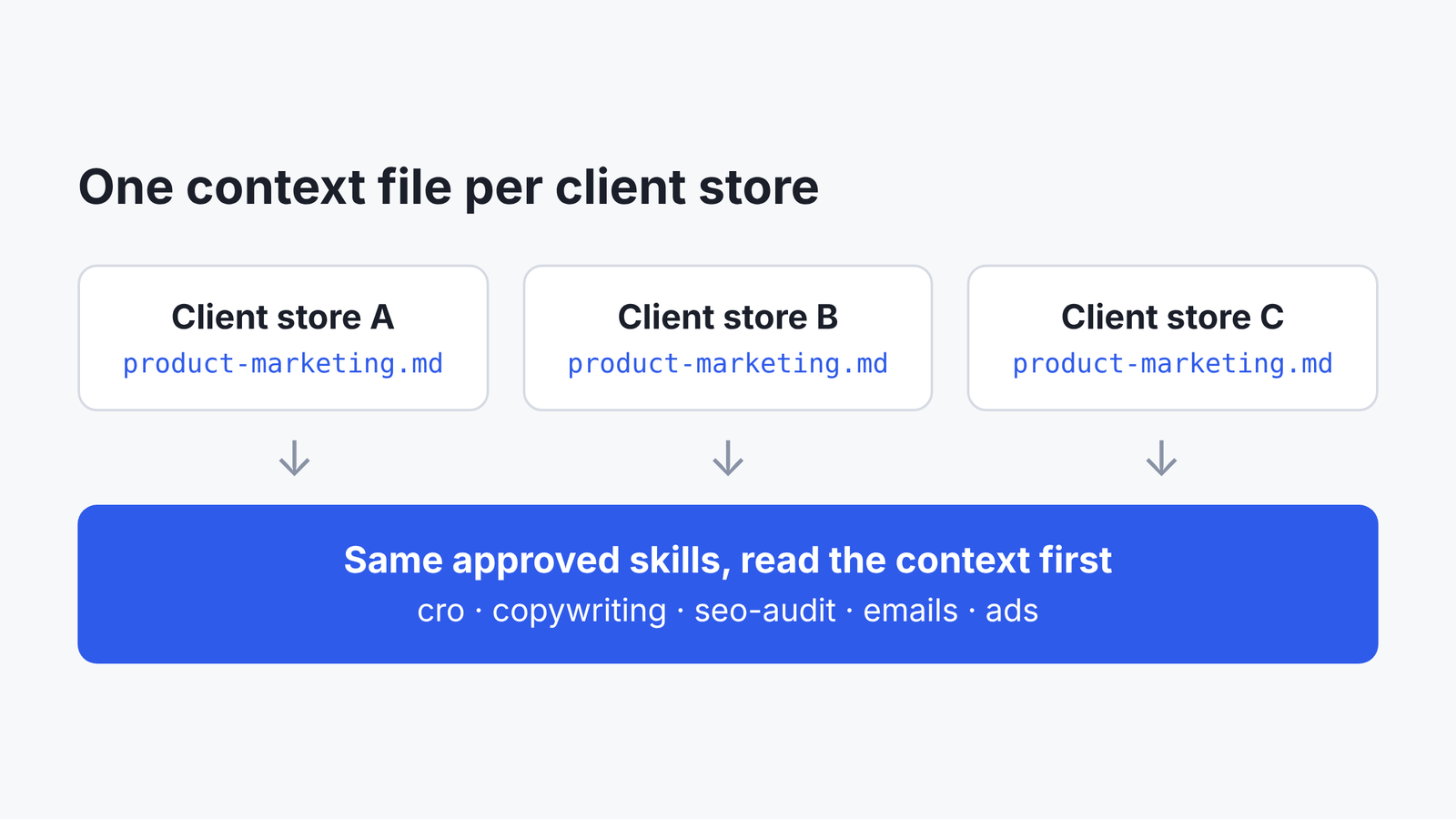
A free skill can lead to a paid service
Every skill is a SKILL.md file in plain text, so you can read it before installing. That reading is worth the time, because a free skill can still be tied to a paid product.
Ilias Ism, who is building the backlink service LinkDR, ships a skill called linkdr in his SEO skill set. It plans a backlink purchase from LinkDR around a budget, then sends a checkout link. Corey Haines' repo, for its part, publicly lists its sponsors and says they have no influence over what the core skills recommend.
Both disclose this in the README, so nobody is hiding a cost. Still, when the agent runs on a client's behalf, a suggestion to buy a service can go straight into the plan for spending the client's budget.
If you find any, decide whether to keep, edit or drop the skill, and tell the client if it will spend their money.
Install only from where the author publishes
ECC, a free set of 71 agents and 311 skills for Claude Code, puts a warning at the very top of its README. According to the project, third-party re-uploads and unofficial copies aren't reviewed by them and may contain malware. They recommend installing only from official channels such as the GitHub repo, the npm package and the project website, and starting from the workflow you need rather than the whole catalog.
That warning matters more if the machine running your agent holds data or access for several clients, because one unknown skill could then reach all of them. ECC also ships a scanner for agent configuration, covering prompts, hooks, tool connections, permissions and secrets. Your team can work in the same spirit: keep a list of approved skills, record where each one was installed from, and add a new skill only after someone has read it.
Skills connected to client accounts should default to read-only
The risk goes up when a skill is allowed to change data, not just read it.
Claude Ads, a skill that audits ad accounts across 12 platforms including Google, Meta, TikTok and Pinterest, shows one way to fence this in. Its README says every connection is read-only by default. To apply a change, the skill needs a tested function for that exact action, a specific account ID, a before-and-after diff, the account owner's approval within a preset cap, and a way to roll it back.
In our view, that's the bar to set for any skill that connects to a client's ad account or Shopify admin. If a skill can't say clearly what it's allowed to change, give it read access only, or don't connect it. When a change is needed, the person approving it should be someone at the agency who has agreed a spending ceiling with the client.
Back to the client's question.