All stories · Article
92% say AI works, 27% can prove it: write 3 lines before you start
In a survey Sprinklr released in late October 2026, 92% of teams running customer-facing AI said it meets expectations, yet only 27% could quantify a result. Most had skipped a starting number.
Share: WhatsApp · Telegram · X · Facebook · LinkedIn · Email


Most teams say AI works. Few wrote down where they started
Picture the weeks after you switch on an AI ad feature or a new AI app. Its report shows green arrows. What are those arrows compared against?
A study by research firm Metric Sherpa, produced with Sprinklr, suggests most teams cannot say. Among organizations using AI in regular live operation, 92% said it met or exceeded expectations, while 27% said they could quantify a result precisely using records or reports. The answers come from 807 US marketing, service and customer experience practitioners, are self-reported and unaudited, and Sprinklr, which sells a customer experience platform, commissioned the work. Shopify stores were not the subject.
The gap opens before launch: only 34% defined clear goals and success metrics before deployment, and 29% set a baseline. The gap starts in the preparation, before anyone switches the tool on.
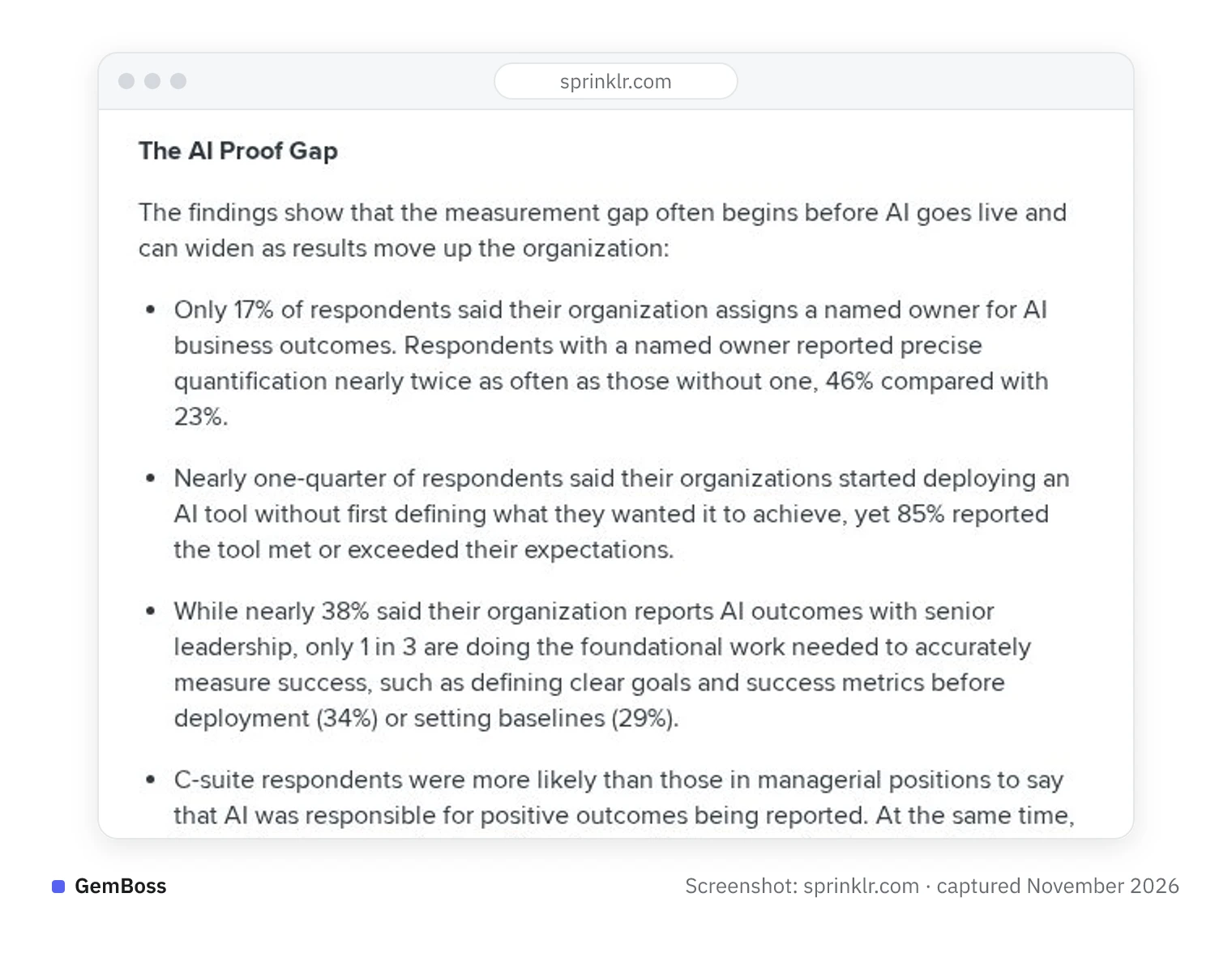
The findings list in the Sprinklr press release, on Sprinklr newsroom, captured November 2026.
Why can't the app's own report settle it?
Every tool reports on what it optimizes. Constantine von Hoffman, senior editor at MarTech, laid out the pattern on October 30, 2026: an ad platform optimizes conversion, a service platform optimizes containment, a content system optimizes engagement. "All three can show improvement inside their own dashboards while the business outcome stays flat."
The survey adds a related number. 85% of respondents reported gains in at least one metric category their organization had not tracked before launch. MarTech notes the researchers could not tell whether those teams added measurement later or relied on another source.
The tool ends up grading its own work.
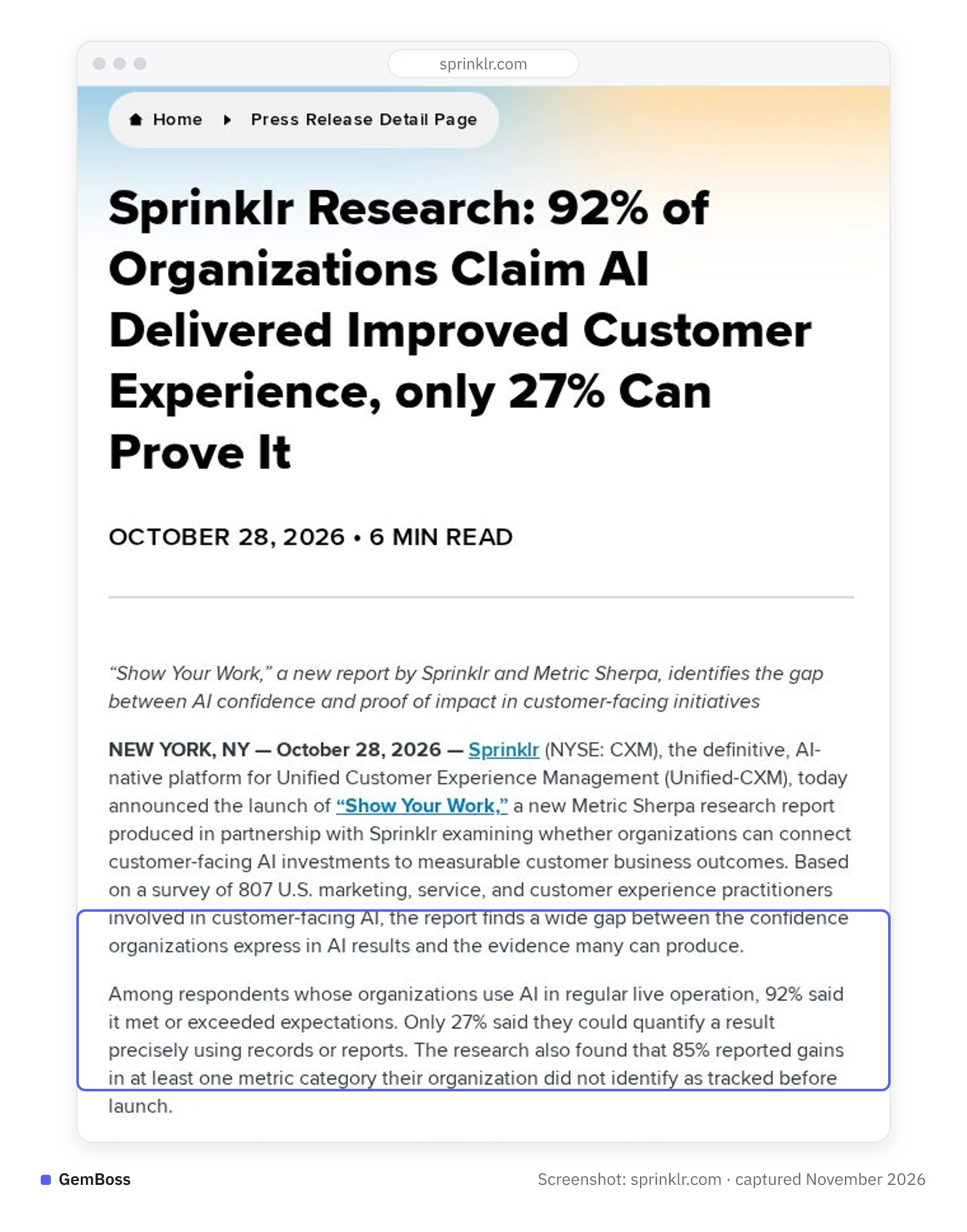
The headline numbers in the Sprinklr press release, on Sprinklr newsroom, captured November 2026.
For a store going into peak season, this is a money question. The AI is rarely the only thing that changes in those weeks, and without a number written down before launch, you cannot separate what the tool added from everything else that moved.
If you are not adding AI spend this season, none of this needs action yet.
Three lines to write before you switch it on
MarTech suggests picking one AI tool and, before the next review, deciding the result you want, its starting level, what counts as success and what to compare it with. Then note in advance which result means expand, change or stop. Few get that far. Only 28% have agreed rules for that decision, and 37% check AI results on a fixed schedule.
For a small store, that shrinks to a three-line note. Treat it as a check to run yourself, since the study did not look at stores:
- The number you will watch, taken from your store's orders, not from the app.
- Its value before launch.
- The level at which you stop, and the date you will look again. Illustration only: weekly revenue from abandoned-cart emails, $600 before launch, switch the tool off if it is not above $600 after four weeks.
What to expect at the first check
The report suggests starting with one application and reviewing it after 90 days. A first look at two to four weeks is a peak-season suggestion, not the study's advice, so keep the note for the longer review.
Expect some mess. MarTech reports that teams using three or more measurement practices reported more problems, and the researchers could not tell whether measuring exposed them or the deployments were more complex.
Write the three lines before you switch anything on.