All stories · Article
AI characters can now hold one face, so one can front many ads
AI characters can now keep the same face across clip after clip, so one character can front many ads. For @AiwithZoaina, "the bottleneck was never the idea.
Share: WhatsApp · Telegram · X · Facebook · LinkedIn · Email
It was repeatability." The fix is a character sheet plus a locked first frame.
Repeatability, not realism, is what changed
The workflows creators share now are built around sameness, so every new scene starts from the same face and the same proportions.
@Rosey_watson lays the process out like a production line. Character sheet first, then a first frame, then a motion prompt, then a 30-second dance video. Each stage fixes something before the next one adds movement. @Rosey_watson sees that as a far more practical way to make repeatable content.
The product has to stay put too. In a giveaway post promoting Seedance 2.5, Vadoo AI showed a fall T-shirt video made with an AI influencer and pointed out that the shirt's design held steady as the character moved between shots. Treat it as a vendor demo. The detail still matters to a store: a print that changes between cuts makes the ad unusable.
One character can front many ad concepts
Once a character stays stable, it stops being a one-off clip and becomes something a brand can cast again. @viipin8 points to Jean Phil, an AI character that set off a wave of remixes, and applies the idea to product marketing. Instead of finding a new character for every concept, @viipin8 suggests building one with GPT Image 2.5 inside CapCut, generating four views to lock the look, then using it to recreate the style of a trending product ad. "It's about turning a consistent character into a creative asset I can use across different marketing concepts," @viipin8 wrote.
That post carries the #CapCutPC and #capcutmarketing tags. @Weeleey6 posted almost the same content, with the same tags, the same day. Read both as part of a CapCut push. The idea of a recurring character does not depend on any one tool, though.
@MonetizationDon shows what that looks like in practice. They made a "Delicious & Crunchy" burger commercial fronted by their own AI character, Alexa Grey, using GPT Image 2.5 and Seedance 2.5 inside Higgsfield. No camera crew, no location shoot. The post shares it as a demo of the workflow.
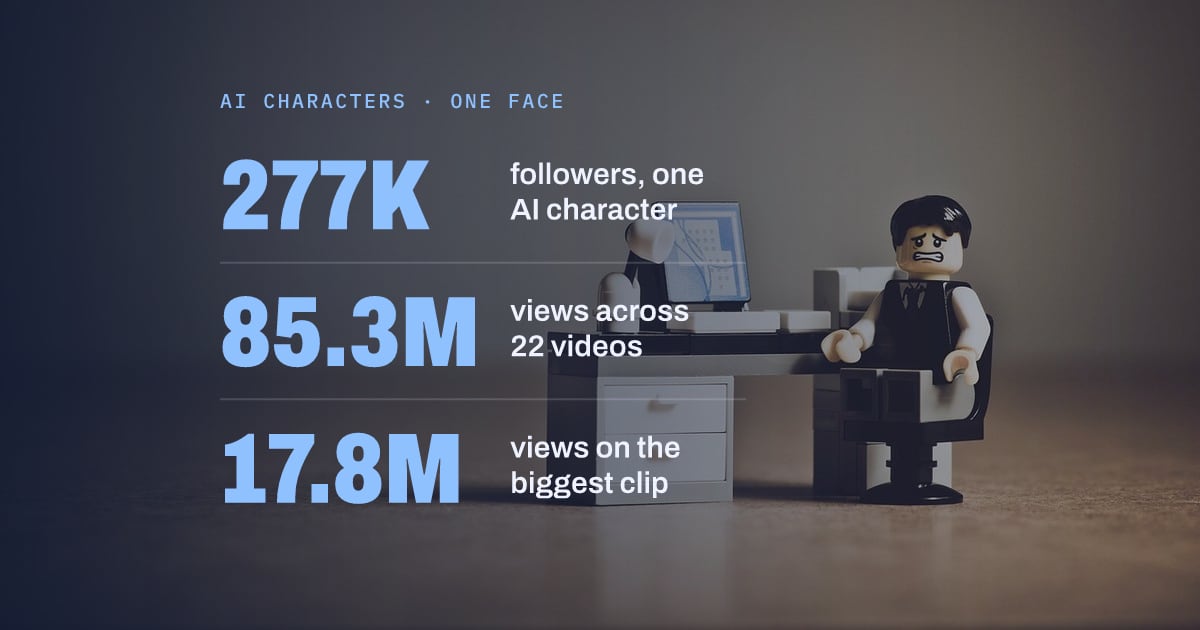
The pull of one recognizable face shows up in the numbers @k1rallik cites for an AI character called Brigitte Macaron: 277K followers and roughly 85.3M views across 22 videos, with 17.8M on the biggest clip. Viewers vote on her next outfit, then come back to see it. Her creator reportedly made $50K from ads, paid contracts and a token. That is media income from an audience, not product sales.
Tool makers sell the same idea. Higgsfield's own account, @higgsfield_ai, posted a new take on its "Arena Zero" trailer, built with its Katana tool and featuring AI influencers. "AI influencers are movie stars now," the post opens. It has drawn 384,131 views, and it is the company promoting its own product.
Higgsfield AI 🧩@higgsfield_aiAI influencers are movie stars now.
From social feeds to short dramas and action films in one week.
A new take on the Higgsfield’s Arena Zero trailer, featuring viral AI influencers. Made with Higgsfield Katana. https://t.co/Q8Pq1rXTtQOct 10, 2026 · View on X
Brands can cast AI characters in two ways
The first is the recurring face above: one character, many concepts, recognizable from ad to ad. The second goes the other way. It uses a different character for each story and keeps the product as the only constant.
Ryze is a brand example of the second. According to Atria, Ryze has been running AI storytelling ads with completely different characters: a literal water woman, a zombie, a mom and daughter, a couple at a BBQ. Same product each time. Atria describes the ads as mini episodes rather than product pitches, and says AI makes it cheap to test endless storylines.
Atria@tryatria_AIRYZE IS GOING ALL-IN ON AI STORYTELLING ADS 🤯🎬
And they’re getting WILD with it.
💧 Literal water woman
🧟 Zombie
👩👧 Mom + daughter
🍖 Couple at a BBQ
Completely different characters.
Completely different worlds.
Same product.
They’re turning ads into mini episodes instead of traditional product pitches.
AI makes it cheap to test endless storylines at scale.
This might be the next big creative unlock. 👀Sep 18, 2026 · View on X
Why would a face with no name work at all? @leonabboud argues the strength of this kind of ad is that the person in it is nobody. No following, no backstory. "It’s a face built to match a moment you already lived for the context of that one ad or a series," @leonabboud wrote. The viewer recognizes their own week in it.
Cost is the other half. @marcusyul sets the two side by side. A UGC creator needs the product shipped, brings one face to one niche, and every reshoot is a new invoice. An AI character needs a prompt, can be any face for any niche, and a reshoot is just another generation. For a brand testing angles, that difference decides how many versions it can afford to run.
What an AI character still can't carry
"Human content still outperforms most of my ad accounts," media buyer @Aazarshad wrote. That is one buyer's accounts, not a study.
Trust is what @leonabboud calls the missing part. Nobody goes to a local meetup to meet an AI avatar or listens to a podcast where one tells its story. In @leonabboud's framing, AI ads make people want something, and the founder is the person they trust enough to buy it from. The two do different jobs in the same funnel.
Reach is also hard to predict. @BasiliskBSL created a new AI influencer on Higgsfield and posted the exact same video on three platforms. After 24 hours it had 632 views on X and 292 on TikTok. On Instagram, from a brand-new account with no audience, it had 99.3K views and 102 new followers. The creator is asking other people why. Same character, same video, very different results.
Much of the excitement above comes from tool makers or campaign-tagged posts, so the numbers that count are the ones in a store's own ad account.
Start with one product and one winning ad
The low-risk way in is a test, not a new channel.
- Build one consistent character for one product. Make a character sheet with several views, then lock a first frame for every scene. That is the process @Rosey_watson and @viipin8 describe.
- Rebuild an ad that already works. Take a current winner and remake it with the character, keeping the hook and script. The only change should be who is on screen.
- Run it next to the human version and read all three numbers. @CEO_Vlad's breakdown on AI UGC ads is a useful split. CTR says the hook worked, hold rate says the body held attention, and CPA says the offer converted. Reading CTR alone is the common mistake.
- Test more than one character. As @k1rallik puts it, "your first character might flop."
If a character wins, keep its sheet and locked first frame. That file is where the next concept starts.
Sources
- https://x.com/AiwithZoaina/status/2107522815994028516
- https://x.com/Rosey_watson/status/2104502925175480776
- https://x.com/vadooai/status/2106442605643071632
- https://x.com/viipin8/status/2108592426223083831
- https://x.com/Weeleey6/status/2108598818379858417
- https://x.com/MonetizationDon/status/2107388608260825597
- https://x.com/k1rallik/status/2107916652822065551
- https://x.com/higgsfield_ai/status/2108985607846547849
- https://x.com/tryatria_AI/status/2100983687924125881
- https://x.com/leonabboud/status/2109702890877010353
- https://x.com/marcusyul/status/2107216031915885020
- https://x.com/Aazarshad/status/2102826991838007783
- https://x.com/BasiliskBSL/status/2109064579120615839
- https://x.com/CEO_Vlad/status/2096410853499195851