All stories · Article
AI or real people: Which UGC videos should AI make?
Some direct-to-consumer (DTC) brands are hiring people to make video ads with AI tools.
Share: WhatsApp · Telegram · X · Facebook · LinkedIn · Email
Between September 21 and October 16, three job posts on X, one for a supplement brand’s post by @Choi1of1, one for a post by @Rogerecomprof for a DTC brand that says it makes at least $10 million in revenue, and one for a post by @ecomyas for another US supplement brand, made that skill a core requirement. Two explicitly mentioned AI-generated user-generated content (UGC) videos.
The appeal is volume. The US supplement brand’s post says the hire will produce video ads at scale. On Meta, though, the number of videos you upload may differ from the number of distinct ads its system sees.
If you want AI to help win more orders, use it to make genuinely different videos, and decide which parts still need a real customer’s voice.
Meta groups videos that look alike
Andromeda is the first filter in Meta’s ad delivery system. In an announcement dated December 16, 2025, Meta said Andromeda scans tens of millions of ads whenever someone opens Facebook or Instagram, then narrows them to a few thousand candidates. The most relevant and distinct creatives move forward.
Meta also said it groups ads that share major visual and thematic features. When ads look or feel alike, the system treats them as variants of one creative and shares what it learns across the group. Its example was two visually identical ads with different calls to action: that is an edit to one idea, not creative diversification.
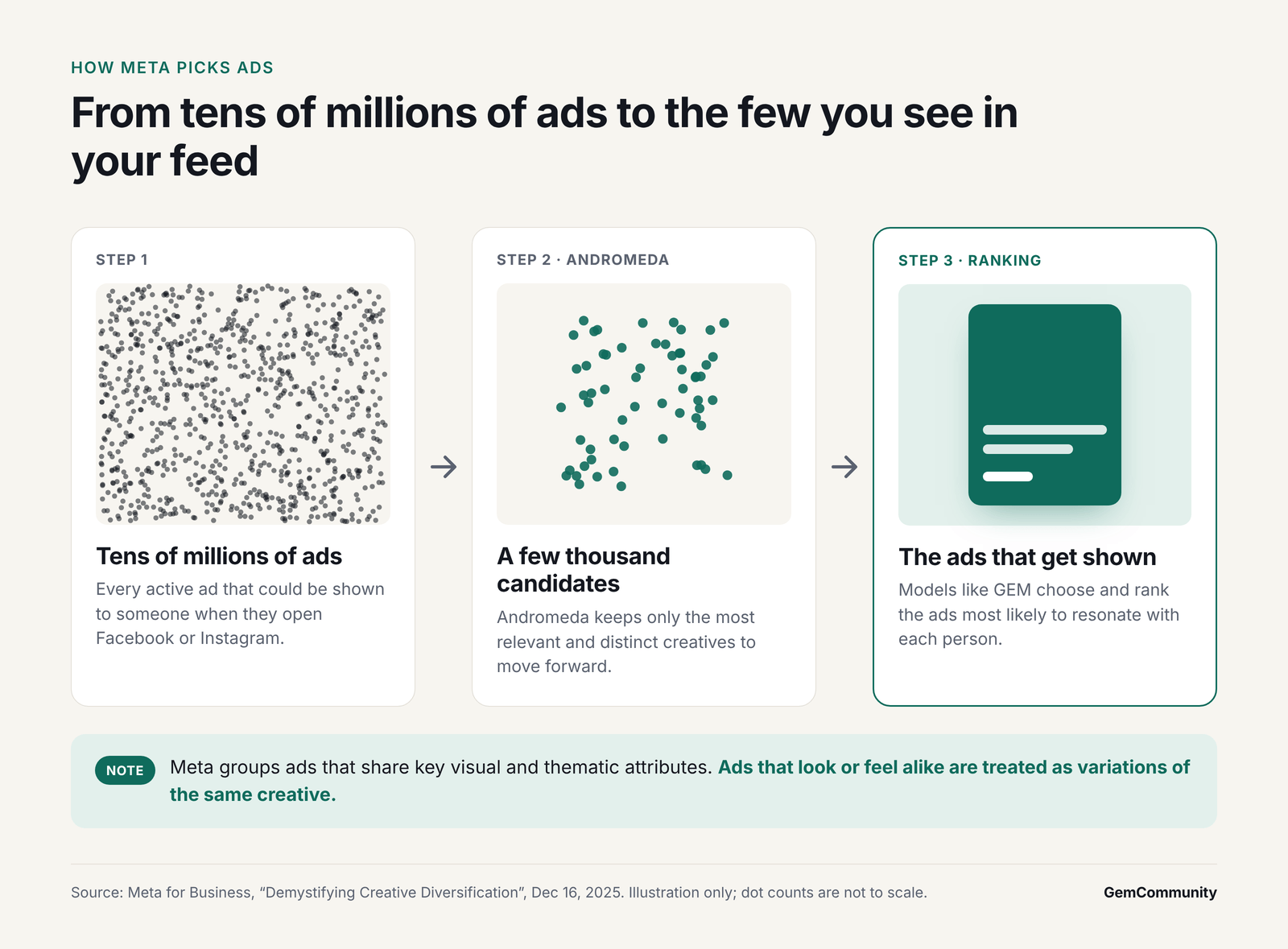
Based on Meta’s description, ten videos with the same character and camera angle but different opening lines would likely land in one group. They may not create ten separate chances to reach new customers.
That makes the easiest AI workflow a trap: keep the character and setting, swap the script, and produce video after video.
Find the gaps before increasing video volume
A software company’s approach to UGC offers a useful way to avoid that trap. Hector Serrano, who says he built the paid UGC program for Wispr Flow, @hectorserrranoo argues that a common mistake is simply making more videos when ad performance stalls. In his view, similar speakers, angles and messages keep reaching the same audience. More videos then repeat the same signal.
@hectorserrranoo
Hector says his team first looks for gaps: ideas and audiences its current ads have yet to reach. It then picks five suitable creators to test new angles, formats and concepts, and scales up only after several approaches work. He says the program now has more than 50 creators producing roughly 500 to 700 ads a month.
The sequence matters more than the count. The team identifies a gap before increasing output. Wispr Flow’s videos feature real people; AI may produce video faster than a shoot, but it cannot skip the work of finding that gap.
Give each ad idea its own audience, reason to buy and visual approach
Start with the customer, not the AI prompt. In its announcement on creative diversification, Meta advises advertisers to vary an ad’s visuals, feel, story and message. Each ad can speak to a different purchase motivation, such as an emotional benefit or a product feature.
Use that guidance to check each video idea before production:
- Who is it for? A first-time buyer, someone using a competing product, or someone buying a gift.
- Why would they buy? To save time, get a reasonable cost per use, or trust ingredients backed by evidence.
- What will it look like? Who appears, where it is filmed, whether it uses video or still images, and what appears in the first frame.
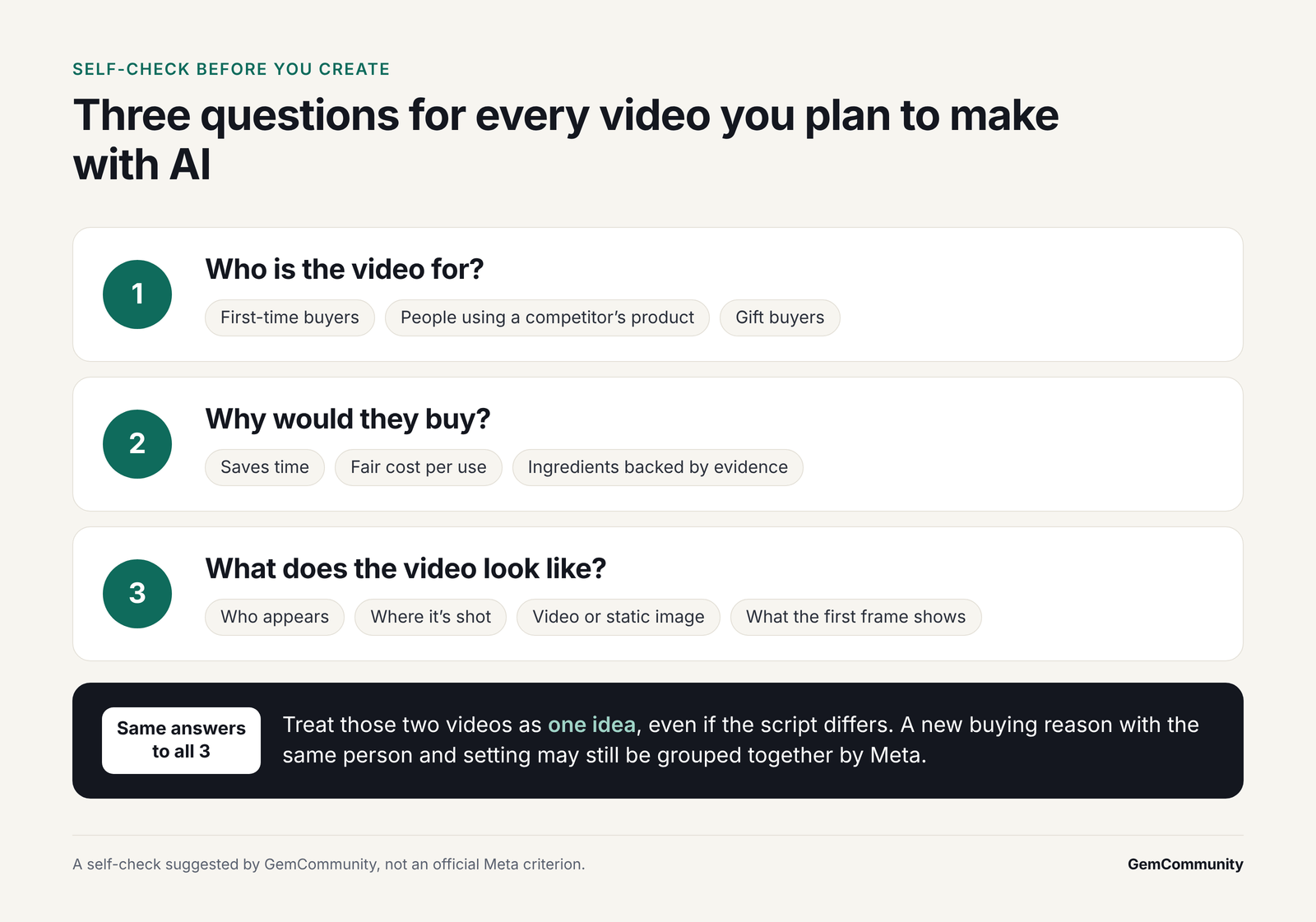
If two videos have the same answers to all three questions, treat them as one idea even if the dialogue differs. This is a way to review your own ideas, not a criterion Meta has published. Since Meta groups ads by visual features as well as theme, two videos with different reasons to buy might still be grouped if they use the same person and setting. AI helps most here: you can change the setting, format or scene for each idea without arranging another shoot.
Leave personal experience to real customers
Of the video types you could make with AI, customer experience stories deserve the most care. Shayan, an ecom brand owner who previously worked at Zendrop, says in a job post for an ad strategist by @Shay_pes that his brand spends more than $1 million a day on ads. He says it uses only real UGC videos and never AI-generated UGC, although it does use AI animation.
The objection also comes from people building AI tools. Alex Cooper, co-founder of an AI ad tool, @alexgoughcooper argues that ordinary people dislike AI. In his view, if customers discover every ad was made with AI, the cost outweighs the benefit, however lifelike the technology becomes.
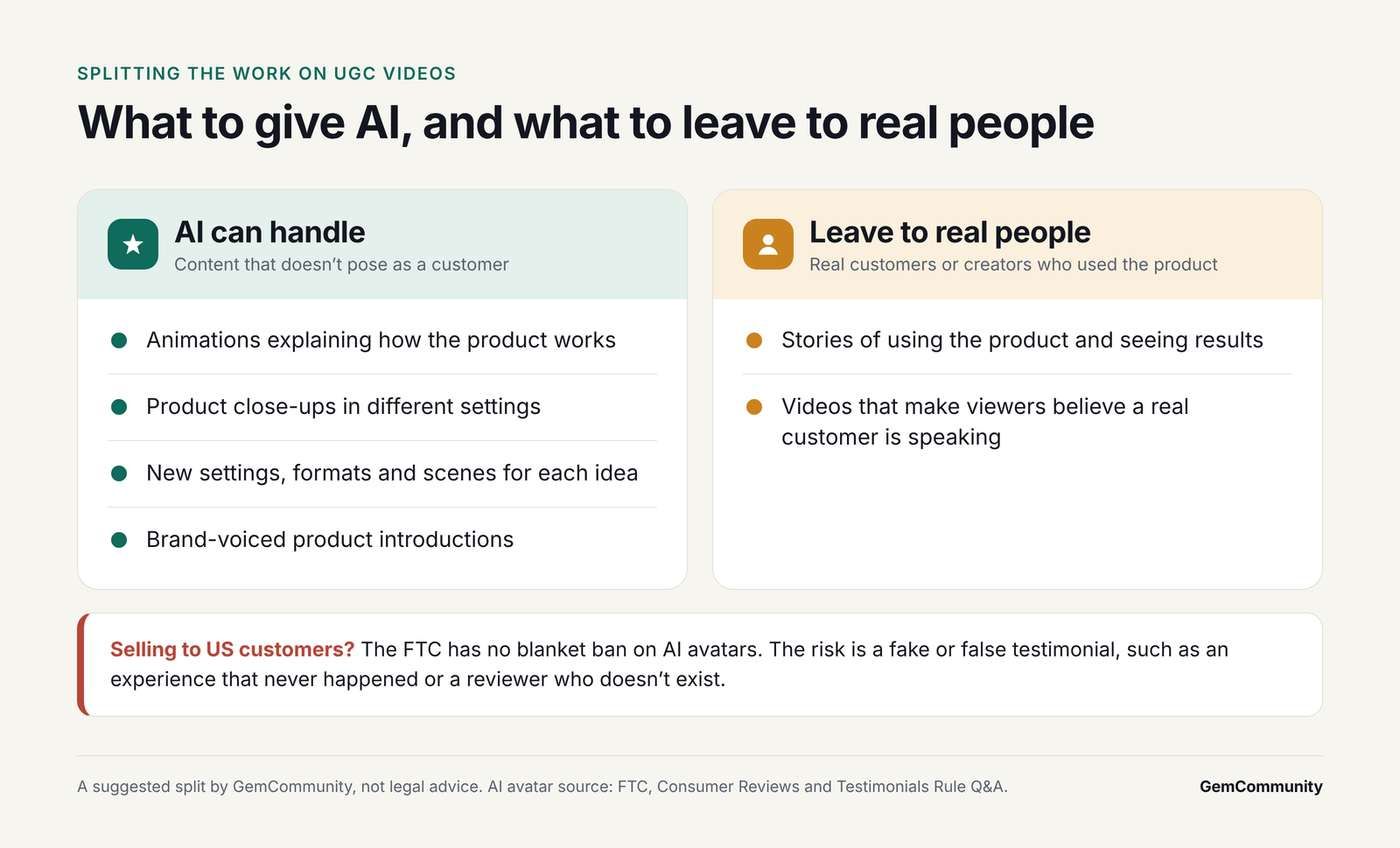
For stores selling to US customers, there is also a legal risk tied to what the video says, rather than the use of AI itself. The US Federal Trade Commission’s Q&A on its rule for reviews and testimonials says the rule does not generally ban AI avatars in marketing. A testimonial delivered through an avatar is prohibited when the testimonial is fake or false, for example, when it is attributed to someone who does not exist or has never used the product, or when it misrepresents their experience.
A safer division of work is to let AI handle videos that do not impersonate customers: an animation explaining how a product works, close-ups of the product in different settings, or a brand introduction. A story about having used the product and noticed a real difference belongs with an actual customer or a creator who has genuinely used it.
Decide before making the video
Before making an AI video, answer two questions: what idea does it add that your current videos lack, and who is speaking in it? If the idea is new and the speaker is the brand, AI can move quickly. If the video tells a personal experience, let a real customer film it.