All stories · Article
An AI CRO audit gives a Shopify store test ideas, not answers
An AI audit can turn a Shopify store into a ranked list of tests in one sitting, but it hands you hypotheses, not verdicts. That is the real lesson of a video from Davie Fogarty Mentors, where Fogarty audits his own store with Claude.
Share: WhatsApp · Telegram · X · Facebook · LinkedIn · Email
This is a summary and review.
The setup is two documents and a phone-sized browser
Fogarty runs the audit inside a plain Claude project, not Claude Code or Codex, so anyone can repeat it (video, 0:15). The store is The Oodie, a wearable blanket brand he says has done over $800 million in sales (video, 0:31).
The project gets two files. The first is an audit brief that tells the AI what to judge: clarity, trust, friction, the offer, product page conversion, the path from the homepage, the mobile experience, objection handling and prioritization (video, 1:14). The second holds source inputs: top products, price points, key metrics and customer objections (video, 2:15). Without the brief, Fogarty says, pasting a link gets you basic advice.
Then Claude's Chrome extension opens the store at about 400 pixels wide, so it sees the mobile layout, and clicks and screenshots its way through the site (video, 4:15). His reason: the AI reads front-end code well, but a screenshot lets it judge the design itself (video, 4:01). The run takes about 10 minutes.
The video is also a pitch. It closes with an invitation to his paid mentorship program, and the prompts sit behind a link in the description (video, 11:25).
The inputs in the demo were placeholders
Fogarty had ChatGPT write the source inputs from the store's URL and did not write them himself (video, 2:15). On the numbers he is blunt: "The key metrics, obviously, this is all completely made up." (video, 3:00)
That matters more than it sounds. Every priority the audit assigns rests on those inputs. The output on screen even flags it, listing the metrics among the things it could not verify (video, 7:58).
His own fix is simple. Write the homepage messaging and objections yourself, add real reviews, and give it real numbers: connect Shopify through the AI toolkit, MCP or the API, or just screenshot the Reports page and drop it in (video, 2:32; video, 3:00).
Four findings came back, and Fogarty rejects one
The executive summary leads with four problems on The Oodie's mobile site (video, 5:02):
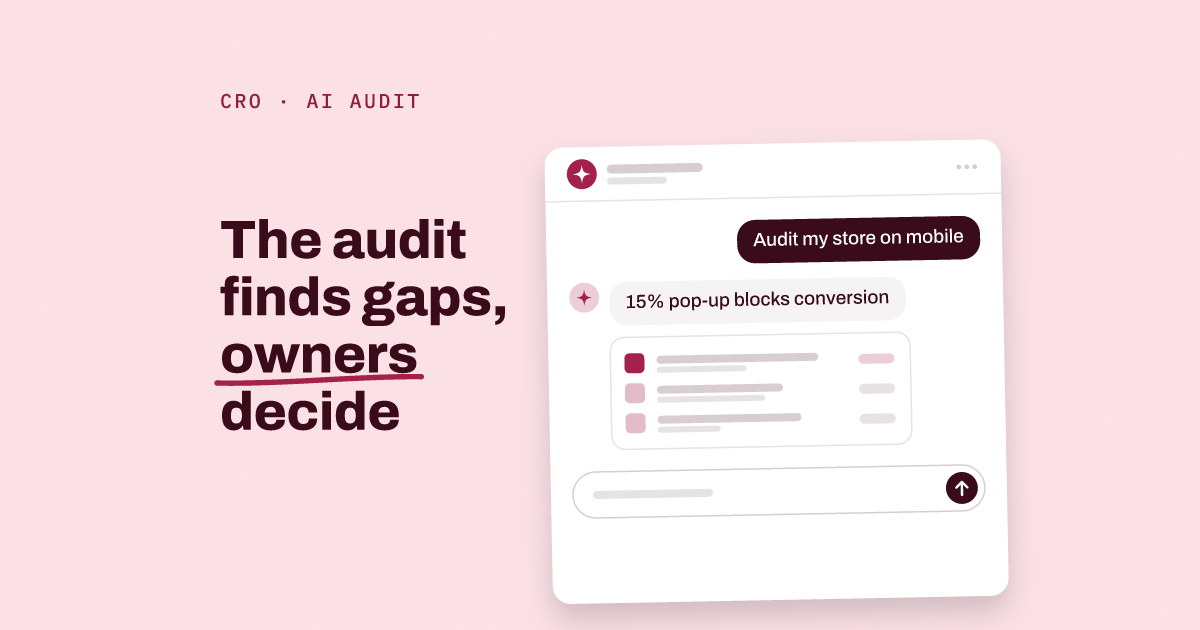
- A 15% pop-up that cannibalizes and blocks conversion. Fogarty says it needs weighing against other factors.
- A homepage that never tells a first-time visitor what an Oodie is.
- Sizing shown as jargon. He calls this valid; he was confused shopping his own site.
- An offer that contradicts itself and feeds the "always on sale" objection.
He rejects the homepage finding for his brand. He says the business is over 50% repeat and that other products now bring in over 50% of revenue, so the page does not need to explain the original (video, 5:37). For a brand under $100 million, he says, the same finding would hold.
That is the pattern to copy. The audit spotted a real gap. Deciding whether it mattered took a fact only the owner had.
From finding to test: objection blocks, copy, a 30-day plan
The prioritized action plan turns findings into tests: change the pop-up, rename the sizes, move a gift box toggle below add to cart, rework the homepage hero (video, 6:35). It also proposes an objection block on the product page that answers questions like "Will it fit me?" so shoppers do not have to dig through reviews.
Fogarty asks Claude to build that block in Oodie branding. It returns the block plus a comparison table, placed under an existing section (video, 8:00). With Shopify connected through Sidekick or MCP, he says, you could tell it to deploy. A bigger brand should A/B test first (video, 7:47).
A second prompt rewrites site copy. Fogarty ranks that low: a new product page, new imagery, a new product title, offer or bundles will usually move more (video, 8:47).
The last prompt builds a 30-day roadmap. Its first item retimes the pop-up around a 40% scroll point and stops it from firing again, against a target add-to-cart rate of 11 to 11.5% (video, 9:59). That target comes from the same made-up metrics, so treat it as an example. Each test carries a score for impact, effort and confidence, and the AI can be asked to estimate revenue per test (video, 10:31; video, 11:25).
Run it on your own store this week
- Write the source inputs yourself. Pull real conversion and order numbers from Shopify, and copy the objections from your actual reviews.
- Run the audit at phone width. Fogarty points the browser there because that is where most of the traffic is.
- Read every finding as a hypothesis. Strike the ones that clash with something you know about your customers, as Fogarty did with his homepage.
- Start with high-impact, low-effort tests, and change one thing at a time (video, 10:31).
The audit is the cheap part. The test is where the answer comes from.