All stories · Article
An AI label makes shoppers trust the ad and the company more, but want to buy less
Ask shoppers about trust and they say an AI label makes them trust the ad and the company more. Measure whether they would buy, or whether they engage, and the label pulls both down.
Share: WhatsApp · Telegram · X · Facebook · LinkedIn · Email
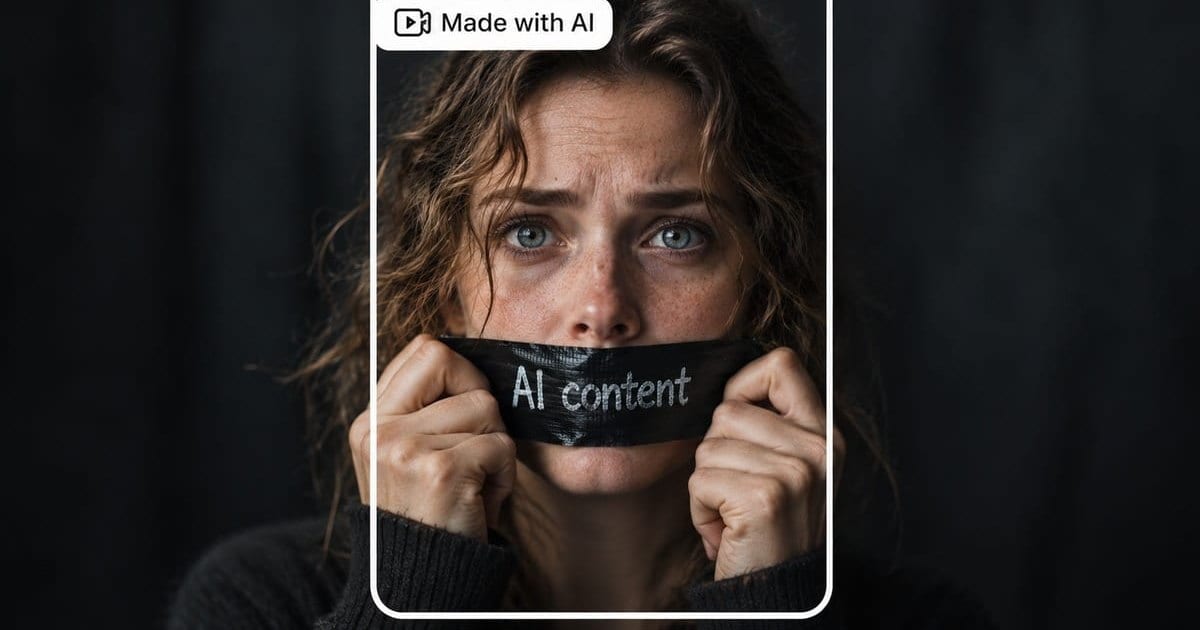
So the closer a question sits to the purchase, the worse the label looks. That is a pattern across studies of different people, not something anyone has tested head to head. Here is what each source measured, and what to count on your own page before you build one.
AI videos pull millions of views in days
On October 31, 2026, @onlytapa wrote about a sleep and snoring brand that had posted only AI videos for less than two weeks: 7.6M views and 19k new followers, with zero ad spend. The poster estimated sales at about $15k.
Tapa@onlytapaThis brand has been posting AI videos for less than 2 WEEKS
→ 7.6M views
→ 19k new followers
→ ~$15k in sales (estimate)
Completely organic. Zero ad spend
It's a sleep and snoring product, and every single video on the page is AI
Most brands take months to get a new ad account profitable. This page did it in under 2 weeks
Full breakdown of how brands are building these below 👇Oct 31, 2026 · View on X
Kynaro Lab, a faceless AI athlete teaching one boxing move per video, went from 0 to 173k followers in 10 days, with 30M views across 12 posts, @nolantoken reported. The page points to a boxing app that is still "coming soon".
Trust is the weak spot. On October 25, 2026, @Jaiydanimate, an animation account, called a separate group of viral videos scams, because they reuse a real 3D artist's assets with an AI script and voice: "I've seen these going around a bunch and it seems like a lot of people don't know they're made with AI." That case has nothing to do with the brands above.
Surveys show an AI label makes shoppers trust the ad and the company more
Two industry surveys lean positive. Yahoo, an ad platform, and Publicis Media, a media group, released "Trust Through Transparency" on February 28, 2024. Ebco ran it in October and November 2023 with over 1,200 U.S. consumers and more than 350 U.S. advertisers, who saw sample ads with and without a line saying AI made them.
When people noticed that line, AI ads got a 47% lift in ad appeal, 73% in ad trustworthiness and 96% in overall trust for the company.

The lifts apply only to ads where viewers noticed the label. Yahoo and Publicis Media release on www.yahooinc.com, captured in November 2026.
The IAB, the ad industry's trade body, found something milder with Sonata Insights in January 2026. In Tubefilter's report on the study, 73% of consumers said clear disclosures would either increase or have no impact on their likelihood to purchase. The same report says 82% of ad executives think Gen Z and Millennial consumers feel positive about AI-generated ads, but only 45% of consumers do.
Tests show an AI label makes shoppers less willing to buy and engage
A UK study of 358 consumers, who viewed ads made with ChatGPT and Stable Diffusion, found that "AI disclosure diminishes advertising value and purchase intentions", according to its abstract in the Journal of Research in Interactive Marketing. The drop ran through lower trust in the ad itself, and it was smaller for people with a positive view of AI.
Behavior in a real feed tells a similar story. Researchers at the University of Southern California analyzed TikTok engagement after AI labels arrived, then ran six preregistered experiments. The labels reduced engagement.
The paper's summary rules out lower quality and fear of manipulation as the cause. Instead, the label weakens the one-sided bond viewers feel with a creator (a parasocial connection), because it signals less effort. Labels that signal more effort can soften the drop.
An AI label hurts most on pages built around one character
That mechanism matters most for a page built on one recurring face. @nolantoken explained why Kynaro Lab works: the character is the same every time, "so the page feels like one coach you follow". A coach you follow is exactly the bond the USC paper says a label can thin out.
Three numbers that show how shoppers react to your AI label
Be open that the videos are AI, and test how you present it:
- Pick your numbers before the first post: saves, link clicks, and comments asking whether a video is AI.
- Compare like with like: the same time window and the same kind of product.
- Test the effort signal: show the research or script behind a video, then watch saves and clicks.
Sources
- @onlytapa · x.com
- @nolantoken · x.com
- @Jaiydanimate · x.com
- "Trust Through Transparency" · yahooinc.com
- Tubefilter's report on the study · tubefilter.com
- its abstract in the Journal of Research in Interactive Marketing · emerald.com
- analyzed TikTok engagement · citations.prolific.com