All stories · Article
Brand dashboards and strategy still miss agent-driven demand
Ecommerce teams track conversion rate (CR) and return on ad spend (ROAS) every week. But neither metric shows whether AI recommended their brand, chose a competitor or left them out of the conversation entirely.
Share: WhatsApp · Telegram · X · Facebook · LinkedIn · Email


Shopify can already track AI-driven sales
Shopify has introduced Sales channels > Agentic, giving merchants a dedicated view of performance across supported AI shopping channels.
The dashboard tracks four metrics:
- Sales
- Orders
- Online store sessions
- Online store conversion
Merchants can also explore search queries where their products appeared through Shopify Catalog.
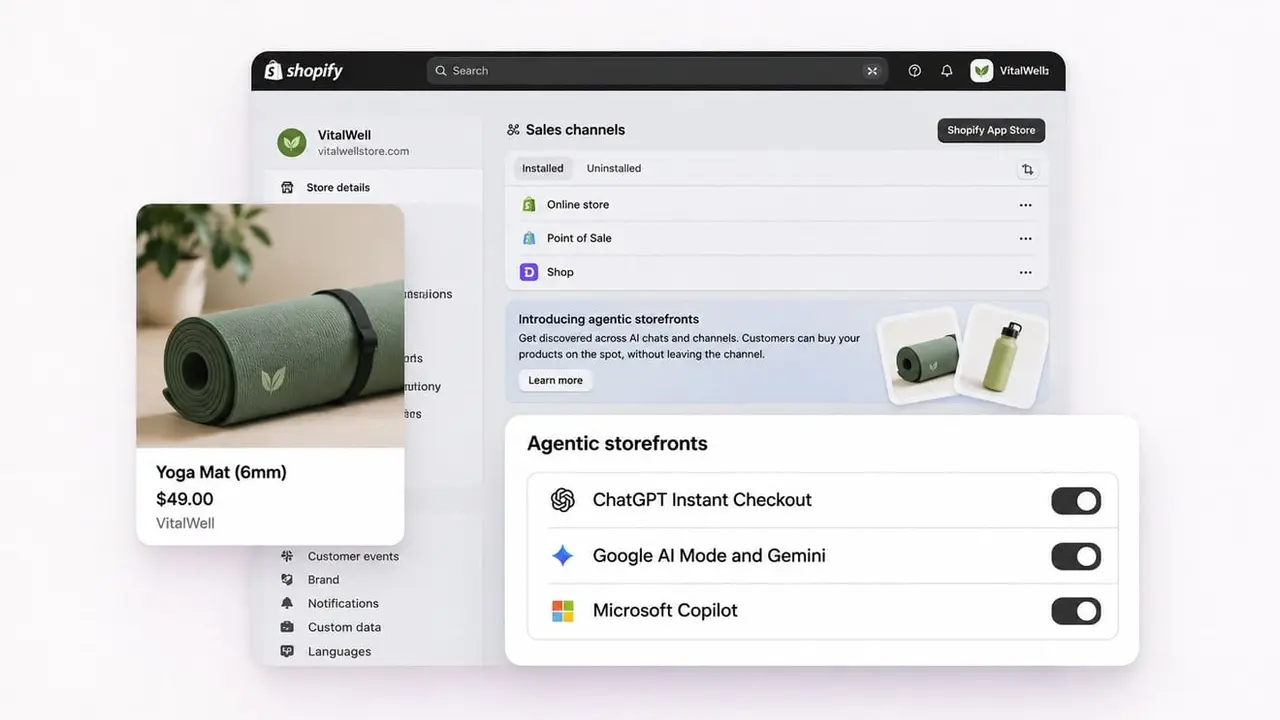
This means Shopify can show what happens when AI brings shoppers to a store. But it does not provide a complete picture of how often AI recommends a competitor instead.
Source: Shopify Help Center.
The missing metric is brand visibility
Consider a shopper asking ChatGPT for the best skincare brands for sensitive skin.
If AI recommends your brand and the shopper clicks through, Shopify can record the resulting traffic and sales.
But if AI recommends three competitors and never mentions your brand, there is no session to track and no conversion to report.
That is why referral traffic alone is insufficient.
A Search Engine Journal study covering 108 million sessions across 57 websites found that AI accounted for just 0.66% of traffic. Yet ChatGPT visitors converted at approximately 13.8%, compared with 3.02% for Google organic visitors across the 55 sites tracking conversions.
The sample includes different website types, not just ecommerce stores. Still, it highlights why AI's influence cannot be judged by traffic share alone.
Measure what Shopify cannot show
Merchants can start with a simple monthly AI visibility audit.
Ask the same 10 to 20 shopping questions every month.
For example:
- What are the best skincare brands for sensitive skin?
- Which sustainable clothing brands should I consider?
- What are the best running shoes for beginners?
Record three things:
| Metric | What to check |
|---|---|
| Brand mentions | Does AI recommend your brand? |
| Product accuracy | Does it describe your products correctly? |
| Competitor visibility | Which competitors appear instead? |
If your products are missing, check Shopify's Listing quality indicators, including descriptions, images, reviews, variants and store policies.
Also monitor actual ChatGPT referrals in GA4 by filtering chatgpt.com / feed. Practical Ecommerce explains how to identify these visits using UTM parameters.
Remember: GA4 only captures clicks. The monthly visibility audit helps identify recommendations that never generate a visit.
What to do this week
- Review sales, sessions and conversions in Shopify's Agentic dashboard.
- Test your brand against a fixed set of shopping questions in ChatGPT and other relevant AI platforms.
- Fix missing or inaccurate product information in Shopify Catalog.
CR and ROAS still matter. But they tell merchants what happened after shoppers arrived. Brand visibility tells them whether AI helped shoppers choose them in the first place.
Ask AI next
- What tools can automate the monthly AI brand-visibility audit instead of manually asking ChatGPT each time?
- What signals or ranking factors actually determine which brand ChatGPT recommends first in shopping queries?
- Which specific Shopify Catalog fields or schema changes most improve a product's odds of being recommended by AI?
- Do other ecommerce platforms like BigCommerce or WooCommerce offer an equivalent AI-referral dashboard?
- What signs show AI platforms beyond ChatGPT, like Perplexity, are driving real shopping traffic?