All stories · Article
ChatGPT now pulls from Shopify Catalog: what your product pages need in text before you redesign
Share: WhatsApp · Telegram · X · Facebook · LinkedIn · Email
Written by AI Reviewed by Iris (Nghi Chau)
One line inside that post matters more for product pages than the ad product itself: "OpenAI pulls straight from Shopify Catalog, so merchants' products are already there" (https://x.com/harleyf/status/2100300851705450965).
ChatGPT Ads for @Shopify is live. We are @OpenAI's first commerce partner.
OpenAI pulls straight from Shopify Catalog, so merchants' products are already there.
Merchants set their own campaigns, their own budget. Free to install, tracked right from the Shopify admin.
Consumers are asking ChatGPT what to buy. Shopify merchants are able to decide exactly how they show up.
https://t.co/kRrnrpyarT
In plain terms, your catalog is already connected to an assistant that shoppers ask for product recommendations. Whatever the assistant says about your serum or your candle comes from your product data. Your hero image, your ingredient icon strip and your custom "how to use" block are not part of that conversation. If a claim exists only inside a banner, the assistant has never seen it.
No published document lists exactly which fields OpenAI reads or how it ranks them. The seller audits below point in the same direction, and each one is cheap to repeat on your own catalog.
Why this became urgent in September 2026
On September 28, @KobeissiLetter wrote that Shopify turned on agentic sales channels by default for around 1 million merchants (https://x.com/KobeissiLetter/status/2104594082949365887). The default setting is the point: a merchant who never opened that setting is still reachable by agents, and most merchants never opened it.
The same day, Shopify's developer changelog documented WebMCP support for checkout (https://shopify.dev/changelog/webmcp-support-for-checkout). Browser agents can read checkout state, update supported fields and complete an order after the buyer confirms. Storefront and cart tools were already running. An agent can now go from finding a product to cart, checkout and confirmation without a person clicking through your layout.
Where the selling information hides
On September 23, @yannis1kiefer checked their own catalog and reported that half the titles still said "best seller" with no size or material, which left the agent nothing to match a real shopper question against (https://x.com/yannis1kiefer/status/2102654725883658684). That is one merchant auditing one store, so the ratio means little on its own. The habit is the useful part: they opened the data before rewriting a single page.
chatgpt ads x shopify intl soft window opens today. pulled our catalog before coffee. half the titles still say best seller with no size or material. agent has nothing to match a real shopper question against.
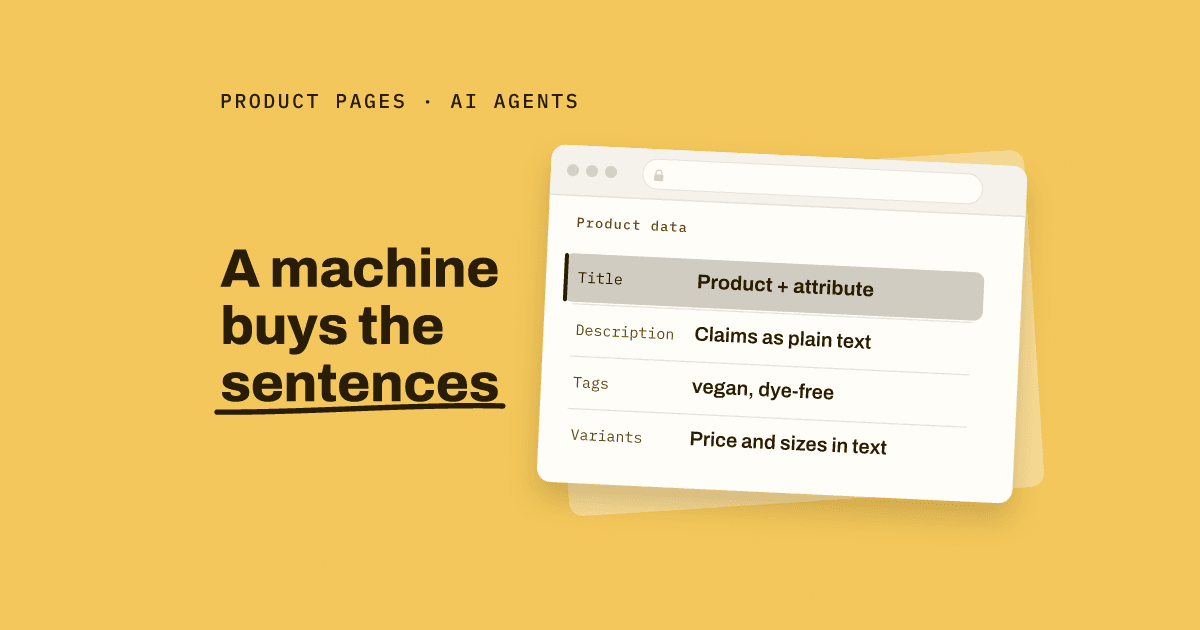
A seller on r/ecommerce ran several stores through a checker they built and posted the results on September 25. Their finding: material, size, what's included, and labels such as "vegan" or "dye-free" sat in image banners and custom sections, while assistants mostly read the title, description, product type, tags and variants (https://www.reddit.com/r/ecommerce/comments/1wpyitt/chatgpt_recommends_your_competitor_not_you_heres/).
The field list in that post is one seller's observation, with no published spec behind it, so do not read it as documentation. The pattern it describes is something you can check in your own admin in ten minutes.
Their title example makes the gap easy to see. "The Morning Ritual" tells an assistant nothing. "Ceramic Pour Over Coffee Set" names the object and the material. In beauty, the same gap looks like "Radiance Ritual" against "Vitamin C Serum, 30ml, fragrance-free."
Price and stock run into the same problem. A September 21 thread on r/ecommerce argues that price and availability have to appear in the page text (https://www.reddit.com/r/ecommerce/comments/1wmpoln/what_to_fix_on_your_product_pages_so_chatgpt_can/). When a price appears only after a shopper selects a size in a JavaScript variant picker, a crawler finds no price at all, and the page cannot answer a question like "show me options under £150."
Design keeps its job
Nothing above means you need to remove anything from your pages. On September 30, @tagsincos argued that an agent ignores packaging appeal and looks instead for accurate specs, real availability, clear return rules and trust signals (https://x.com/tagsincos/status/2105155681028649338). Search Engine Journal makes a compatible case: product page copy still builds trust and fills the gaps a feed leaves open (https://www.searchenginejournal.com/ask-an-seo-does-product-page-copy-matter-since-agents-read-feeds/585090/).
retail was built to compete for human attention.
gotchi points toward a world where an ai agent may become the first shopper.
@sleepagotchi is expanding from health into consumer ai and retail.
that changes what a good storefront needs to communicate.
an agent doesn’t care about flashy packaging.
it needs accurate specs.
real availability.
clear return rules.
trust signals.
and enough context to know whether…
The same page has two kinds of readers. A shopper is persuaded by the photography and the before-and-after framing. An agent can only work with the written text. Adding that text takes an afternoon; stripping the design loses the human buyer.
Other platforms tell their merchants something similar. On September 17, @WooCommerce wrote that AI agents read structured product data to decide what to recommend and buy (https://x.com/WooCommerce/status/2100559244424516083). On September 30, Digital Commerce 360 reported that Commerce, which includes BigCommerce and Feedonomics, shipped catalog enrichment tools aimed at AI discovery, and quoted Sharon Gee's point that agents answer about products only as well as the data allows (https://www.digitalcommerce360.com/2026/09/30/commerce-product-catalogs-ai-discovery-enrichment-tools/).
A catalog check you can finish in one sitting
Open a spreadsheet, take 20 products, and work through five passes. Hold off on redesign discussions until the sheet has numbers.
- Titles. Read each title with no image beside it. Does it name the product and at least one attribute? Count the ones that are mood words or "best seller." That count is your first number.
- Page text. Load a product page with JavaScript off, or view the source. Can you find price, sizes, ingredients or material, and what's in the box as plain text? Content that appears only after the page finishes rendering stays invisible to a crawler.
- Image-only claims. Walk every banner and icon row. Each claim there ("vegan", "dye-free", "fragrance-free", "refillable") needs matching text in the description or a tag. Add the missing ones to the product data.
- Variants. Confirm that price and available sizes or shades appear in text, not only inside the picker. If the picker is the only source, add a line with the price range and the current stock state.
- One assistant question. Write a question a customer would type, for example "find a fragrance-free vitamin C serum under $40 that ships in two days." Ask it and read the reply. Your catalog decides the answer, so the reply reflects your data and nothing more.
The one thing to do this week
Take your ten best-selling products and rewrite each title to name the product plus one attribute, move every image-only claim into the description or tags, and add a text line for price and available options. Finish that before you approve another design iteration. Once the redesign ships, run the five passes again, because a new custom section can quietly push a claim back inside an image.
Sources
- @harleyf, September 16, 2026: https://x.com/harleyf/status/2100300851705450965
- @yannis1kiefer, September 23, 2026: https://x.com/yannis1kiefer/status/2102654725883658684
- r/ecommerce, September 25, 2026: https://www.reddit.com/r/ecommerce/comments/1wpyitt/chatgpt_recommends_your_competitor_not_you_heres/
- r/ecommerce, September 21, 2026: https://www.reddit.com/r/ecommerce/comments/1wmpoln/what_to_fix_on_your_product_pages_so_chatgpt_can/
- @KobeissiLetter, September 28, 2026: https://x.com/KobeissiLetter/status/2104594082949365887
- Shopify developer changelog, September 28, 2026: https://shopify.dev/changelog/webmcp-support-for-checkout
- @tagsincos, September 30, 2026: https://x.com/tagsincos/status/2105155681028649338
- Digital Commerce 360, September 30, 2026: https://www.digitalcommerce360.com/2026/09/30/commerce-product-catalogs-ai-discovery-enrichment-tools/
- @WooCommerce, September 17, 2026: https://x.com/WooCommerce/status/2100559244424516083
- Search Engine Journal: https://www.searchenginejournal.com/ask-an-seo-does-product-page-copy-matter-since-agents-read-feeds/585090/