All stories · Article
Meta CPA and ROAS are getting worse: what to fix before you order more ad creative
Share: WhatsApp · Telegram · X · Facebook · LinkedIn · Email
Meta ads cost more on average than they did a year ago. On its Q3 earnings call on October 21, 2026, Meta said average price per ad (roughly what an advertiser pays each time an ad is shown) rose 14% globally versus Q3 2025, while total ad impressions rose 10%.
When impressions get pricier, CPA (cost per order) tends to follow, and the reflex at a lot of stores is to make more ads. The catch is that new ads still send people to the same page. If that page doesn't deliver what the ad promised, shoppers click and leave, and at today's prices every wasted click costs more than it used to.
Prices are rising faster than impressions, and the two sides read it differently
Meta credits the increase to better-performing ads and an improving economy, according to CFO Susan Li. Keep in mind this is a global average: what any one store actually pays depends on its markets and placements.
David Herrmann, who manages Meta ads for a number of brands, takes a less upbeat view. He argues that auctions are filling up faster than new ad inventory, and that Meta has become so good at reaching in-market shoppers that CPA spikes once that pool runs dry. His fix is to add reach and frequency campaigns (where you buy a set reach and number of impressions up front), run his best creatives to a custom audience, and give it at least 4–6 weeks before judging the results.
Which explanation holds up will take more data to tell. For sellers, though, the takeaway is the same either way: a click that doesn't turn into an order is likely costing more than it used to.
Falling ROAS doesn't necessarily mean you're short on creative
When numbers slide, "tired" creative is usually the first suspect. Adam Taylor, who builds ad creative systems for brands running on Meta, tells the story in a post promoting his service of a founder whose skincare brand targets women over 40 and spends around $45,000 a day. ROAS (revenue per dollar of ad spend) fell from 2.4 in July to 2.1, then to 1.8 in September, with the product, offer and scripts unchanged. The founder concluded the brand needed more creative and kept shipping two new batches of video every week.
Adam Taylor@adamtaylorlJust got off a call with a founder spending $45K a day on Meta.
Skincare. Women 40+. Seven figures a month at 18% margins.
July: 2.4 ROAS
August: 2.1
September: 1.8
Same product. Same offer. Same scripts that used to print.
He had one theory about why.
It was wrong.
He built the account himself. Found the angles, wrote the scripts, tagged every ad by angle in his own spreadsheet.
July was his best month ever.…Oct 19, 2026 · View on X
In Taylor's telling, the problem was who appeared in the videos. The ads used creators in their 20s, pointed to a listicle written for women over 40, and drew comments saying the person on screen didn't look 40. The target customer saw someone much younger walking her through a skincare routine, and kept scrolling.
The mismatch can also sit on the landing page. Jeronimo Canale, founder of Synced, which helps DTC brands grow sales, points to pages that break the ad's promise: free shipping in the ad but a fee at checkout, or a bundle in the ad that isn't on the page. As he puts it: "People leave, you paid for the click, and Meta learns that your clickers don't buy."
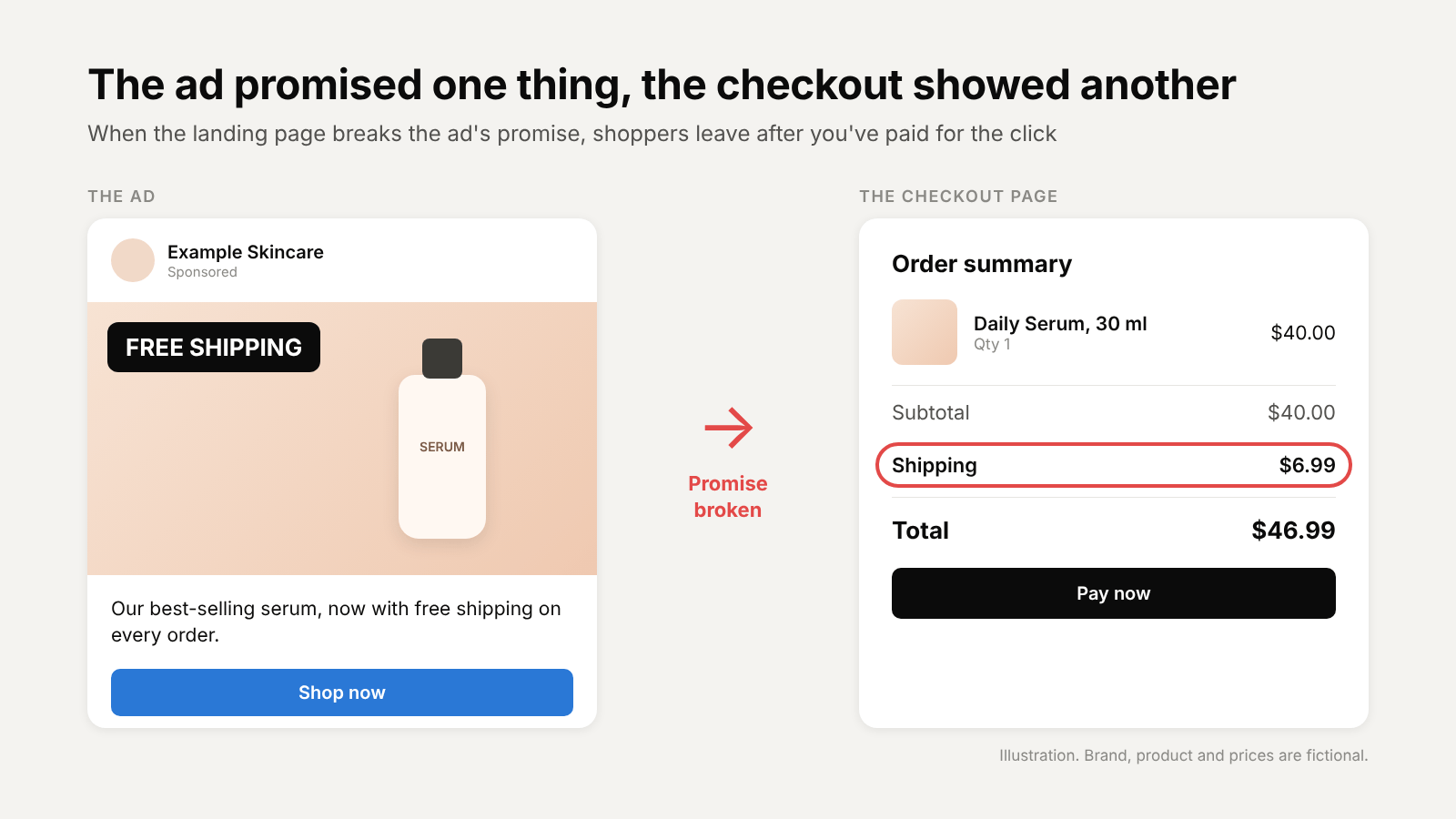
That last part is the real worry. The cost doesn't stop at one click; it also shapes how Meta judges the people who show interest in your ads.
Three questions to ask with the ad next to its landing page
Before you even open the page, Canale suggests working out what each order leaves you before ad spend. In his example, a $40 product leaves only $15 after the product cost, packing, shipping and payment fees, and that $15 is the most you can pay to win a customer.
Then pull up your highest-spending ad next to its landing page, on your phone, and go through these in order:
- Does the discount, free shipping or gift in the ad show up on the page, and does it still hold at checkout?
- Is the product, bundle or color from the video right there on the page, and is it in stock?
- Are the person in the video and the copy on the page speaking to the same customer?
If any answer is "no", fix that gap first, on the page or in the ad, and only then scale up the number of creatives.
What to do before you order more video
You can't control what Meta charges across the board, but your landing page and your creative are yours to fix.
Before you commission another batch of video, spend a few minutes putting your top-spending ad side by side with its landing page. Once the promise matches on both sides, the extra creative you make has a real shot at driving orders. If everything matches and CPA keeps climbing, Herrmann's reach and frequency approach is the next thing to try, as long as you give it the full 4–6 weeks before drawing conclusions.