All stories · Hot News
Etsy's new AI terms: no copycat training, broad rights stay
The marketplace now promises not to train copycat AI models using sellers’ creative work. But its revised terms still allow Etsy and its partners to use seller content for AI development, with no clearly defined opt-out for US sellers.
Share: WhatsApp · Telegram · X · Facebook · LinkedIn · Email

Etsy has narrowed its AI training commitments after longtime sellers threatened to leave the marketplace over changes to its Terms of Use. But the revision does not remove the platform’s broader rights to use seller content.
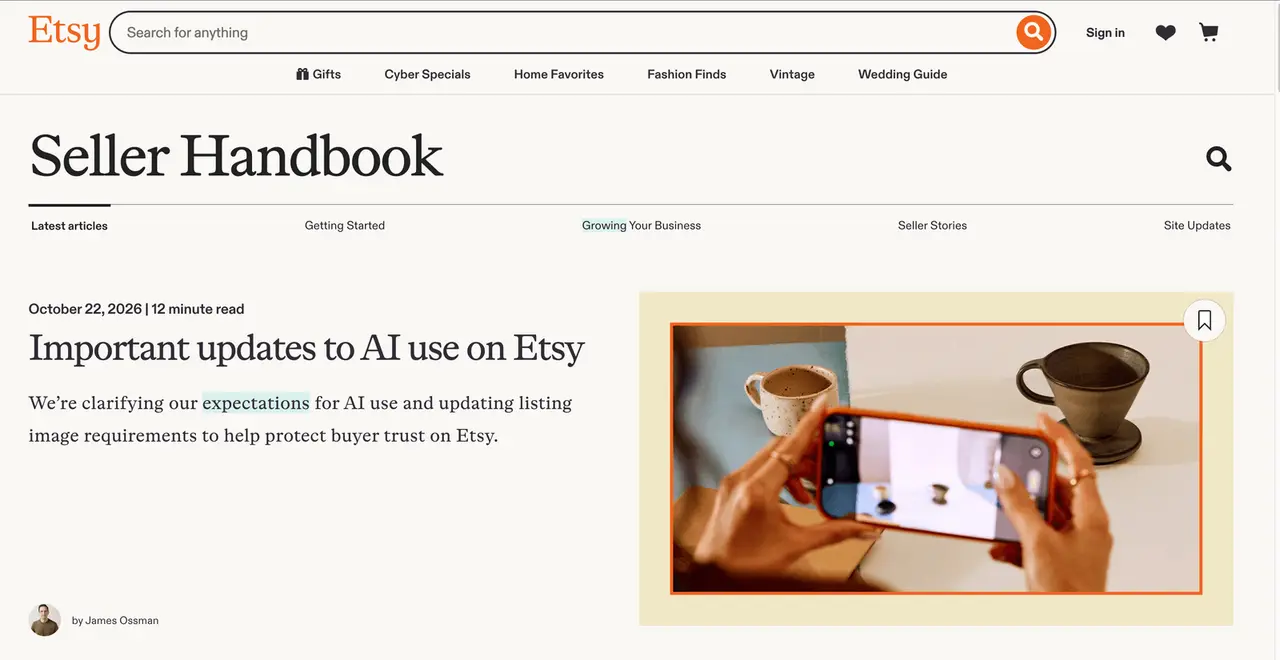
On November 23, 2026, Etsy updated its Terms of Use following weeks of criticism over a clause allowing the company, its partners and vendors to use sellers’ content to develop, train, test and improve AI technologies.
The revised terms, scheduled to take effect on December 16, add an explicit commitment not to use sellers’ content to train AI models designed to replace their creativity or create copycat versions of their products.
That is a meaningful clarification, but not a withdrawal of Etsy’s AI training rights.
What Etsy changed after the backlash
The controversy began with an October 26 update to Etsy’s Terms of Use.
The new language expanded the existing content license to explicitly cover AI and machine learning. It allowed Etsy, its partners and vendors to use content uploaded by members to develop, train, test and improve AI technologies.
The provision covered content such as listing photos, product descriptions, videos, reviews and community posts.
For sellers whose businesses depend on original artwork, handmade products and distinctive designs, the concern was straightforward: their work could become training material for AI systems capable of producing competing or imitation products.
Some longtime sellers responded by closing their shops.
Aaron Millard, an illustrator who had run his Etsy shop for nearly a decade, said in an Instagram post that he was deleting it, The New York Times reported. Kristen and Geoff Zephyrus, founders of the home goods and stationery brand Cognitive Surplus, also closed their Etsy shop after 13 years on the platform.
Following the backlash, Etsy said it would revise the terms. The company subsequently incorporated its anti-copycat commitment into the November 23 version.
Sources: Etsy’s original AI policy announcement | The New York Times report, republished by The Philadelphia Inquirer
What Etsy now promises, and what it still allows
The revised Section 5(C) makes two things clear.
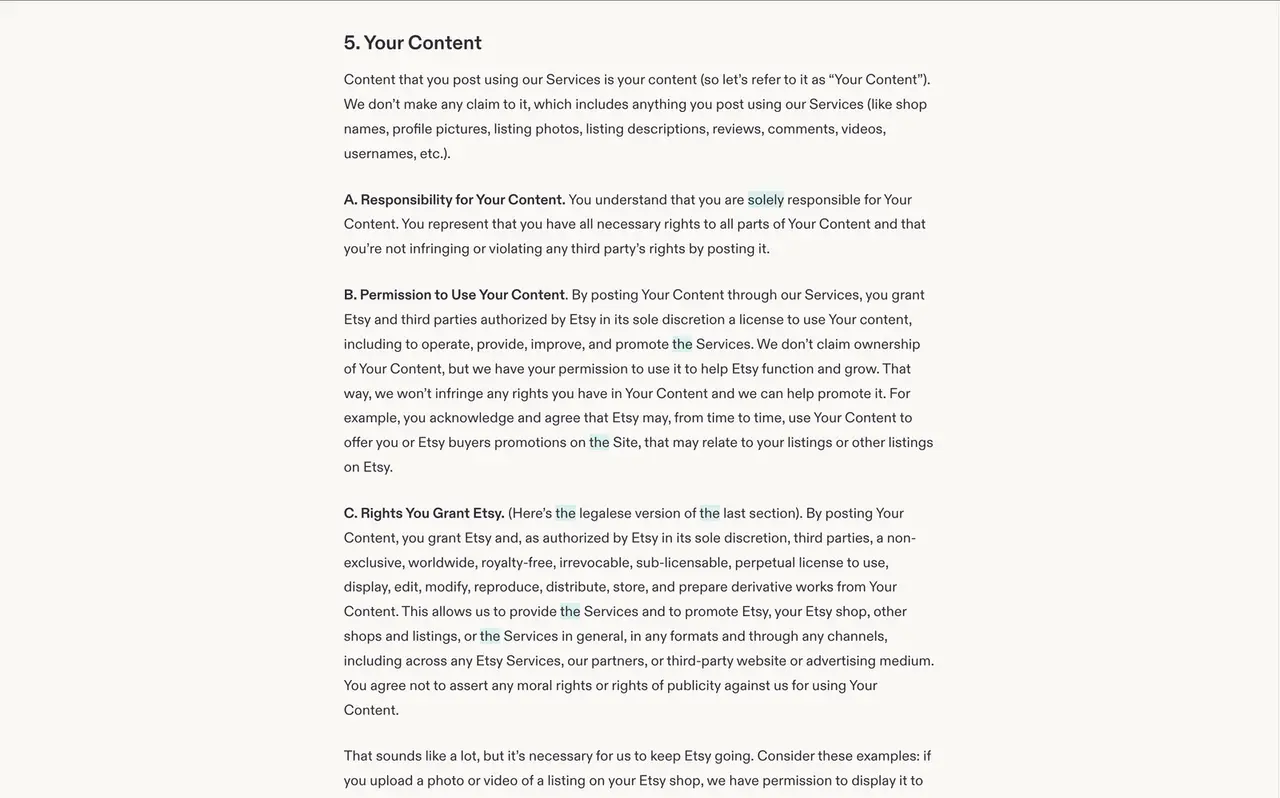
What Etsy promises not to do
Etsy says it will not use seller content to train AI models designed to:
- Replace sellers’ creativity.
- Create copycat versions of products sold on Etsy.
It also says its purpose in working with partners and vendors that provide or train AI models is to support sellers and the Etsy community, not to enable imitation of their products.
What Etsy still allows
The same section continues to authorize Etsy, its partners and vendors to use seller content to develop, train, test and improve AI technologies for purposes including:
- Helping buyers find, discover and understand products.
- Developing tools that help sellers run their shops.
- Providing and improving customer support.
- Promoting and advertising products and Etsy.
- Protecting the marketplace, detecting fraud and enforcing policies.
In other words, Etsy has drawn a boundary around one particular use of AI: training models intended to copy or replace sellers' creative work.
It has not withdrawn permission to use that work for other AI applications.
The distinction matters because AI development is not limited to generating competing products. Search, recommendations, advertising, fraud detection and seller tools can all involve learning from marketplace content.
Source: Etsy Terms of Use, Section 5(C)
Can US Etsy sellers opt out of AI training?
One of the most important details in the revision is what disappeared.
The October 26 version stated that AI training rights were subject to applicable opt-out rights described in Etsy’s Privacy Policy.
That specific qualification is absent from the November 23 version.
According to Value Added Resource’s review of Etsy’s Privacy Policy and US Regional Privacy Policy, neither document identifies a specific mechanism allowing US sellers to opt out of AI training on their original creative work while keeping their shops open.
Some sellers in the EU and UK may have additional rights to object to certain processing of personal information under local privacy laws. However, those rights do not necessarily cover every type of creative content uploaded to Etsy.
This distinction is important: a right to control certain uses of personal information is not automatically the same as a right to prevent AI training on product photographs, artwork or descriptions.
Sources: Value Added Resource: Etsy revises AI training terms | Etsy Privacy Policy
What happens to your content if you close your Etsy shop?
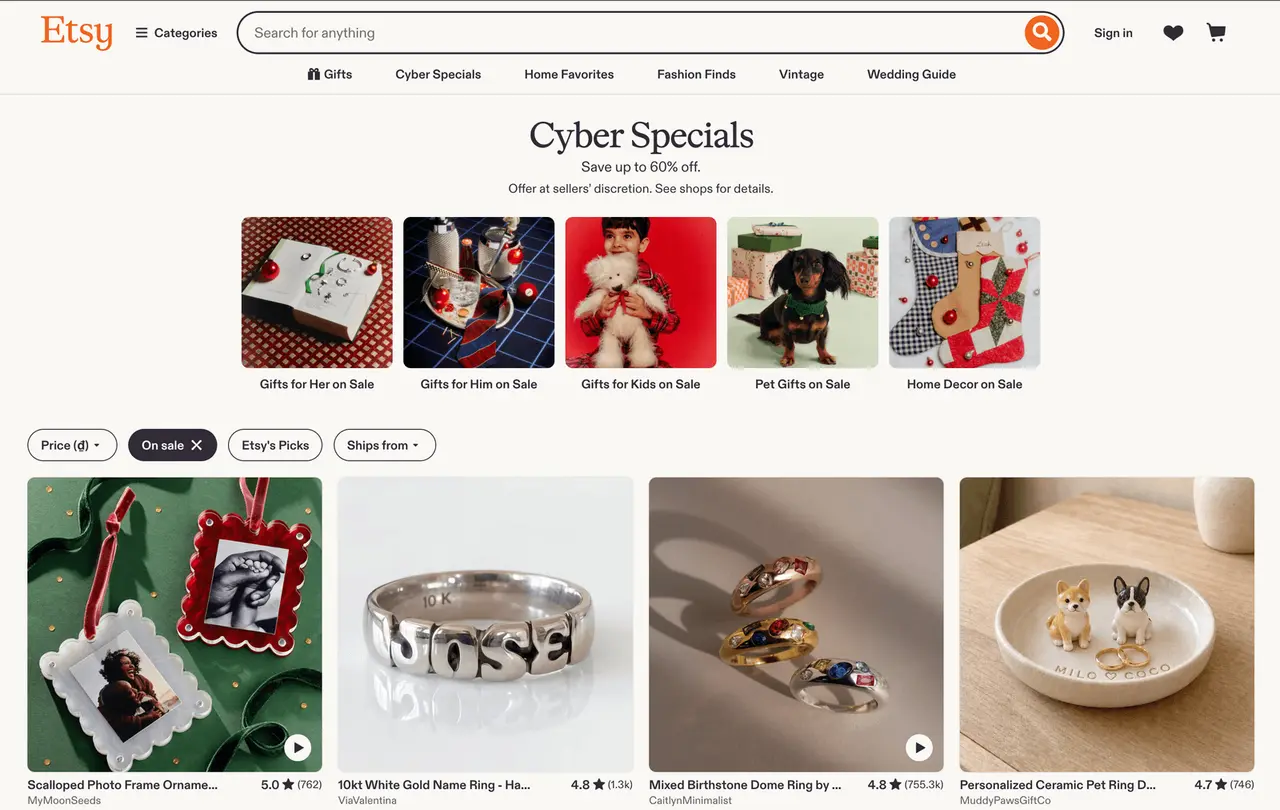
Etsy's revised terms also retain the existing content license.
Under Section 5(C), sellers grant Etsy and authorized third parties a license that is:
- Worldwide.
- Royalty-free.
- Irrevocable.
- Sublicensable.
- Perpetual.
Sellers retain ownership of their work. But ownership and permission to use content are two different things.
The terms also state that closing an account does not necessarily affect the availability of all content previously posted through Etsy. They do not clearly explain what happens to content already used in AI training if a seller removes a listing or closes a shop.
This leaves an important question unanswered: If a seller leaves Etsy, what rights, if any, can they exercise over content that has already entered an AI development process?
Value Added Resource has highlighted this uncertainty, and the revised terms do not spell out how previously uploaded or deleted content is handled in AI training.
What Etsy sellers should take away
Etsy has responded to seller pressure by making its anti-copycat commitment part of the Terms of Use. That is more meaningful than a general statement from a company representative because the commitment now appears in the agreement itself.
However, three issues remain:
- AI training is still permitted. The revised terms continue to cover AI development for search, seller tools, customer support, advertising and marketplace security.
- A general US opt-out has not been identified. Sellers cannot assume they can exclude their creative work from AI training while continuing to operate their shops.
- The license remains broad. It is still perpetual and irrevocable, and closing a shop does not automatically resolve what happens to previously uploaded content.
The revised terms take effect on December 16, 2026.
For Etsy sellers, the decision is therefore not simply whether the company has promised to protect human creativity. It is whether the remaining rights granted to the platform are acceptable for the kind of creative business they operate.
Etsy has narrowed the promise. It has not given sellers back full control over how their content may be used.