All stories · Hot News
Google confirms AI Overviews uses existing Search rankings. No separate AEO rules for websites
Share: WhatsApp · Telegram · X · Facebook · LinkedIn · Email

Google has clarified how AI Overviews and AI Mode select source links: they start with pages already ranked in Search, then look for additional sources that support the answer. For Shopify sellers, this means there is no need to chase a separate set of AEO rules. The priority is to make product pages eligible for inclusion, provide useful information in text, and keep product data accurate.
On November 24, 2026, Google published new documentation explaining how its generative AI Search features select, verify and link to web sources. The company also announced a December core update targeting improvements in how Search understands longer, more complex questions and personalized results. No rollout date has been confirmed.
AI Overviews starts with Google's existing search rankings
According to Google's new Attribution and factuality in Search generative AI features documentation, AI Overviews uses existing Search results as its starting point, then runs additional searches to find sources that support different parts of an answer.
The process works in three stages:
- Ranked results: Google starts with relevant pages already indexed and ranked in Search.
- Query fan-out: AI may run additional searches to find information covering different parts of a complex question.
- Source selection: Google links to pages that support the information presented in its AI-generated answer.
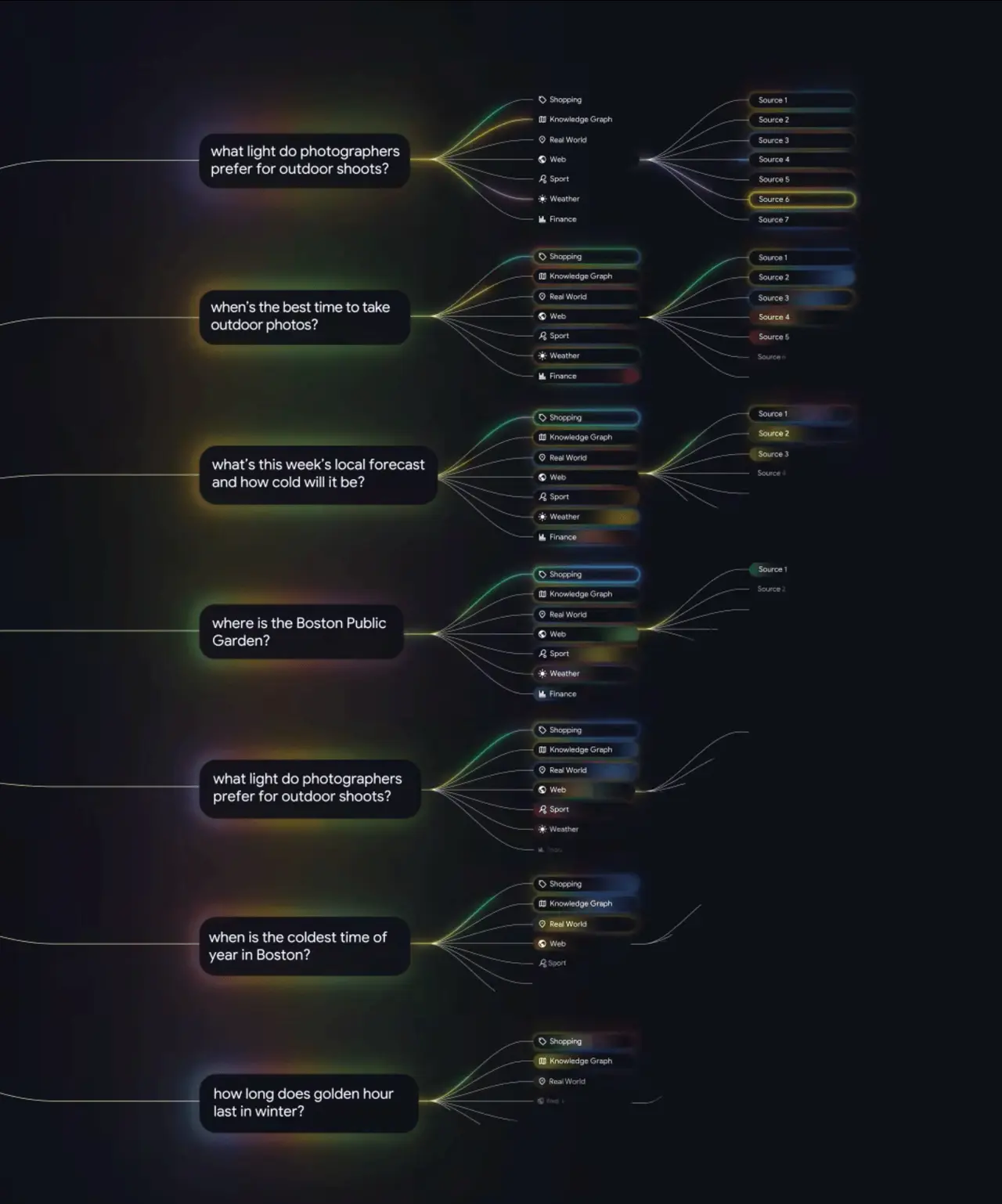
This means AI Overviews is connected to Google's existing ranking systems, not a separate search engine with its own AEO ranking rules.
Google's guidance for AI features also confirms that existing SEO best practices apply. Websites do not need special AI files, additional schema or a separate optimization strategy to appear in AI Overviews or AI Mode.
However, being eligible for inclusion does not guarantee a citation.
Is your store accidentally excluding itself from AI Overviews?
Before rewriting product descriptions, check whether Google can use your pages in the first place.
First, product pages must be indexed and eligible to display a snippet in Search.
noindexprevents a page from appearing in Search.nosnippetprevents Google from displaying a text snippet and can restrict the page's use in AI Overviews.max-snippetlimits the amount of text Google can display.
For Shopify stores, check theme code, SEO apps and custom settings that may add these directives.
Second, check your Search generative AI control in Search Console.
Google provides a dedicated control for managing whether site content can be used or displayed in Search generative AI features, including AI Overviews and AI Mode.
One common misconception: blocking Google-Extended in robots.txt does not automatically remove a website from AI Overviews.
Google-Extended controls content use for certain other Google generative AI products. It does not determine whether a website appears in Google Search or its AI features.
See Google's official generative AI controls documentation.
Give AI useful product information to cite
Once a page meets the technical requirements, its content needs to answer real shopping questions.
Google says AI Overviews and AI Mode can use query fan-out to explore different aspects of a question. A shopper researching a product may want to know its materials, dimensions, compatibility, care instructions, delivery time or return conditions.
A product page containing only a name, price and promotional description offers little information to answer those questions.
Two ecommerce examples illustrate how to present useful product information:
<text color="secondary" size="xs">Example: Product specifications</text>
The product page lists its 6061-T6 aluminum construction, 2 oz weight, 86 × 54 × 6 mm dimensions, card capacity, RFID protection and warranty.
<text color="secondary" size="xs">Example: Product information and customer questions</text>
Its bedding guide provides specific measurements across product sizes. Its returns policy explains return conditions and fees.
These are examples of useful content structures, not evidence that Google has cited these pages in AI Overviews.
For Shopify product pages, make relevant buying information available as text:
| Information | What to include |
|---|---|
| Specifications | Dimensions, weight, materials and composition |
| Compatibility | Supported devices, models and use cases |
| Usage | Instructions, cleaning and maintenance |
| Shipping | Processing times, delivery options and restrictions |
| Returns and warranty | Return periods, exclusions and coverage |
The goal is not to add endless FAQs. It is to answer the questions that influence a customer's purchase decision.
Google recommends making important information available in text, even when images and videos are also used.
Keep product information consistent across your website and feeds
Product information must also match across different data sources.
Google recommends aligning structured data with visible page content and keeping Merchant Center information accurate and up to date.
Shopify sellers should regularly check:
- Product prices and discounts.
- Inventory and availability.
- Variants, sizes and colors.
- Shipping costs and conditions.
- Product specifications and descriptions.
Google's ecommerce product data documentation explains how structured data and Merchant Center feeds help Google understand product information.
For example, a product page may show a new price while Merchant Center still contains the old one. A product may also be sold out on the website but remain available in the feed.
These discrepancies can affect the accuracy of product information used across Google's Search and Shopping experiences.
Another detail: do not change a page's updated date just to make it appear fresh. Google's date guidance advises against artificially refreshing dates without significant content changes.
What Shopify sellers should do before December
Google announced the December 2026 core update on November 24, shortly after the November update was marked complete. The new update aims to improve how Search understands and ranks relevant content, including longer and more complex questions. No specific rollout date has been announced.
This is not a product-page-specific update, and Google has not announced a new AEO ranking system. Sellers do not need to rewrite their entire catalogs in response.
Start with your five best-selling product pages.
| Priority | What to check |
|---|---|
| 1. Eligibility | Confirm indexing, snippet eligibility and Search generative AI inclusion. Review noindex, nosnippet and max-snippet. |
| 2. Text content | Check that relevant specifications, materials, compatibility, usage, shipping and return details are available as text. |
| 3. Accuracy | Compare visible content with structured data and Merchant Center. Correct outdated prices, inventory and product attributes. |
Record when changes are made and monitor Search Console performance.
Do not attribute every traffic fluctuation to the December update. The first full week after the November update, November 25 to December 1, overlaps with Thanksgiving, Black Friday and Cyber Monday. Search Engine Journal has highlighted this seasonal overlap as a challenge when interpreting traffic changes.
Google's core update guidance recommends waiting until a rollout is complete and collecting at least another week of data before evaluating its impact.
The key distinction: being eligible for an AI citation does not mean being selected for one. Sellers cannot control which pages Google chooses, but they can make sure their product pages are accessible, informative and accurate.
Ask AI next
- What signals decide which eligible pages Google actually selects to cite in an AI Overview?
- Can Search Console show how many clicks or impressions come specifically from AI Overviews citations?
- What tools can track whether a Shopify store's product pages are being cited in AI Overviews?
- What are the first signs to watch for once the December core update actually starts rolling out?
- Has Google rolled out AI Overviews and AI Mode across all search markets and languages yet?