All stories · Hot News
Google launches Gemini 4 Neon at $3 per million input tokens
The new model targets coding agents and complex workflows. Google says it can reduce task costs by 50–80% compared with competing models.
Share: WhatsApp · Telegram · X · Facebook · LinkedIn · Email

Google DeepMind launched Gemini 4 Neon on November 18, 2026, adding a mid-tier model to its Gemini 4 lineup.
Priced at $3 per million input tokens and $15 per million output tokens, Neon sits between Gemini 4 Carbon and Hydrogen. It targets coding agents, office workflows and scientific applications, with an emphasis on completing complex tasks faster and using fewer tokens.
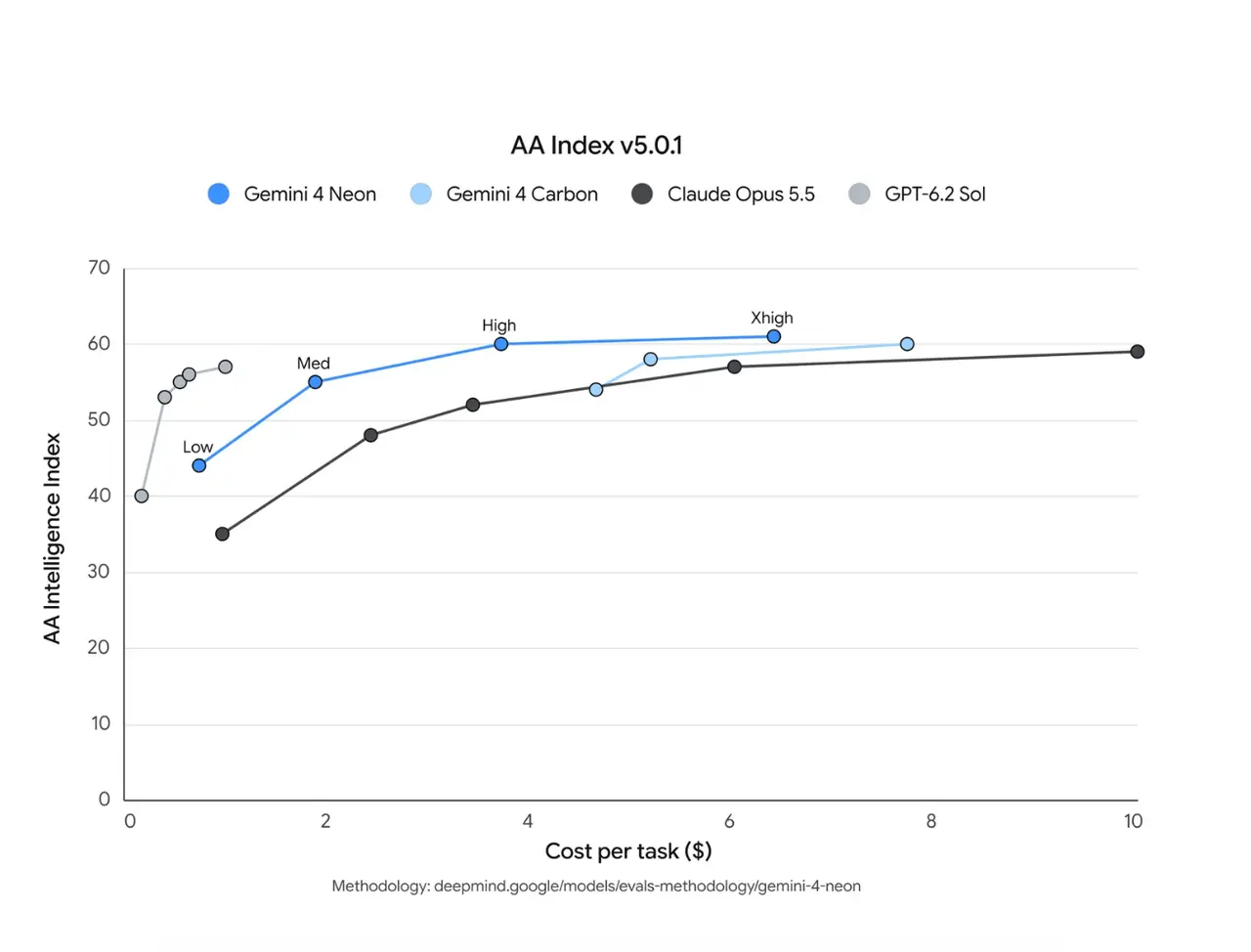
The headline is not its token price. It is Google's claim that Neon can deliver comparable results at substantially lower cost per task.
Source: Google DeepMind's launch announcement
A new model between Carbon and Hydrogen
Gemini 4 Neon fills the middle position in Google's latest model lineup:
- Carbon: Google's higher-capability model for demanding, complex tasks.
- Neon: A balance of reasoning capability, speed and cost, aimed at coding agents and multi-step workflows.
- Hydrogen: A faster, lighter option for everyday tasks.
Neon is designed for work that requires more than generating a single response. It can handle multi-step coding workflows, use tools and process information across longer tasks.
Google also provides four reasoning levels: Low, Medium, High and XHigh. Developers can adjust how much reasoning the model uses based on the complexity of each task.
That flexibility matters because deeper reasoning can improve performance, but it also increases token consumption and API costs.
Google is selling lower cost per task, not cheaper tokens
Neon's API pricing is:
| Token type | Price per 1 million tokens |
|---|---|
| Input | $3 |
| Output | $15 |
| Cached input | $0.15 |
Compared with competing models:
| Model | Input | Output |
|---|---|---|
| Gemini 4 Neon | $3 | $15 |
| GPT-6.2 Sol | $2 | $10 |
| Claude Opus 5.5 | $4 | $20 |
Sources: Google, OpenAI, Anthropic.
Neon is 50% more expensive per token than Sol, but 25% cheaper than Opus 5.5.
Google's argument is that token price alone does not determine the final bill. If a model uses fewer tokens to complete a task, its total cost can still be lower.
The company reports that Neon reduces task costs by around 50–80% compared with competing frontier models in selected evaluations. Google also says Neon delivers comparable or better quality than Carbon at three times the speed and 60% of the cost.
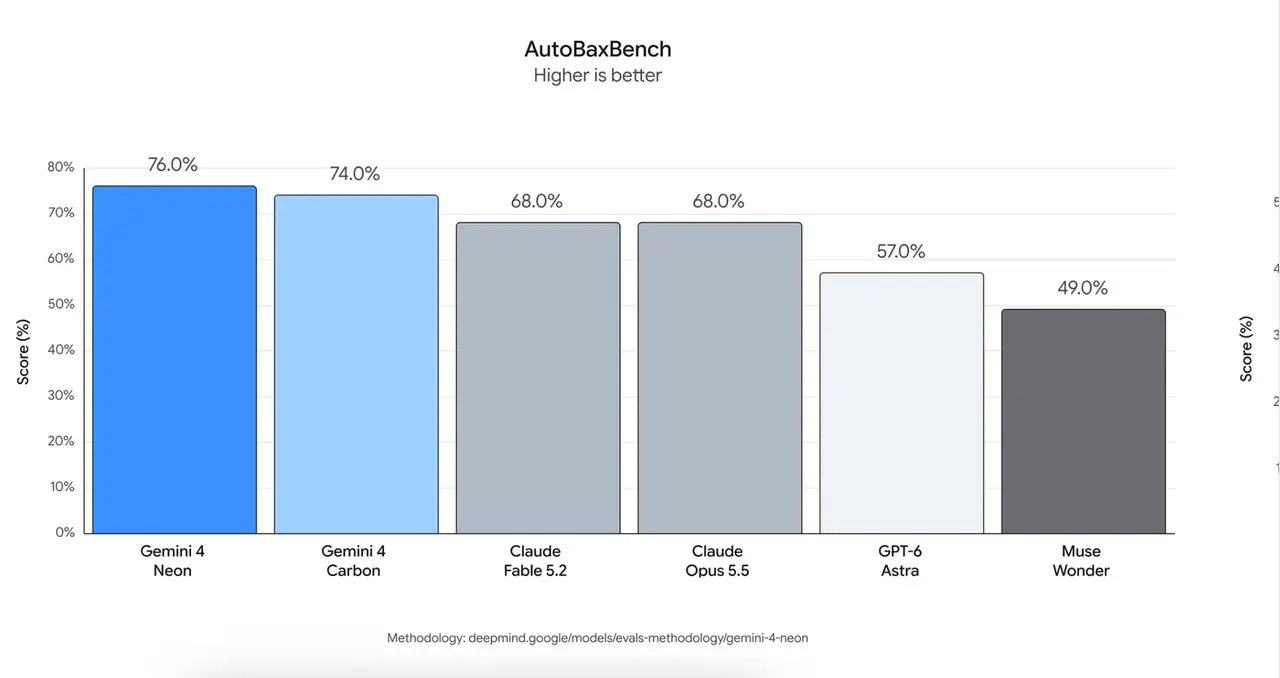
These figures come from Google's published evaluations. They should be treated as benchmark-specific claims, not guaranteed savings across every application.
What the new pricing means for AI products
For businesses integrating AI into their products, the difference between token pricing and task pricing has direct financial consequences.
Consider an AI feature that writes product descriptions, answers customer questions or processes orders. Its actual cost depends on more than the model's published input rate.
It also depends on:
- How much product or customer data the model reads.
- How many output and reasoning tokens it generates.
- Whether repeated input can be cached.
- How many times it needs to call tools or retry a task
Ask AI next
- Is Gemini 4 Neon available through Shopify-focused AI tools like Shopify Magic, or only via direct API integration?
- How can a merchant estimate real per-task cost on Neon vs GPT-6.2 Sol for product description workflows?
- What independent benchmarks or cost-tracking tools exist to verify Neon's claimed task-cost savings?
- Which reasoning level, Low to XHigh, works best for a customer-support chatbot versus a coding agent?
- What signs would show Neon's real-world savings differ from Google's benchmark claims?