All stories · Hot News
Google launches Stitch Loop, an AI agent that keeps improving products after launch
Google Labs has introduced Stitch Loop, an experimental AI product agent designed to continuously monitor and improve software after it goes live.
Share: WhatsApp · Telegram · X · Facebook · LinkedIn · Email

Unlike conventional coding agents that focus on building features and completing pull requests, Stitch Loop works on what happens next: identifying security vulnerabilities, improving performance, fixing accessibility issues and finding opportunities to improve product metrics.
The goal is to help small product teams maintain and optimize their products without having to rely entirely on developers to identify every issue and propose every fix.
Source: Google Labs, Introducing Stitch Loop
From building products to continuously improving them
Once a product goes live, development does not stop. Teams still need to monitor user behavior, investigate performance bottlenecks, patch security vulnerabilities and understand why users abandon important journeys such as checkout or signup.
These tasks often compete with new feature development, particularly for smaller teams with limited engineering resources.
Stitch Loop addresses this post-launch workload by connecting to a product's GitHub codebase and live product data, including logs, user behavior and customer feedback.
Google says teams can supply this context through more than 180 integrations, custom Model Context Protocol (MCP) servers or local command-line uploads.
Rather than waiting for developers to identify problems manually, Stitch Loop continuously looks for opportunities to improve the product against goals defined by the team.
Four steps turn product insights into code changes
Stitch Loop organizes its work into four stages:
Suggestions: Identifies improvement opportunities based on evidence from the product's own data.
Solutions: Proposes one or more ways to address each issue, outlining the trade-offs, scope and, where relevant, visual design options.
Build: After the team selects a solution, Stitch Loop writes the code in an isolated cloud sandbox and creates a GitHub Pull Request. Relevant PRs can include screenshots and videos showing the proposed changes.
Reflect: Monitors live product data to evaluate the results, learns from positive and negative outcomes, and uses those findings to inform subsequent improvements. It continues monitoring even after a target has been reached.
The final approval remains with the team. Stitch Loop does not merge code automatically. Every proposed change must be reviewed and approved through GitHub.
Three built-in loops target security, performance and accessibility
Google is launching Stitch Loop with three ready-made improvement loops:
- Cybersecurity: Scans the codebase for vulnerabilities and proposes fixes. This loop combines Gemini 4 Carbon's cybersecurity capabilities with CodeMender, Google DeepMind's autonomous code security agent.
- Latency: Monitors performance and looks for bottlenecks that could slow down the product.
- Accessibility: Identifies accessibility issues and opportunities to make the product more usable.
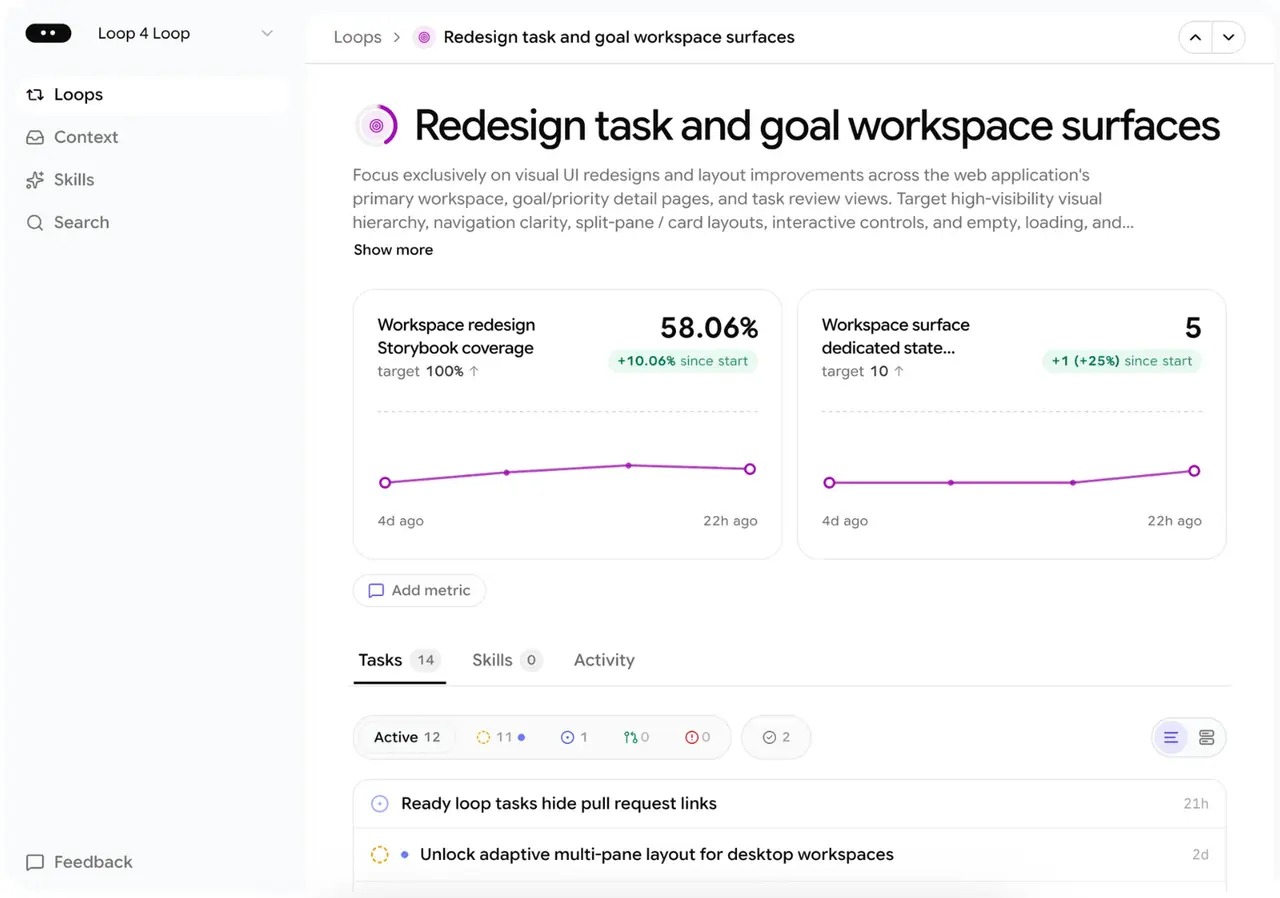
Teams can also create custom loops around their own business objectives. Google gives improving checkout conversion as one example.
This makes the system relevant beyond traditional software maintenance. A team could use it to investigate checkout drop-offs, identify potential improvements and turn selected solutions into code changes for review.
Stitch Loop also works with existing development workflows
Google is positioning Stitch Loop as more than a standalone dashboard.
It can serve as a service layer for coding agents such as Google Antigravity. Other agents can retrieve persistent product context and proposed improvements through Stitch CLI and MCP, allowing teams to combine different models and development tools.
Stitch Loop also integrates with Slack. Teams can use @stitch to receive daily insight digests and initiate new improvement loops without constantly switching between applications.
Waitlist is open globally
Stitch Loop is currently an experiment from Google Labs. Its waitlist is open to users worldwide, with eligible Google AI Ultra subscribers receiving priority access.
Google has not announced general availability or pricing.
The product's value will ultimately depend on whether its recommendations identify meaningful problems rather than generate more pull requests for developers to review. Continuous monitoring alone does not guarantee better products; the quality of the insights and proposed fixes matters just as much.
For product teams, the bigger shift is that AI is moving beyond helping developers ship code. It is beginning to take on the ongoing work of keeping shipped products secure, fast and usable.
Source: Google Labs
Ask AI next
- How does Stitch Loop prioritize which issues to surface so it doesn't flood developers with low-value pull requests?
- Do I need my Shopify store's codebase on GitHub to use Stitch Loop, and what's the minimum setup to connect it?
- Can Stitch Loop work with standard Shopify themes, or only fully custom codebases?
- What evidence should sellers watch for to confirm Stitch Loop's fixes actually raise checkout conversion?
- Is a Google AI Ultra subscription required to run custom loops, or only for priority waitlist access?