All stories · Article
Google still gets 5x more search queries than ChatGPT, and AI shopping relies on Google Shopping
The idea that ChatGPT is replacing Google as the starting point for online shopping is gaining traction.
Share: WhatsApp · Telegram · X · Facebook · LinkedIn · Email
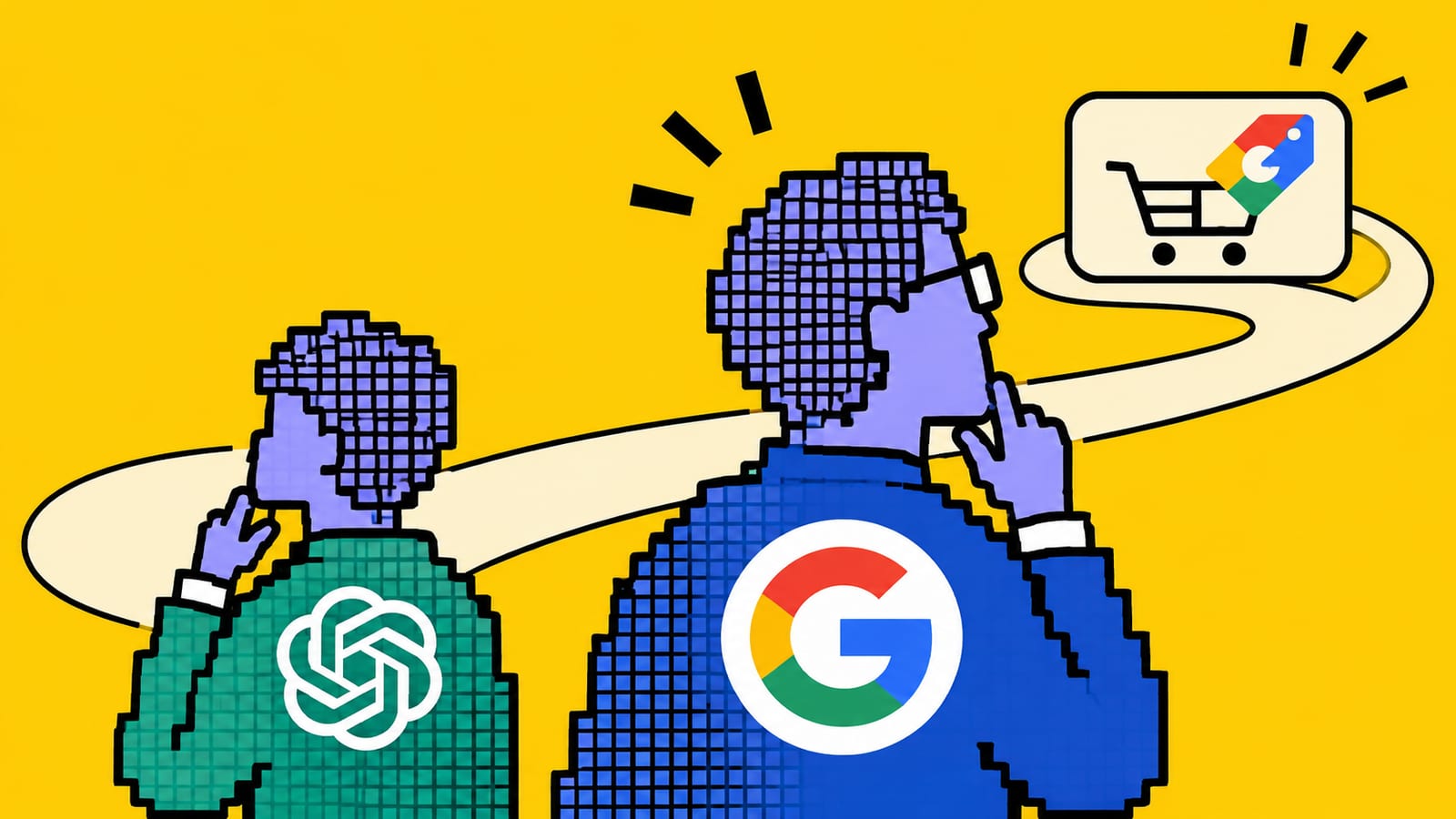
But recent data tells a more complicated story: Google remains significantly larger in search, and even AI-powered shopping experiences are sending shoppers back to Google's product ecosystem.
For Shopify sellers, this changes where the competition happens. Getting discovered in AI search is no longer just about optimizing your website for ChatGPT or Google. It also means making sure your products are properly represented in Google Shopping.
Google still handles far more searches than ChatGPT
On November 3, Search Engine Journal reported a statement from Adam Fry, ChatGPT consumer product lead at OpenAI: ChatGPT's search-like query volume is approximately one-fifth of Google's.
- Adam Fry, ChatGPT consumer product lead
:::
*Source: **https://www.bigtechnology.com/p/openai-chatgpt-search-is-about-20*
Third-party traffic data shows an even wider gap. According to Ahrefs, Google accounted for 24.74% of tracked web traffic in October, compared with just 0.36% for ChatGPT.
These figures measure different things, so they should not be treated as a direct comparison of search volume or shopping activity. But they challenge the idea that shoppers have already moved away from traditional search.
Google is still a major discovery channel. And it is increasingly integrating AI into that experience rather than leaving the shopping journey entirely to external AI assistants.
AI Mode keeps a surprising amount of product discovery inside Google
A Findrix study reported by Search Engine Land and summarized by MarketScale analyzed 55,198 AI-generated answers and found that 57% of product links in Google's AI Mode directed users to Google Shopping pages.
Why does this happen?
Google already has product information such as prices, ratings and inventory availability through its Shopping ecosystem. That gives AI Mode a way to present product options without sending shoppers directly to individual merchant websites.
The practical consequence is important: a shopper may discover and compare your product through Google Shopping before ever reaching your storefront.
And with an average of just 3.9 products appearing per query in the study, visibility is a limited opportunity. Being eligible to appear is not the same as actually getting a place.
ChatGPT Shopping may also depend on Google Shopping data
Google's influence does not necessarily stop at its own AI experience.
Research discussed in a seoClarity webinar recap published by Search Engine Journal suggests that 83% of products in ChatGPT's shopping carousel came from Google Shopping.
A separate small-scale test in Australia shared by Warren Hance on LinkedIn found that 75% of the product links examined carried Google's srsltid tracking parameter, commonly associated with organic Google Shopping listings.
Neither finding proves that every ChatGPT shopping result comes from Google. The research also has limitations: one is a secondary report of an earlier study, while the Australian test covered only a small sample across three product categories.
Still, both point in the same direction: Google Shopping data may be playing a much larger role in AI-assisted product discovery than many merchants realize.
For physical-product sellers, the distinction between optimizing for Google and optimizing for ChatGPT may therefore be smaller than it appears.
What this means for Shopify sellers before BFCM
If both Google AI Mode and ChatGPT's shopping experience draw heavily on Google Shopping product data, Merchant Center becomes an important part of your AI visibility strategy.
That does not mean a good feed guarantees a top position. AI systems can use additional signals, and product selection differs across categories and queries.
But inaccurate or incomplete product information can undermine your visibility before shoppers even reach your website.
Start with your best-selling products and check three things:
AI visibility is not the same as website traffic
There is another measurement problem worth paying attention to.
A shopper may discover a product through an AI-generated shopping result and complete a purchase without visiting the merchant's storefront in the usual way. In such cases, conventional website analytics and referral reports may not capture the entire discovery journey.
That means a low volume of ChatGPT referrals does not necessarily tell the whole story about how AI influences shopping decisions.
Google is also expanding advertising in AI Mode. Its rollout covers 10 markets, with further expansion planned for Brazil, Mexico and the UK in Q4 2026. Existing Search, Shopping and Performance Max campaigns are eligible by default, with no separate opt-out for AI Mode.
As AI-assisted shopping develops, merchants will need to look beyond website sessions and monitor product visibility, feed health and sales attribution across different shopping surfaces.