All stories · Hot News
Haiku 5.5 Is Now Available on the Claude Platform and Claude Code
Anthropic just added Haiku 5.5 to Claude Code, suggesting it be used as a "subagent" alongside Opus 5.5 or Sonnet 5.5. Just days later, Claude Code users are already customizing their own multi-model task delegation setups.
Share: WhatsApp · Telegram · X · Facebook · LinkedIn · Email
ClaudeDevs@ClaudeDevsHaiku 5.5 is now available in the Claude Platform and Claude Code. On average, it costs around 75% less to run than Haiku 4.5.
It pairs well with Opus 5.5 or Sonnet 5.5 as a subagent. Use it for high-volume, cost-sensitive tasks like summaries, compactions, or database queries. https://t.co/RB9xCWo4DbOct 7, 2026 · View on X
Anthropic Positions Haiku 5.5 as a Budget-Friendly Subagent
@ClaudeDevs announced that Haiku 5.5 is now live on the Claude Platform and inside Claude Code, noting specifically: "On average, it costs around 75% less to run than Haiku 4.5." Anthropic says Haiku 5.5 is ideal for acting as a subagent alongside Opus 5.5 or Sonnet 5.5, handling high-volume, cost-sensitive tasks like summarization, compaction, and database querying.
Earlier, on September 28, @ClaudeDevs launched Sonnet 5.5 with guidance on choosing between Sonnet 5.5 and Opus 5.5, migrating from Sonnet 5 while adjusting effort levels, and implementing them in Claude Code.
According to @dr_cintas, Anthropic's release post included Terminal-Bench 4.0 scores: Haiku 5.5 scored 39.2%, while Sonnet 5.5 hit 70.6%. This benchmark is precisely why @dr_cintas limits Haiku 5.5 to lookup tasks and keeps it away from editing files.
The Community Approaches Task Split Differently, But Shares the Same Core
Three posts that went viral this week all re-architect Claude Code into a "multi-model squad," though each assigns roles differently.
@dr_cintas sums up his strategy in one sentence: "Opus plans, Sonnet edits, Haiku reads, Fable reviews at decision points." Opus 5.5 set to high effort handles planning and final code approval; Sonnet 5.5 at medium effort edits files and runs test suites; Haiku 5.5 at low effort splits into two roles—one searching and reading the codebase, the other pulling documentation (this is also the first Haiku version to support custom effort settings); Fable 5.1 serves as an advisor, invoked via the /advisor fable command and receiving the full transcript each time.
@mirku21 calls his approach an "Official Anthropic tip for Claude Code," running it with the command claude --advisor opus --subagents haiku. In this setup, Sonnet 5.5 acts as the main session model—writing diffs and executing the test suite; the Haiku 5.5 subagent runs concurrently across the repo to find files and look up docs; Opus 5.5 steps back into an advisor role, remaining on standby.
@Bober_smart and @thedelost point to a feature that predates Haiku 5.5: "Agent Teams" in Claude Code, enabled via the flag CLAUDE_CODE_EXPERIMENTAL_AGENT_TEAMS=1. Here, Opus 5.5 serves as the architect designing the structure and merging the final PR, individual Sonnet 5.5 instances each own a dedicated folder in a git worktree, and Fable 5.1 operates strictly in read-only mode as an adversary.
Despite these different approaches, the exact trigger points for calling in Opus or Fable overlap across all three:
- Before finalizing a plan or locking down an interface
- When the same bug or test failure occurs a second time
- Before declaring a task complete
Savings Only Happen When You Explicitly Assign Models to Subagents
@Argona0x highlights an easily overlooked detail: by default, all helpers and subagents in Claude Code default to the primary model—Opus—even for basic tasks like finding and organizing files. @dr_cintas adds that the built-in file search subagent (Explore) also runs on the main model, requiring you to explicitly name your custom subagent "Explore" to overwrite it.
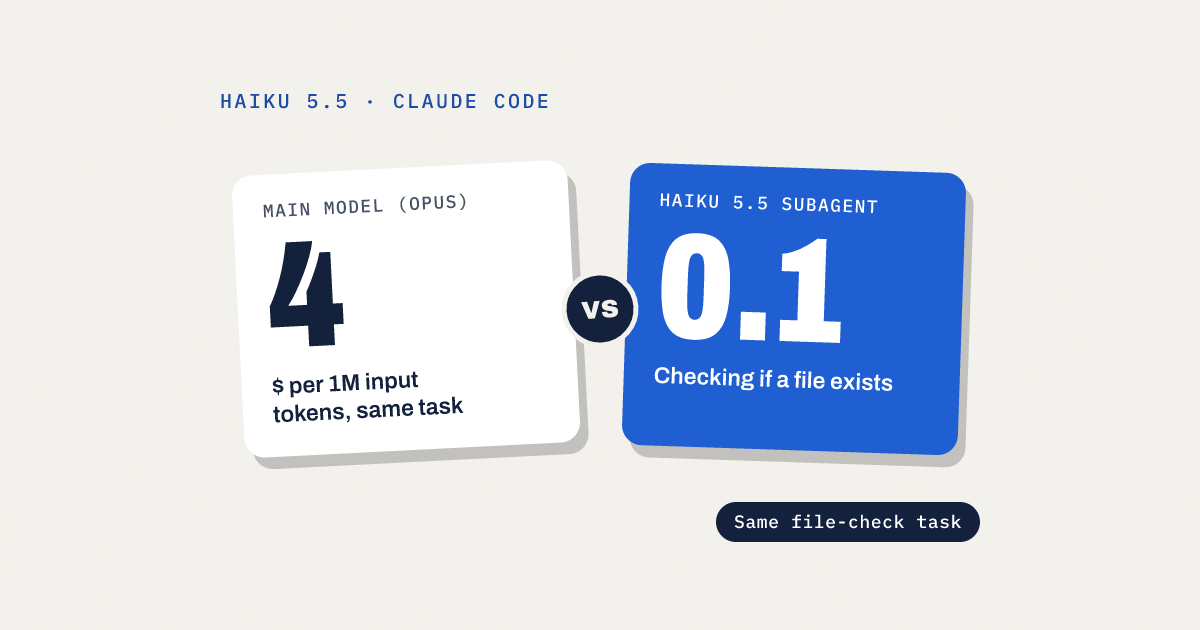
According to @dr_cintas, anyone still running a single model for everything is paying $4.00 per million input tokens just to check if a file exists—a task Haiku 5.5 handles for $0.10. However, reassigning isn't entirely automatic: @dr_cintas notes that the environment variable CLAUDE_CODE_SUBAGENT_MODEL_FORCE can cause Claude Code to ignore subagent-assigned models, CLAUDE_CODE_EFFORT_LEVEL will override effort settings, and for anyone running a Claude Code version older than v2.1.293, the "haiku" alias won't point to Haiku 5.5 yet.
The configuration prompts across all these posts end with the same safety rule: display the diff first, and don't modify anything without explicit user approval.
The actionable takeaway for daily Claude Code power users: offload file reading, repo searches, and doc lookups to a subagent running Haiku 5.5, while reserving high-cost models for the planning phase and major review checkpoints, rather than letting a single model handle the entire workflow from end to end.