All stories · Article
How to design an abandoned-cart email flow that brings shoppers back without giving away margin
An abandoned-cart email flow shouldn't rely on sending the same reminder several times. Each email should have a different job: remind shoppers what they left behind, address their hesitation, introduce an incentive when needed, and create a reason to complete the purchase.
Share: WhatsApp · Telegram · X · Facebook · LinkedIn · Email

A practical way to structure the flow is to gradually increase the level of persuasion, starting with a simple reminder and saving discounts for shoppers who need an extra push.
Illustration from Shopify's guide to abandoned cart emails, captured in November 2026.
1. Give each email a different job
A four-email sequence is one way to structure an abandoned-cart flow. Instead of offering a discount immediately, each message introduces a stronger reason to return.
For example, email marketer @Max_Alexxander shared a four-email structure on November 14, 2026:
| Timing | What it should do | |
|---|---|---|
| 30 minutes to 2 hours after abandonment | Email 1: Reminder, no discount | Bring shoppers back to their cart |
| Around 24 hours later | Email 2: 10% off or free shipping | Give hesitant shoppers a small incentive |
| Another 24 hours later | Email 3: 15% off | Introduce a stronger offer |
| Another 24 hours later | Email 4: 15% off with a deadline | Create urgency and encourage a final decision |
The sequence follows a clear progression:
- Email 1: Recover interest. Remind shoppers about the products they considered. Make returning to the cart easy.
- Email 2: Reduce hesitation. Introduce a small incentive for shoppers who haven't completed their purchase.
- Email 3: Increase the incentive. Offer a stronger discount to those who still haven't converted.
- Email 4: Create urgency. Give the existing offer a clear expiration point.
What the four emails look like in practice
Omnisend's guide to abandoned cart emails, written by Aistė Jočytė and published on February 19, 2026, collects abandoned cart emails Omnisend received from real brands in January 2026. Four of them line up with the four jobs above. The open and click rates below are Omnisend's figures.
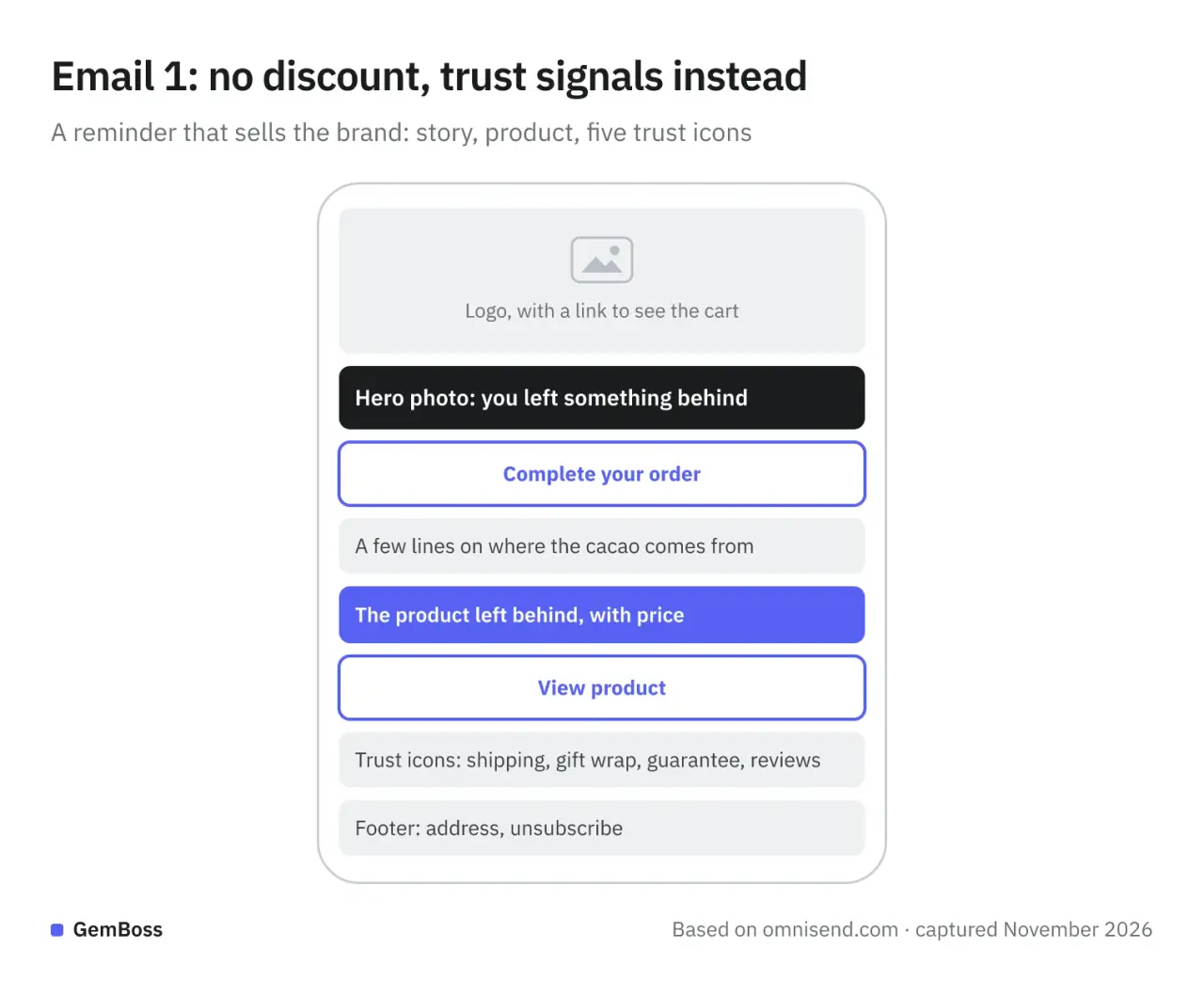
Wireframe of To'ak Chocolate's abandoned cart email, redrawn from the example in Omnisend's guide, November 2026.
Email 1, To'ak Chocolate. The luxury chocolate brand skips discounts and urgency. Its email tells the story of where the cacao comes from, links back to both the cart and the product page, and puts five trust signals where a discount would usually sit, Omnisend notes. Omnisend reports a 56.2% open rate and a 6.2% click rate, and suggests this approach for the first email, before any incentive.
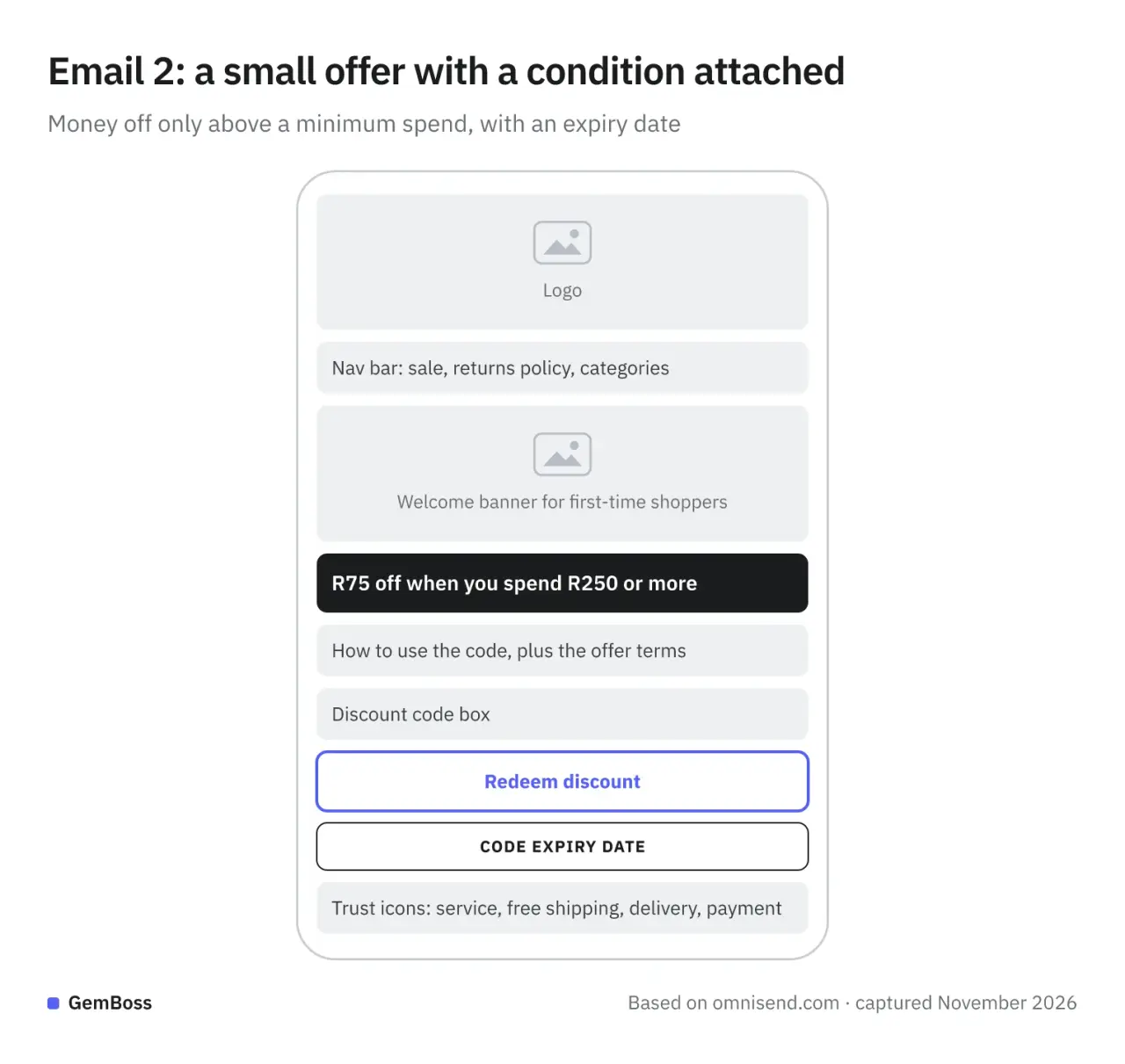
Wireframe of Mopani's abandoned cart email, redrawn from the example in Omnisend's guide, November 2026.
Email 2, Mopani. The South African online pharmacy offers first-time shoppers R75 off orders of R250 or more, with a button to redeem the code and an expiry date. The minimum spend protects margin while pushing order value up, according to Omnisend, which reports a 46.5% open rate and a 9.42% click rate.
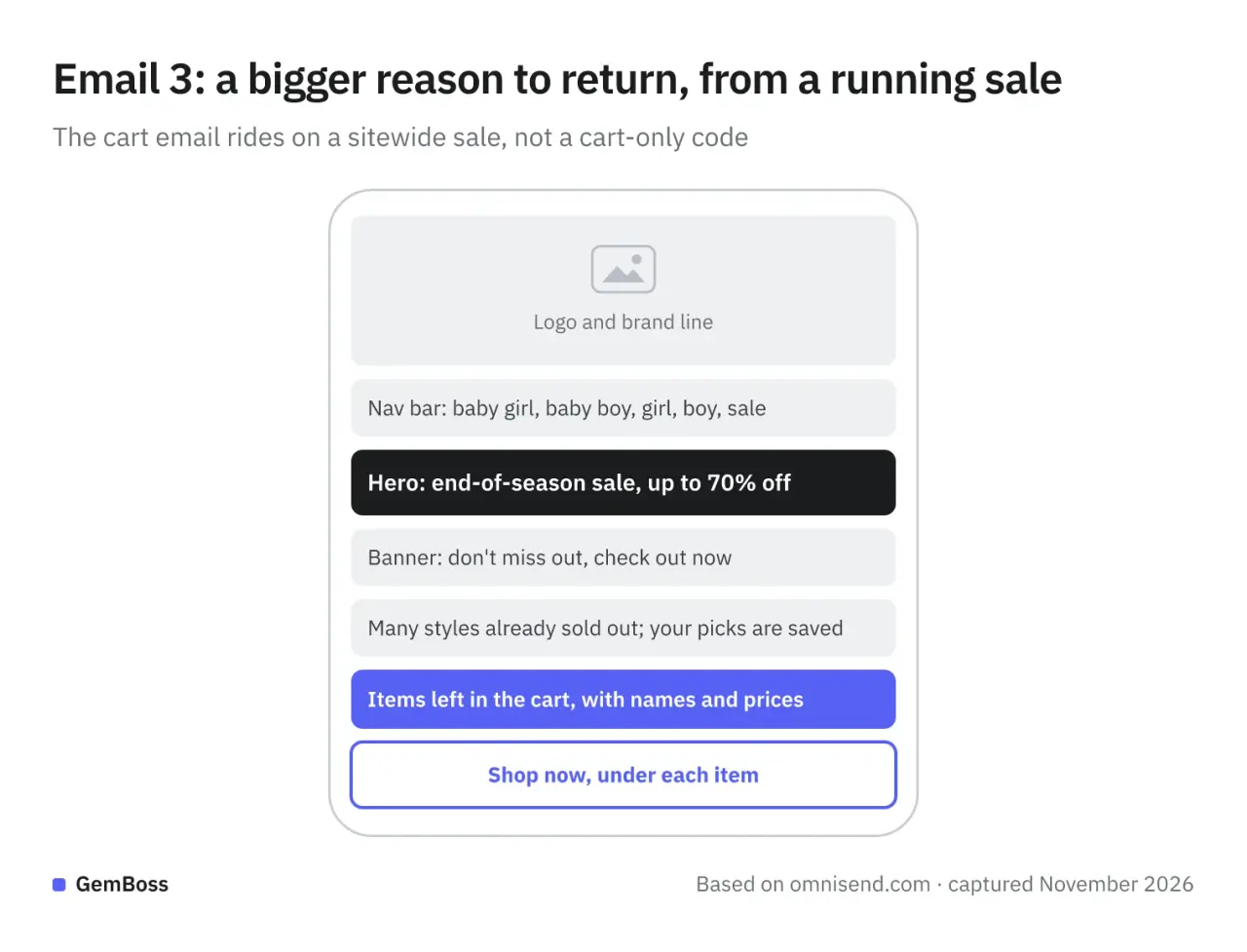
Wireframe of Rachel Riley's abandoned cart email, redrawn from the example in Omnisend's guide, November 2026.
Email 3, Rachel Riley. The London children's clothing brand ties its cart email to an end-of-season sale of up to 70% off and mentions that many styles have already sold out. Shoppers get a stronger reason to come back, but it comes from a sitewide sale rather than a code for their cart, Omnisend notes. Omnisend reports a 52% open rate and a 7.31% click rate.
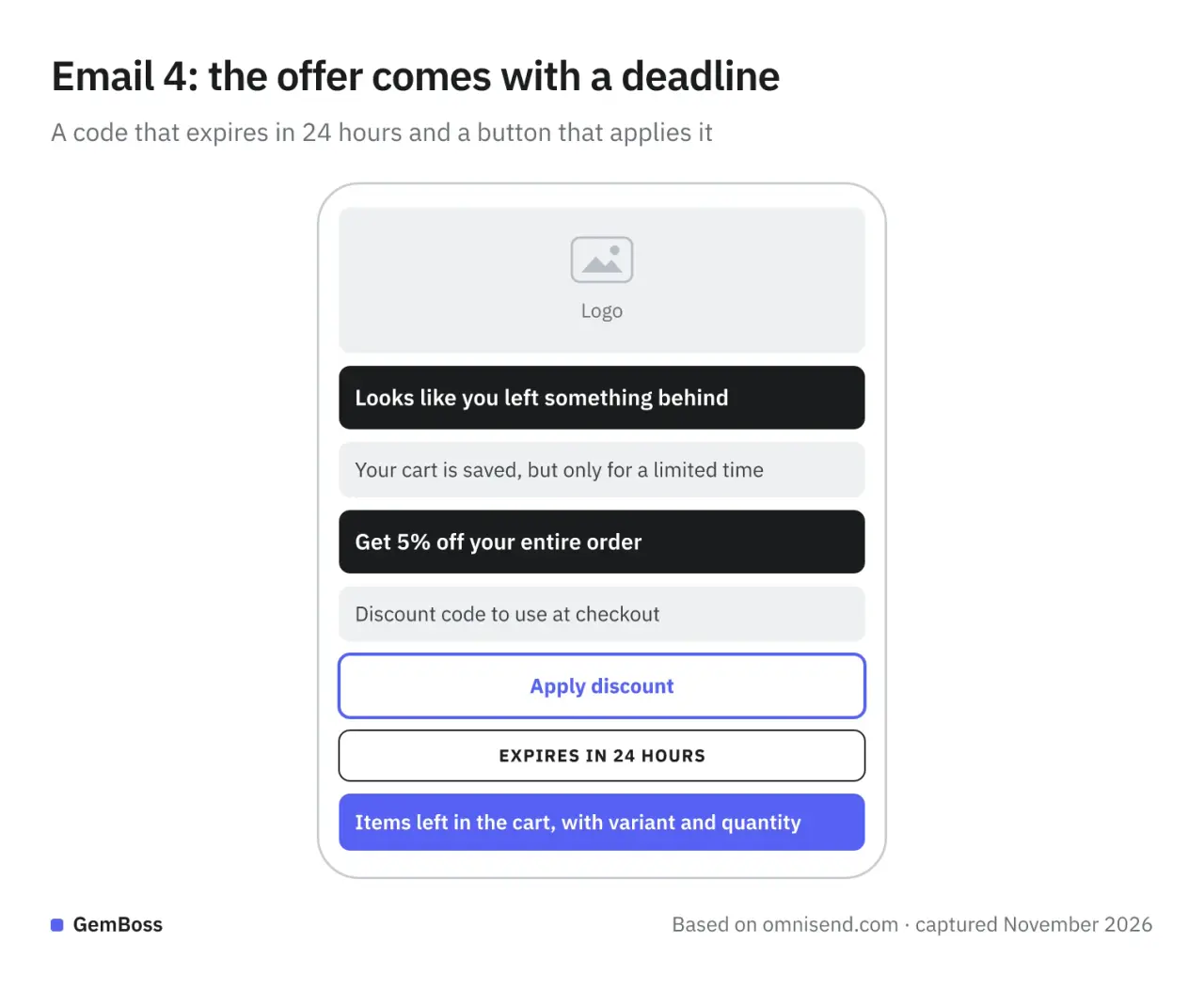
Wireframe of Creality's abandoned cart email, redrawn from the example in Omnisend's guide, November 2026.
Email 4, Creality. The 3D printing supplies store uses the subject line "Still Thinking It Over? Here's 5% Off to Help You Decide!" The code expires after 24 hours, and the button applies it at checkout, according to Omnisend, which reports a 54% open rate and an 8.25% click rate. The discount is smaller than the 15% in Max's sequence. What it shows is the deadline.
What the examples suggest. Omnisend's own suggested sequence is a reminder after 30 minutes, 5% off 24 hours later and 10% off 24 hours after that, so its discounts are smaller than Max's. Both start without a discount. Every incentive in these examples also comes with a condition: a minimum spend, a sale period or a 24-hour expiry. Open and click rates show attention, not additional orders, which section 3 looks at.
The important idea is that not every shopper needs a discount. Some simply need a reminder, while others may need a financial incentive to complete their order.
Omnisend's abandoned-cart email guide offers a similar starting point, recommending an initial reminder after 30 to 60 minutes and a follow-up around 24 hours later.
This gradual approach also helps protect margins. Offering discounts to every shopper from the first email means giving away profit even when a simple reminder might have been enough.
2. When should a store introduce discounts?
There are two common approaches, and they reflect different assumptions about customer behavior.
Approach A: Save the discount for later
The first email focuses on reminding shoppers about their cart. A discount or free-shipping offer appears in the second email.
This is the approach reflected in Max's four-email structure and Omnisend's recommendations.
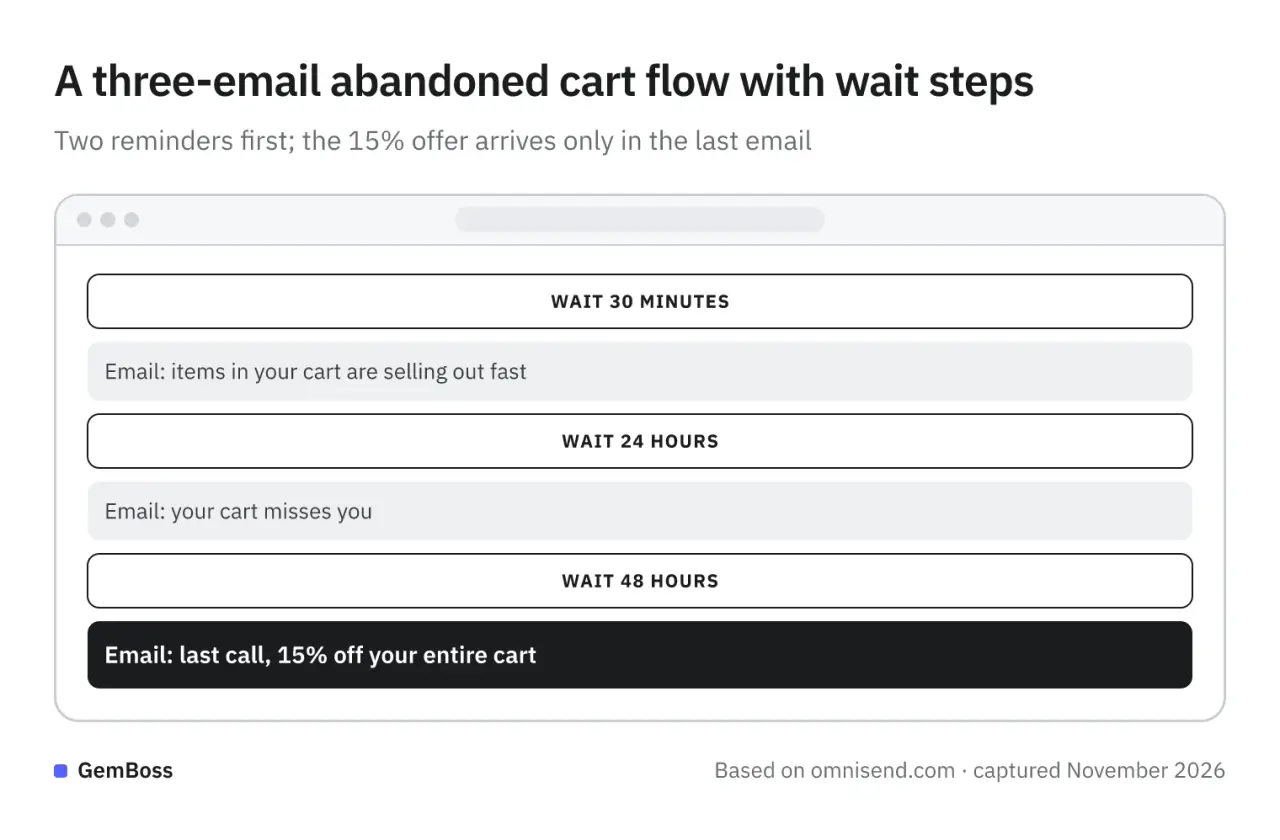
Wireframe of the three-email flow shown in Omnisend's guide, redrawn in November 2026.
It makes sense when a store wants to avoid discounting customers who are already likely to return and purchase.
Approach B: Introduce an incentive immediately
Not every marketer agrees that discounts should be delayed.
@EcomSameer recommends a seven-email abandoned-cart sequence that introduces an incentive in the first email. His approach also separates customers who have already purchased from those who haven't, allowing subsequent messages to address different customer situations.
The trade-off is straightforward:
- Delaying discounts can help protect margins, but may lose shoppers who need an immediate incentive.
- Offering discounts early may recover more hesitant shoppers, but can reduce the profit from customers who would have purchased anyway.
Neither approach should be treated as a universal rule. The right timing depends on customer behavior, product margins and how much incentive shoppers actually need.
3. Are recovered orders actually additional sales?
This is one of the most important questions when evaluating an abandoned-cart flow.
An email platform may attribute an order to an email because the customer purchased after receiving it. But that doesn't necessarily mean the email caused the purchase.
Consider two different metrics:
- Recovery rate: The percentage of abandoned carts that eventually turn into purchases.
- Incremental lift: The additional purchases generated by the email compared with what would have happened without it.
A Reddit user in r/ecommerce shared a test comparing four abandoned-cart email schedules.
The version sending its first email after 1 hour and 15 minutes initially achieved an approximately 18% higher recovery rate than the four-hour version.
However, after introducing a holdout group that received no abandoned-cart emails, the advantage fell to around 4%.
This suggests that some shoppers would have returned and purchased anyway. The email may have received credit for orders it didn't actually generate.
The result is self-reported and comes from one store, so it shouldn't be treated as definitive research. The test also changed the final email's content in the four-hour version, making it difficult to isolate the effect of the first-email delay alone.
A high recovery rate doesn't necessarily mean the email generated the same number of additional orders.
That's why a holdout group matters. By randomly excluding some eligible shoppers from the flow, a store can compare purchasing behavior between those who receive the emails and those who don't.
4. What should store owners test?
Rather than copying an existing sequence exactly, test the elements that directly influence conversions and profitability.
First-email timing
Compare sending the first reminder after one hour versus four hours. Keep the subject line, email content and subsequent messages identical so that timing is the main variable.
Max also identified first-email timing as a high-ROI A/B testing opportunity.
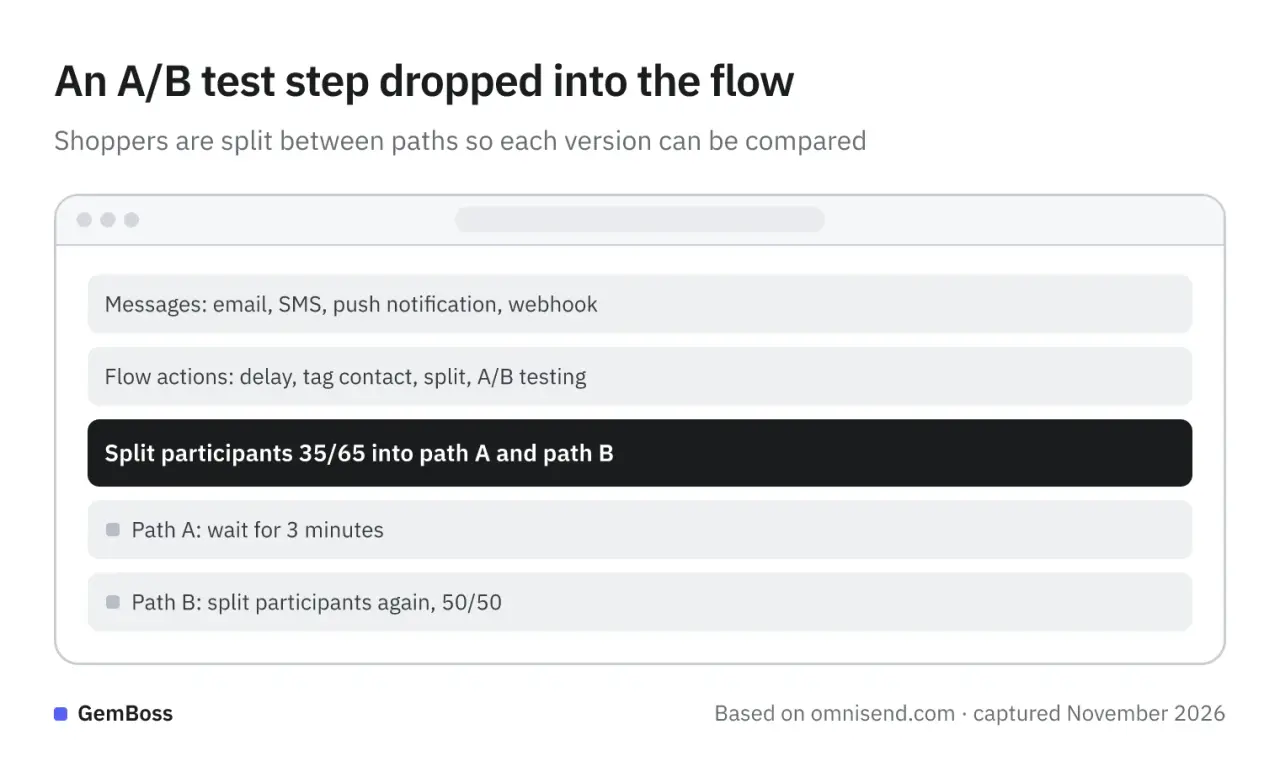
Wireframe of the A/B testing step in an Omnisend flow, redrawn from Omnisend's guide, November 2026.
The second-email incentive
Compare a 10% discount with free shipping. The goal is to identify which offer generates more purchases while preserving more margin.
Discount timing
Compare introducing an incentive in the first email against introducing it in the second. This helps establish whether customers actually need an offer to return.
Holdout group
Randomly exclude a portion of eligible shoppers from the abandoned-cart flow. Compare their purchase rates with those receiving the emails.
Klaviyo's guide to Global Holdout Groups explains how holdout testing measures the incremental impact of marketing rather than relying solely on attributed conversions.
There is also another issue worth investigating: not every abandoned cart is caused by price.
Baymard Institute's research on cart abandonment highlights problems such as unexpected costs and complicated checkout experiences. A discount cannot fix these underlying issues.
What to measure
- Incremental orders: How many more orders did the email group generate compared with the holdout group?
- Revenue per recipient: Total revenue divided by the number of eligible recipients.
- Contribution margin: Whether additional revenue remains profitable after discounts, shipping costs and other expenses.
The objective isn't simply to recover more carts. It's to generate additional profitable orders.
The takeaway: Build the flow around customer hesitation, not around a fixed number of emails. Start with a reminder, introduce incentives when needed, and increase the urgency only for shoppers who haven't converted. Then use A/B tests and a holdout group to determine which sequence actually creates more profitable sales.
Sources · 8 · shopify.com, x.com, omnisend.com +3
- Shopify's guide to abandoned cart emails · shopify.com
- @Max_Alexxander shared a four-email structure · x.com
- Omnisend's guide to abandoned cart emails · omnisend.com
- @EcomSameer recommends a seven-email abandoned-cart sequence · x.com
- shared a test comparing four abandoned-cart email schedules · reddit.com
- identified first-email timing as a high-ROI A/B testing opportunity · x.com
- Klaviyo's guide to Global Holdout Groups · help.klaviyo.com
- Baymard Institute's research on cart abandonment · baymard.com
Ask AI next
- How do you calculate contribution margin per recovered abandoned-cart order after discounts and shipping costs?
- What holdout-group size is statistically reliable for small stores measuring incremental lift?
- What minimum order value should a cart-recovery discount require to boost AOV without hurting margin?
- What behavioral mechanism lets trust-signal-only cart emails like To'ak's convert without any discount?
- What's considered a good incremental lift from an abandoned-cart flow across stores, beyond one single test?