All stories · Hot News
Instinct says more than $1B a year goes through its agent; in Accenture's survey, 9% of consumers would let an agent buy alone
Share: WhatsApp · Telegram · X · Facebook · LinkedIn · Email
Written by AI from 8 public posts Reviewed by Iris (Nghi Chau)
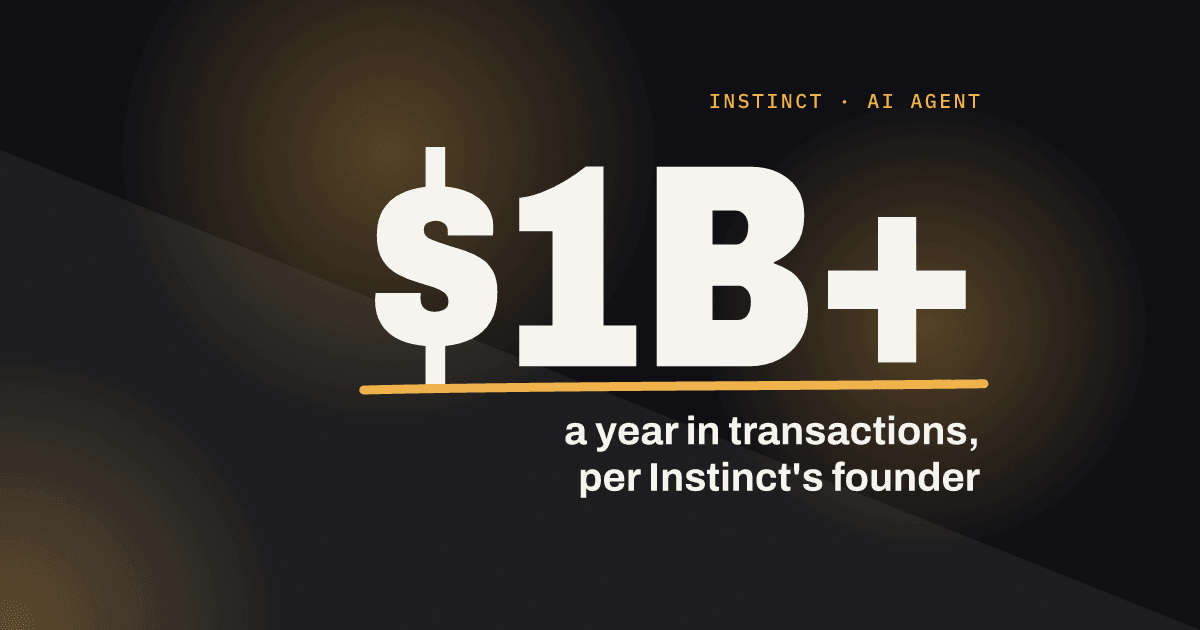
Noah Shinn, the founder of the personal AI agent Instinct, said in an episode of the Invest Like the Best podcast published September 28 that more than $1 billion a year in transactions now goes through Instinct (episode).
The figure is Shinn's own, and we could not find an independent source that confirms it. It also comes from people who asked for an invite to a new product, so it says more about early users than about shoppers in general.
Surveys of the wider public find much less willingness to let an agent pay without a check. The largest one, from Accenture, was run in January 2026, before Shopify added Meta as an AI sales channel in September, so attitudes may have moved since.
A list of surprising and mind-boggling stats from this conversation:
- $1B+ a year in transaction volume (still invite only)
- Growing 10%+ A DAY and has spent zero dollars on marketing
- 40% of users shared a personal credit card with Instinct within 3 weeks
- Compute demand is doubling roughly every week
- At 5 to 8% daily growth over the months it takes to bring new compute online, Instinct would reach about…
- What Instinct reports: The episode description says Instinct is about a year old, still invite-only, growing roughly 10% day over day and spending nothing on marketing. In a list of figures from the conversation, host @patrick_oshag adds that 40% of users shared a personal credit card with Instinct within 3 weeks and that 50% of transaction volume is travel.
- How Instinct plans to earn money: Shinn told @patrick_oshag that users would pay nothing and merchants would pay one transaction fee across the platform. No rate has been set.
- The fee range Shinn mentioned: In the same clip, Shinn compared what other platforms take, by Shinn's own estimate: Shopify between 2.5% and 3%, Amazon upwards of 10%, Apple 30% on in-app purchases. Shinn did not say what those shares include, so they should not be read as the fee a store pays on each order. On the top of the range: "I'm not saying we're gonna be at 30%, but you can see the range."
- Accenture's survey: Accenture asked 25,590 consumers in 16 countries. Of those, 9% would let an agent act on its own within set limits and complete a purchase, and 32% would let an agent choose within a budget but check that choice before approving payment.
- ACI Worldwide's survey: Retail Dive reported on an ACI survey of more than 3,300 US and UK consumers, in which 7% of fashion shoppers would let an AI assistant buy without approval. The story adds that 53% were uncomfortable letting an assistant buy for them and 14% would require manual approval for every purchase, without saying whether those two figures cover all respondents or only fashion shoppers.
What does a shared card say about trust?
Instinct's card figure shows that invited users trusted the agent with payment details. It does not show how often they let a purchase go through without checking it first.
One user's account shows what that can look like. @nishyb made 5 to 10 online purchases through two agents, one of them Instinct, and wrote that Stripe Link (Stripe's saved-payment service) appeared to ask for approval on every transaction. @nishyb wanted fewer of those checks for small orders from known stores: "trusted vendor + below trigger amount? Just charge the card."
In Accenture's sample, the preference ran the other way: more people chose the check-first option than the no-check option.
What does this mean for Shopify sellers?
The fee is the part that would reach sellers directly. If Instinct starts charging it, each order placed through the agent would carry a known cost that a store could compare with its ad spend. Until Instinct names a rate and a start date, there is no number to compare.
Shopify's own controls cover a named set of agents. Under Sales channels > Agentic in the admin, Shopify's Help Center lists the AI channels that can get a store's products through Shopify Catalog: ChatGPT, Microsoft Copilot, Meta, Google AI Mode and Gemini, Shop, and "other channels" from independent developers and startups.
By default, the setting "Allow Shopify to manage for me" gives those channels access to the store's products, turns on direct checkout (the agent completes the checkout) where relevant, and adds the store to new channels automatically. A seller who turns it off can set access channel by channel. Shopify's changelog shows the default in use: Meta was added as a channel on September 8, with products shared by default.
Instinct is not on that list. The episode description says Instinct has its own phone and its own computer and can do almost anything online that its user would do. If Instinct buys from Shopify stores that way, through the storefront as a shopper would, its orders may not pass through the Agentic settings at all. Neither Instinct nor Shopify has said how Instinct checks out at Shopify stores.
Sources
- https://podcasts.apple.com/gb/podcast/noah-shinn-building-instinct-the-personal-agent/id1154105909?i=1000792019848
- https://x.com/patrick_oshag/status/2104575947630362792
- https://x.com/patrick_oshag/status/2104652976447168787
- https://www.accenture.com/us-en/insights/consulting/talk-my-ai-agent
- https://www.retaildive.com/news/consumers-trust-ai-advise-do-not-consent-purchasing-them/830990/
- https://x.com/nishyb/status/2096713680495005968
- https://help.shopify.com/en/manual/online-sales-channels/agentic-storefronts/agentic-home
- https://changelog.shopify.com/posts/meta-is-now-an-ai-channel-in-your-admin