All stories · Article
Is your AI chatbot losing sales? Fix its missing answers first
70% of Shopify Inbox conversations happen while shoppers are actively deciding to buy, according to Shopify's AI chatbot guide. When those chats end without an order, one reflex is to swap the bot.
Share: WhatsApp · Telegram · X · Facebook · LinkedIn · Email
That reflex may miss a cheaper fix. Inbox's AI answers from your catalog and FAQ, so rules never written as numbers may leave any bot guessing. Five rules are worth writing first, and one door worth opening.
Shoppers' top AI complaint: getting stuck with it
Alchemer surveyed 2,009 US consumers about AI in customer service, and MarTech published the results on October 2, 2026. 89% said AI had hurt their experience with a company at least once. Nearly six in 10 said knowing a company uses AI makes them expect faster replies.
The biggest complaint, at 44%, was how hard it is to reach a person when needed. Others got an AI reply that missed the question (37%), got wrong information (26%) or had to repeat what they had already said (30%), and one in five said AI made fixing their issue take longer.
Those are US shoppers across all industries, so read them as a direction rather than your store's numbers. One account on X described the same loop while setting up a smart plug: six customer service contacts, two GenAI text bots, one GenAI voice chatbot and two humans.
rat king 🐀@MikeIsaactrying to set up a smart plug and i’ve gone through 6 customer service reps
two GenAI text bots, one genAI voice chatbot, two humans
the lesson is i should have just plugged my dollar store power strip into the wall and chastised myself for dabbling in thee internet of thingsOct 25, 2026 · View on X
Can Shopify's AI tools answer shipping and delivery questions?
Bill Hunt, President at Bisan Digital, audited 122 top Shopify storefronts between August and September 2026 and published the results in Search Engine Journal on October 14, 2026. One test put the questions buyers ask to the policy tool Shopify installs for AI agents. That tool is separate from your store's chatbot, though it reads your store's own policies.
| Question asked of the tool (88 stores) | Usable answer |
|---|---|
| What is the return window for this item? | 70 of 88 |
| Can used or open-box items be returned? | 5 of 88 |
| Can I cancel an order after placing it, and by when? | 2 of 88 |
| What does shipping cost to Boston, and when will it arrive? | 0 of 88 |
The misses were not always blank.
Two stores sent back their shipping FAQ when asked about cancellation. Another store's FAQ promised free standard ground shipping on US orders over $75, and that line never came back for the shipping-cost question.
Checkout told the same story. In live test checkouts at 74 stores, 36 could price shipping to Boston and none returned an arrival date or a carrier. Not one of the 122 stores passed all nine checks an agent needs to settle a purchase decision.
The answers are on your pages, written as prose
Hunt found the information was usually there. The tool reached it when a question sounded like the name of a policy page, and, return windows aside, missed it when the question sounded like a buyer. 70% of the stores whose policy text he could read stated the return window in prose; only 7% of product pages carried it as structured data.
Your own chatbot may stumble in the same places. It may read the same policy pages and FAQ, and a rule that sits in the middle of a paragraph can leave it guessing.
If it guesses, the guess may land while someone is deciding to buy.

Will switching to another chatbot fix it?
On its own, probably not. Shopify describes Inbox's AI as suggesting answers from your product catalog and FAQ content, which a team member can review, edit or send as written.
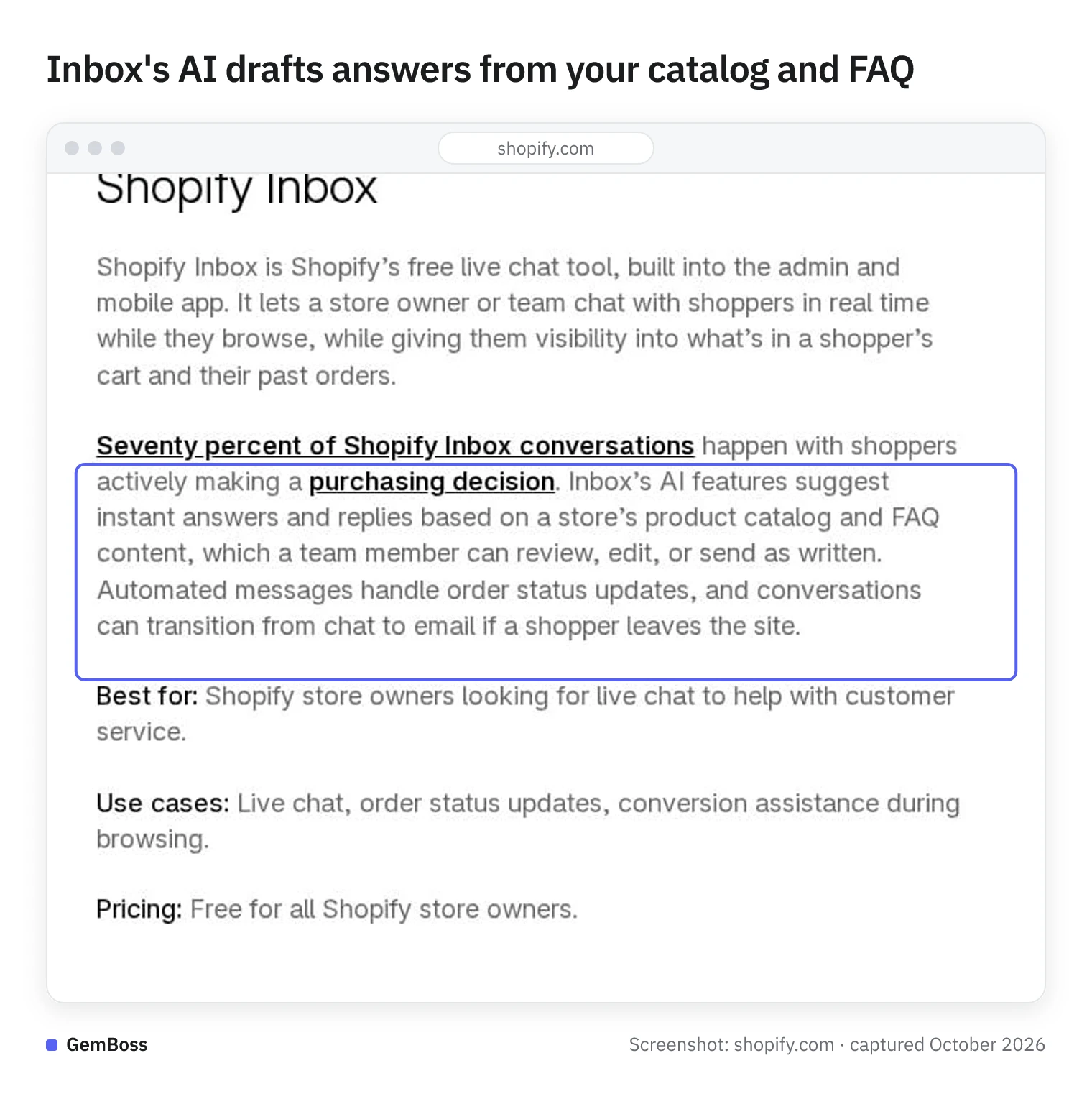
Screenshot of Shopify, captured October 2026.
A replacement bot would most likely draw on the same catalog and FAQ pages. If your cancellation rule isn't written down anywhere, a new bot has nothing better to say than the old one.
The wider numbers are modest too. Shopify's guide cites Deloitte data: only 40% of brands see a positive sales impact from AI chatbots, and 52% report no impact.
The usual dashboards can hide the problem. MarTech notes that first-response time and containment rate can make an AI chat look successful even when the customer comes back through another channel with the same issue, and that escalation rules matter most when the system is unsure.
Set each rule once in admin, then copy it word for word to the pages, so your bot and your shopper read the same thing.
Put a person behind money, delivery and cancellation questions
The sixth job is a door. When a shopper asks about a fee, a delivery date or a cancellation, offer a way to reach your team inside the same reply, even if the answer comes a few hours later.
The Alchemer survey gives the reason: 43% of consumers would pay more for a product or service that guarantees access to human support.

I'd weigh this by what your chats look like. If shoppers rarely ask anything before buying, a bot-only setup may be fine. If your chats are full of delivery and cancellation questions, that is where the door matters most.
Ask your bot the five questions first
Hunt sums up his audit with a line I'd apply to any store chatbot: "For now, most stores that look ready by default are only ready until the buyer asks a real question."
Before you pay for a new bot, ask your current one the five questions above, phrased the way a buyer would; Hunt says most of these checks take an afternoon. Every answer it misses is a rule to write down.
Sources
- according to Shopify's AI chatbot guide · shopify.com
- MarTech published the results on October 2, 2026 · martech.org
- https://x.com/MikeIsaac/status/2114440368876040320
- published the results in Search Engine Journal on October 14, 2026 · searchenginejournal.com