All stories · Hot News
Meta launches Muse in Australia with MECCA, Kogan and Canva
Meta is expanding its personal AI assistant into Australia through nine local partners, including beauty retailer MECCA, ecommerce retailer Kogan, Officeworks and Canva.
Share: WhatsApp · Telegram · X · Facebook · LinkedIn · Email

The launch puts Muse closer to everyday shopping and services, while raising new questions about how AI agents access retailers, handle transactions and protect user data.
On November 17, 2026, Meta launched Muse in Australia, one of its first markets outside the US. The rollout includes nine local partners across retail, property, entertainment, fitness and creative services.

Among the most notable names is MECCA, an Australian prestige beauty retailer founded in Melbourne in 1997. MECCA operates a large network of beauty stores and sells products from international beauty brands, making it an important retail partner for an AI assistant designed to help consumers discover and purchase products.
Other partners include Kogan and Officeworks in retail, Canva in creative services, Ticketek in entertainment, Domain and realestate.com.au in property, SWEAT in fitness, and ShopBack in shopping rewards.
The launch is particularly relevant ahead of Australia's Black Friday and Christmas shopping season. Meta says the timing is intended to help people use Muse for holiday shopping, gift discovery and travel planning.
Muse@MuseMuse, brekkie, and beach, in that order. Muse has arrived in Australia: https://t.co/T2OeSwX3GG 🇦🇺
Nov 17, 2026 · View on X
Sources: Meta's Australian launch announcement · MECCA
From AI assistant to shopping intermediary
Muse is designed to do more than answer questions. It can connect to external services and carry out tasks on behalf of users, including searching for products, making bookings, managing emails and coordinating activities.
The Australian launch introduces a network of connectors that allows Muse to interact with participating businesses directly.
For example:
- MECCA: Access beauty products and shopping services.
- Kogan and Officeworks: Connect users with retail products.
- Ticketek: Help users discover and access entertainment events.
- Domain and realestate.com.au: Support property searches.
- Canva: Connect users with creative tools.
- SWEAT: Access fitness-related services.
- ShopBack: Connect shopping activity with rewards.
However, the launch announcement does not mean every integration is immediately available. Meta is rolling out connectors progressively, with some becoming available after the initial launch.
This distinction matters. A retailer being named as a launch partner does not automatically mean customers can complete every shopping task through Muse on day one.
Why MECCA's participation matters
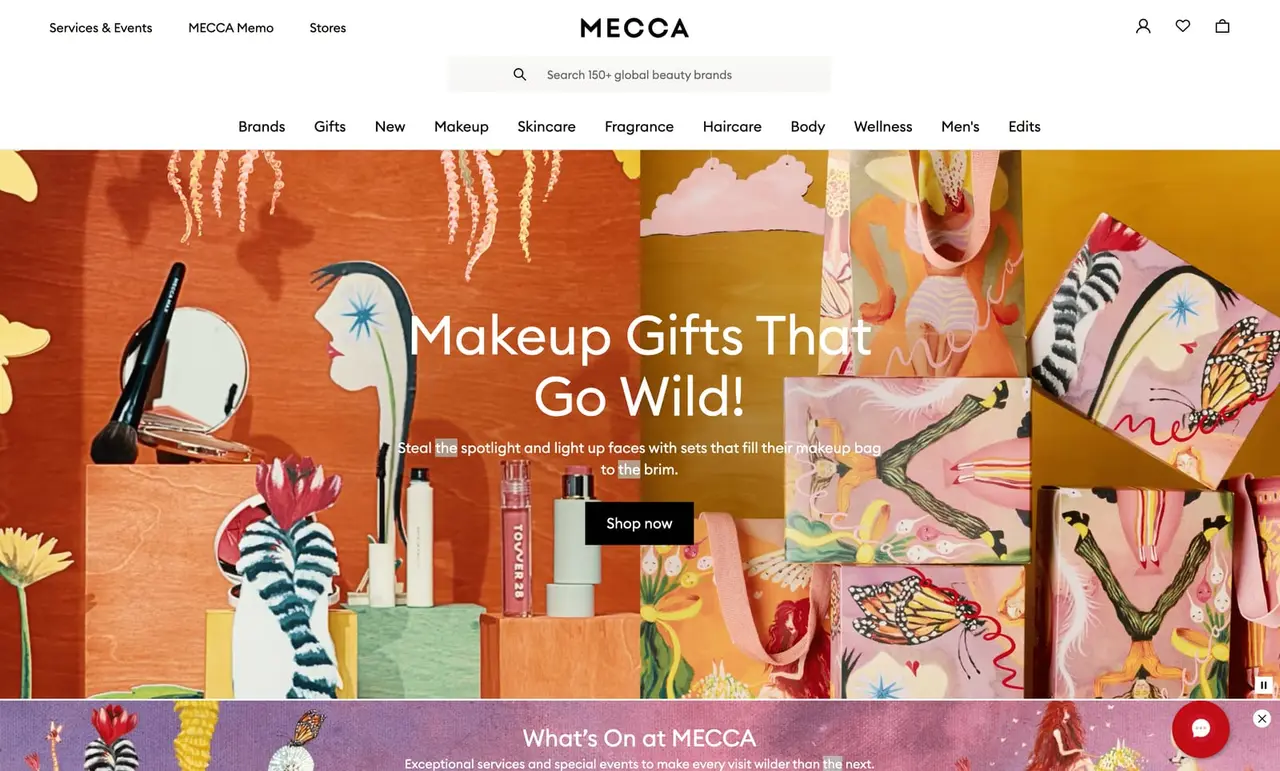
MECCA is particularly interesting because beauty is a category where AI-assisted shopping could become useful beyond simple product discovery.
Consumers often return to familiar products, compare shades, check ingredients or look for alternatives within brands they already trust. These are tasks that can potentially be delegated to an AI agent.
Barney Stacher, CEO of consultancy Retail OCD, told Inside Retail that reordering favourite beauty products is a relatively easy job for Muse. Sephora's participation in Muse in the US provides another example of beauty retailers exploring this channel.
For MECCA, joining Muse creates another potential route through which customers can discover its products and services.
For smaller beauty brands and independent Shopify merchants, the question is different: how can their products become visible to an AI agent when they do not have a direct connector partnership?
Source: Inside Retail Australia: Is Meta's Muse the next big shopping tool to take over retail?
How does Muse handle purchases?
Meta says Muse does not receive unrestricted authority to spend users' money.
According to Meta's explanation of its Australian launch, users must review and approve each purchase before Muse proceeds.
The system also separates permissions by application. Users decide which services Muse can access and what actions it can perform within those services. For example, permission to read emails does not automatically grant permission to send them.
This means the ability to perform a task and the authority to complete a transaction are treated differently.
Meta also says Muse can use one-time payment cards through Link by Stripe, helping keep users' actual card details separate from the agent.
Source: Meta Australia Policy: Muse does the work, you stay in control
Three layers of security behind Muse
Meta describes three important parts of Muse's security model.
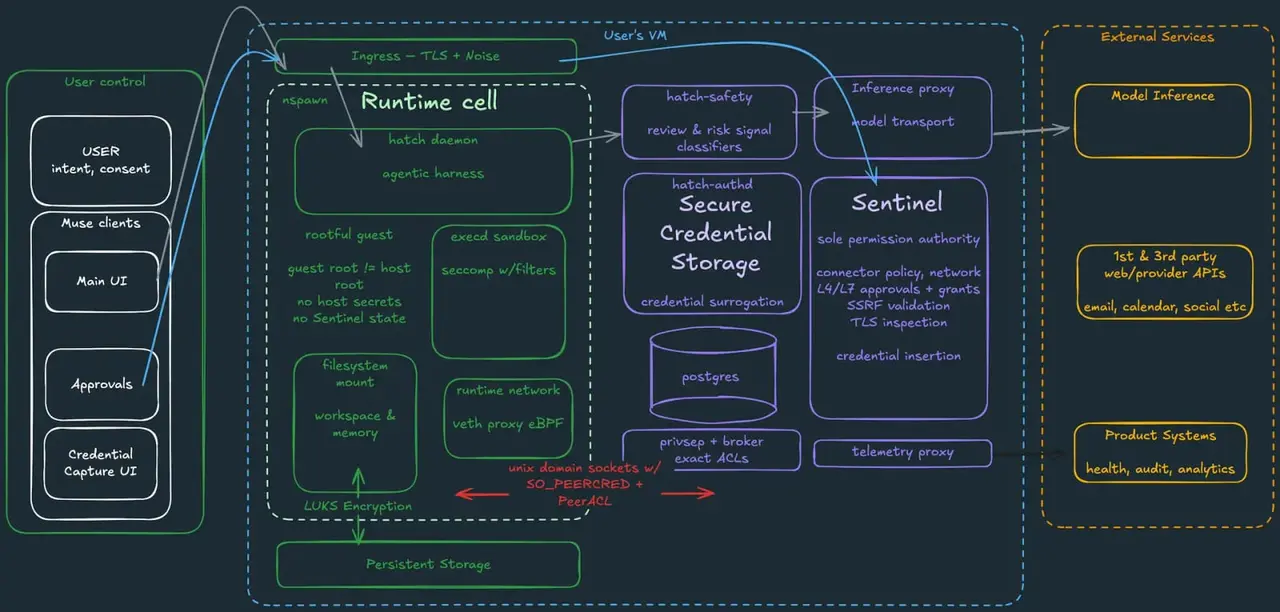
App-level permissions
Users choose which applications Muse can connect to and what actions it can perform. Permissions can be changed or revoked.
Purchase approval
Muse must show the proposed purchase and wait for user approval before completing it. This keeps the final purchase decision with the user.
Credential separation
Muse operates within a dedicated cloud environment called Muse Secure VM. Passwords and payment credentials are stored separately from the agent, preventing it from directly seeing these sensitive details.
Meta also uses Sentinel, a separate security agent designed to review actions and manage access to external services.
Sources: Meta's technical security explanation · Meta's original Muse announcement
Where does user control stop?
These safeguards address access and transaction security, but they do not give users complete control over the infrastructure behind Muse.
Meta may still access data stored in the virtual machine.
According to the technical analysis by FullStack, the current architecture relies partly on operational policies to restrict Meta employees' access to stored data. It does not technically make such access impossible.
Meta is developing Muse Confidential VM, which is intended to use encryption and user-held keys to prevent even Meta from accessing protected data.
Advertising separation is a policy commitment.
Meta says conversations and information stored in a user's VM are not shared with its advertising systems. However, this is a data-handling commitment rather than a technical guarantee that access is impossible.
Meta also acknowledges that browsing activity performed by Muse may indirectly influence the advertisements users see.
Sentinel cannot eliminate every security risk.
AI agents remain vulnerable to threats such as prompt injection. Reuters reported in September 2026 on a security vulnerability identified by an external researcher that could potentially expose sensitive information stored in a user's Muse virtual machine.
The incident does not establish that Sentinel itself was bypassed. It does show why security architecture should not be treated as a guarantee against every possible attack.
Sources: FullStack's technical analysis · Reuters report
What this means for retailers and Shopify sellers
Muse's Australian launch is more than another AI product announcement. It introduces another potential discovery and shopping channel connecting consumers with retailers through an AI agent.
Large retailers such as MECCA have direct connector relationships with Meta. Smaller merchants may not have the same opportunity to negotiate individual integrations.
Shopify VP Product Mani Fazeli has said that Shopify Catalog automatically distributes merchants' product data to personal agents, including Muse. However, there is not yet clear confirmation that the same product discovery mechanism operates in Australia under the same conditions.
This leaves an important question for independent merchants: can Muse discover their products through accessible product data, or will direct partnerships become an increasingly important advantage?
For Shopify sellers targeting Australia, product data deserves attention. Accurate titles, descriptions, prices, availability and product attributes make it easier for AI systems to understand what a store sells and determine whether a product matches a shopper's request.
But better product data should not be confused with guaranteed visibility in Muse. The Australian rollout still needs to establish how non-partner merchants are discovered and represented.
The bigger development is not simply that Meta has launched another AI assistant. It is that AI agents are beginning to sit between consumers and retailers, creating a new layer in product discovery, shopping and customer relationships.
Ask AI next
- What concrete steps should independent Shopify merchants take to optimize their product feeds for discovery by Muse?
- What feed format does Muse use to read Shopify Catalog data, and is there a public spec?
- Which other countries might see Muse launch next, and is there any announced timeline for further international rollout?
- Why can't Meta access data today, and how will Muse Confidential VM's encryption change that?
- How can a merchant track sales or traffic that come specifically from Muse?