All stories · Article
Meta brings Muse to the UK, pushing AI agents into the Black Friday shopping race
Meta has brought its personal AI agent, Muse, to the UK, connecting it with 14 British retail and service brands, including Sainsbury's, Argos, Marks & Spencer and ASOS.
Share: WhatsApp · Telegram · X · Facebook · LinkedIn · Email

The launch marks another step in Meta's effort to turn AI from a tool that answers questions into an assistant that can take action across apps, websites and everyday services.

The timing is deliberate. With Black Friday falling on November 27, Meta is entering one of the year's biggest shopping periods with an AI agent designed to search for products, build shopping baskets and help complete purchases.
The move comes as Walmart also opens its Black Friday deals to Muse in the US. Together, the launches signal a broader shift: AI platforms are beginning to compete for a place in the actual purchasing process, not just product discovery.
Muse arrives in the UK with 14 retail and service partners
On November 23, 2026, Meta announced that Muse was available to UK users aged 18 and above through iOS, Android, muse.ai and WhatsApp.
The UK launch includes 14 retail and service partners:
- Marks & Spencer
- Debenhams Group
- Currys
- Ocado Retail
- Trainline
- Argos
- Sainsbury's
- ASOS
- Jet2
- LOOKFANTASTIC
- Myprotein
- JustPark
- easyJet
- JD Sports
Muse is built to handle tasks rather than simply respond to prompts. Users can give it a goal, connect relevant services and let it work across websites and applications to complete the task.
For example, users can ask Muse to:
- Find products and compare available options.
- Build a grocery basket around a budget or meal plan.
- Organize holiday shopping and gift lists.
- Book travel, manage calendars or send emails.
- Complete multi-step tasks that require navigating websites and filling out forms.
Some partners allow users to connect their personal accounts, while others let Muse navigate their websites directly.
Sainsbury's illustrates how this works in practice. Customers can ask Muse to plan their weekly grocery shopping, find Aldi Price Match products, apply Nectar Prices and identify relevant promotions. Muse can also help customers shop for Tu clothing through Tu.co.uk.
Importantly, customers remain in control. They can review their basket and total before placing an order. Every purchase goes through Sainsbury's own checkout, with its usual order confirmation and customer service.
Meta says Muse can continue working on longer tasks after users close the app, returning when it needs approval or when something changes.
Source: Meta Newsroom: Introducing Muse in the UK | Sainsbury's: Muse gives customers more choice
Walmart brings Muse into its Black Friday shopping experience
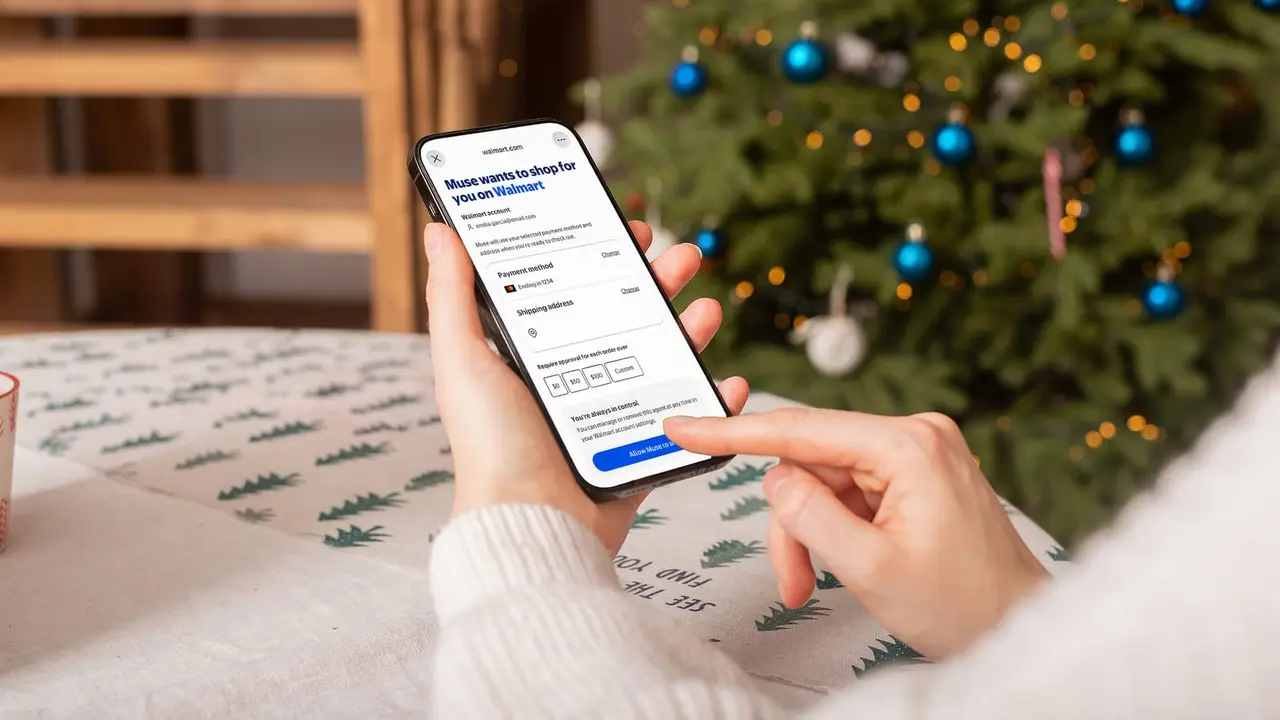
The UK launch is part of a wider push to make Muse a shopping assistant.
On November 24, Walmart announced that US customers could shop its Black Friday deals directly through Muse. The integration runs on Walmart Agent Gateway, a system designed to connect external AI agents to Walmart's retail infrastructure.
The experience allows shoppers to describe what they want and let Muse find relevant products, build a basket and help complete the purchase.
The process has three main steps:
- Describe the request: Ask Muse to find a specific product or identify Black Friday deals, such as a television under $500.
- Set shopping permissions: Connect a Walmart account and create an Agent Profile with a spending limit.
- Review and purchase: Complete the transaction within the Muse conversation using a payment card saved to the Walmart account.
Walmart says customers can approve purchases, set spending limits and review their agent's purchase history. The retailer also says the integration does not share customers' broader purchase history with other parties.
This is an important distinction from traditional AI-powered product recommendations. Muse is no longer simply directing shoppers to Walmart's website. Through Agent Gateway, it can participate in the purchasing process itself.
Walmart says Agent Gateway will support additional apps and AI agents in the future.
The approach also highlights a growing divide in how retailers view agentic commerce. Some are opening controlled connections to external AI agents, while others are more restrictive. The BBC reported that Amazon had blocked Muse from its marketplace, with the agent unable to complete a product search during its testing.
Sources: Walmart: Meta's Muse can now shop Black Friday deals | BBC: Helpful but awkward, a week with Meta's Muse
Meta wants AI agents to become a new shopping interface
The significance of Muse's UK launch goes beyond adding shopping features to an AI assistant.
Traditional e-commerce requires consumers to move between retailer websites, search product catalogs, compare prices and complete checkout themselves. AI agents aim to consolidate more of that journey into a single conversation.
A shopper could describe a budget, a product requirement or a Christmas shopping list. The agent can then search for suitable products, compare options and build a basket.
This changes the role of AI in commerce.
From search to action: Instead of simply recommending products, an agent can interact with retailer systems and help execute a purchase.
From individual websites to connected services: Consumers can access multiple brands and services through one assistant instead of navigating each platform separately.
From occasional queries to ongoing assistance: Because Muse can work across email, calendars, travel services and shopping platforms, Meta wants users to rely on it for more than one-off questions.
For Meta, this creates a new reason for people to return to its AI ecosystem. Shopping is particularly valuable because it connects user engagement with commercial transactions.
The company has also indicated that more brands will join the Muse ecosystem, with PayPal among the partners expected to arrive in the future.
Consumer trust remains the biggest obstacle
The technology may be moving quickly, but consumer willingness to let AI spend money is developing more slowly.
According to Visa's UK research published on November 19, 2026, 77% of surveyed UK consumers use generative AI, yet only 10% feel comfortable sharing financial information with AI assistants.
The research also found:
| Consumer activity | Willingness to let AI handle it |
|---|---|
| Plan a holiday | 38% |
| Order regularly purchased household items | 27% |
| Manage investments | 15% |
| Plan retirement | 14% |
| Handle taxes | 10% |
The survey covered 1,019 UK consumers, with responses collected between July 7 and 9, 2026.
The figures reveal a clear distinction: consumers are more comfortable using AI to research and organize tasks than giving it access to financial information or purchasing authority.
Meta says Muse asks for user approval before important actions, including purchases. It also says Muse cannot access users' passwords or payment credentials, and conversations with the assistant are not shared with Meta's advertising systems.
However, independent testing has highlighted practical limitations.
In a week-long test published by the BBC on November 24, technology editor Zoe Kleinman described Muse as useful but occasionally awkward. The assistant struggled with some tasks, produced socially inappropriate message suggestions and sometimes repeated interactions unnecessarily. It also required frequent user approvals, which could make complex tasks less seamless.
The findings illustrate a central challenge for AI agents: being able to perform a task technically does not guarantee that the experience will be reliable or convenient enough for people to trust.
Sources: Visa UK research | BBC's hands-on review
UK regulators are already watching the rollout
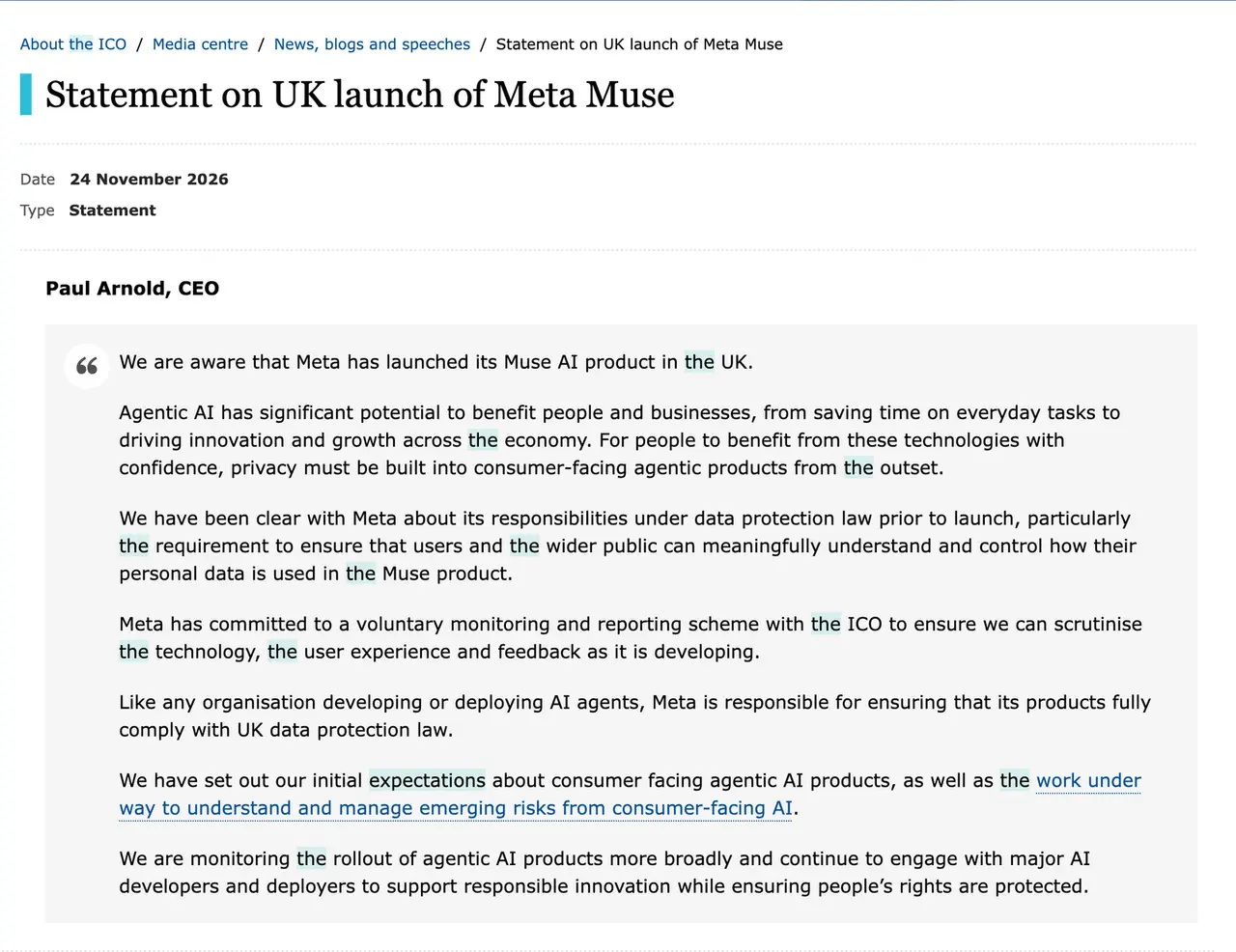
Privacy and consumer protection are also part of the UK's early response to Muse.
On November 24, the Information Commissioner's Office (ICO) said it had already made Meta aware of its responsibilities under UK data protection law before the launch.
Meta has committed to a voluntary monitoring and reporting scheme with the ICO. This will allow the regulator to scrutinize the technology, user experience and feedback as the product develops.
The ICO emphasized that privacy must be built into consumer-facing AI agents from the beginning, particularly when these systems can access personal information and act across connected services.
This matters because Muse is designed to work with sensitive parts of everyday life, including email, calendars, travel accounts and shopping services.
Meta says users can choose which services to connect, control the level of access granted, review the agent's actions and decide whether their interactions can be used to train Meta's AI models.
But the broader question is whether those controls will remain clear and effective as AI agents become more autonomous and connected to more services.
Source: UK ICO: Statement on the launch of Meta Muse
Black Friday will be an early test of agentic commerce
Muse's UK launch arrives just days before Black Friday on November 27, giving Meta an immediate opportunity to test whether consumers are ready to use AI agents for real purchases.
Walmart's integration shows how that experience could work: shoppers describe what they need, Muse finds suitable products, builds a basket and helps complete the transaction.
But a large partner network does not automatically translate into meaningful sales.
For agentic commerce to become a regular shopping behavior, three conditions need to come together:
- Reliable execution: Agents must find the right products, display accurate information and complete tasks without repeated errors.
- Consumer control: Shoppers need clear permission settings, spending limits and visibility into what the agent is doing.
- Retailer participation: Brands must decide how much access external AI agents receive and whether they are willing to let them participate in checkout.
Meta has secured recognizable retail partners and connected Muse to real purchasing infrastructure. The next challenge is turning that technical capability into consumer confidence and repeat usage.
Black Friday may not prove that AI shopping has become mainstream. But it will provide an early indication of whether consumers are ready to move from asking AI what to buy to letting AI help them buy it.
Ask AI next
- How can a Shopify or D2C merchant get listed as a partner in Meta's Muse or Walmart's Agent Gateway?
- What technical standard powers Walmart's Agent Gateway, and can other merchants adopt it?
- How can a merchant check if AI agents like Muse are already visiting or buying from their store?
- Besides Meta's Muse and Walmart, which other AI agents currently support end-to-end checkout for online stores?
- What signals indicate agentic commerce is shifting from pilot programs to mainstream adoption?