All stories · Article
Meta's Creative diversity score: why different visuals matter more than more ads
Meta has added a Creative diversity column to Ads Manager, rating ad sets High, Medium or Low based on how similar their images and video thumbnails look.
Share: WhatsApp · Telegram · X · Facebook · LinkedIn · Email

For advertisers running multiple creative variations, the new column offers another way to look at how Meta evaluates creative diversity: a higher number of ads does not necessarily mean a greater number of distinct visual concepts.
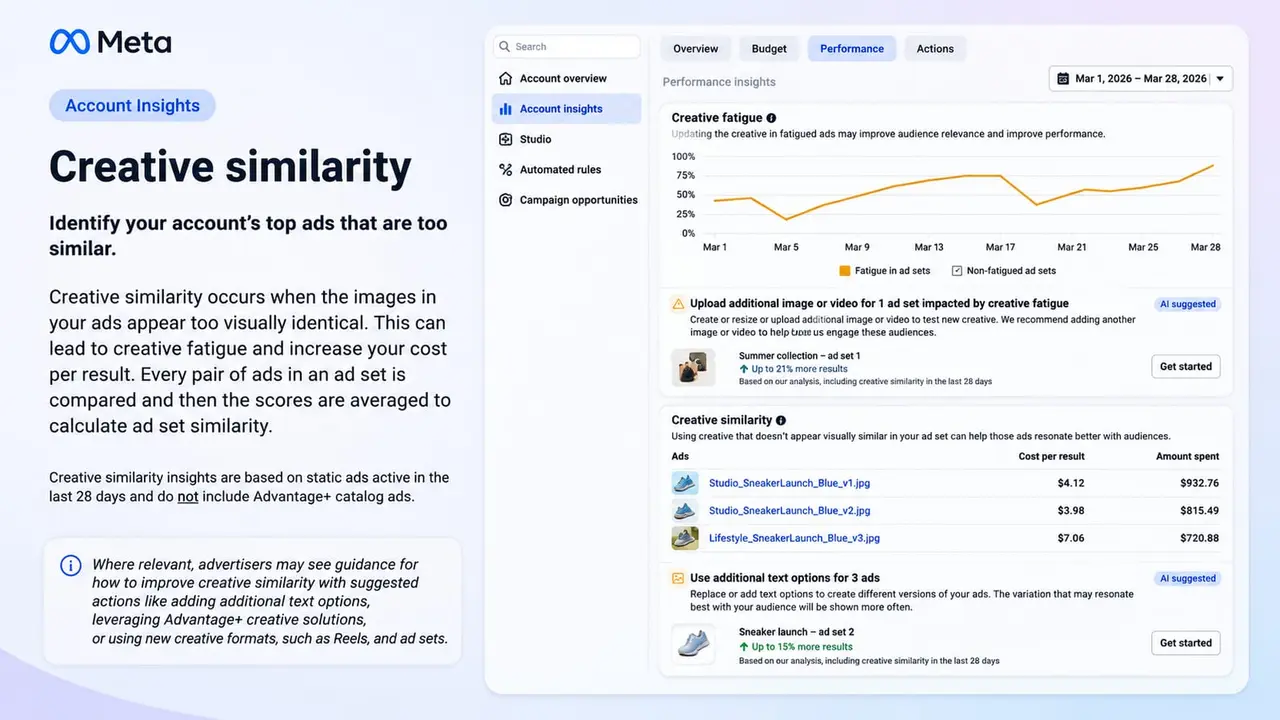
Low measures visual similarity, not advertising performance. Meta labels the metric "estimated and in development", and has not confirmed that it affects ad delivery or costs.
The right response is to review the visuals, check actual performance and introduce genuinely different creative concepts where needed. There is no reason to switch off a winning ad just to improve a label.
What is Meta actually comparing?
Imagine an ad set with ten ads promoting the same product. Five use the same product photo with different headlines. Three use the same creator and opening scene, but different scripts. The remaining two use slightly different crops of the original image.
You may see ten separate ads. Meta may see very little visual variety.
The new Creative diversity column compares the images and video thumbnails within the same ad set, measures their similarity and assigns one of three labels:
- High: The images and thumbnails are visually varied.
- Medium: Some creatives look similar.
- Low: The images and thumbnails look very similar.
Meta does not publish the thresholds behind these labels.
To find the column, open Ads Manager, go to Columns → Customize columns, search for "Creative diversity" and add it to your reporting view. The metric is available at the campaign and ad set levels.
This distinction matters because changing a headline, primary text or CTA does not necessarily create a visually different ad. If the underlying image remains the same, the variation may still look identical to the metric.
The same question applies to video. Different scripts do not automatically mean different thumbnails. If several videos use similar opening visuals, they may still contribute to a Low rating.
Source: Meta Business Help Center, Creative diversity, as quoted and examined by Davide Cosmai, November 22, 2026.
Does a Low rating affect reach or advertising costs?
There is no confirmed evidence that it does.
Meta describes Creative diversity as an estimated metric that is still in development. Its stated purpose is to help determine whether an ad set needs more varied images and videos to prevent creative fatigue and improve performance.
However, Meta has not published the scoring thresholds or confirmed that a Low rating directly reduces reach, increases CPM or raises CPA.
This distinction is important. A metric that identifies visual similarity is not automatically a measure of campaign effectiveness.
Meta's broader guidance on in-development metrics also advises advertisers to use them for directional insights, with caution around strategic planning and important business decisions. Meta for Developers: Estimated and in-development metrics.
Early advertiser observations reinforce the need for caution. MarketingConcurrent reported that some ad sets containing a mix of static images, videos and UGC still received Low ratings. Search Engine Land also documented similar cases, suggesting that the metric may be stricter than advertisers expect.
These are practitioner observations, not proof of a delivery penalty.
Sources: MarketingConcurrent, Search Engine Land.
What should you do with a Low-rated ad set this Black Friday?

The goal is not to turn every Low rating into High. It is to identify whether your ad set relies too heavily on the same visual idea, then decide whether that is affecting performance.
Here is a practical order of operations.
1. Start with the ad sets spending the most money.
Add the Creative diversity column and sort your ad sets by spend. Focus on the highest-spending sets marked Low.
Review the rating alongside CPA, CTR, frequency and conversion trends. A Low rating with stable acquisition costs is not an urgent problem. A Low rating accompanied by rising frequency and deteriorating CPA deserves closer attention.
2. Count genuinely different visual concepts.
Look beyond the number of ads in your account.
Ask:
- How many genuinely different product images are being used?
- Are several videos built around the same creator, setting and opening shot?
- Are you changing the visual concept, or simply changing the headline and text?
A new format alone does not guarantee diversity. A static image and a video can still look similar if they use the same product shot and visual composition.
3. Add a different visual idea, not another cosmetic variation.
If performance indicators suggest creative fatigue, introduce one or two genuinely different executions of the concept that is already selling.
For example:
- Replace another studio product shot with a lifestyle scene.
- Show the product being used rather than simply displaying it.
- Introduce a customer testimonial or UGC perspective.
- Use a different creator, setting or product demonstration.
- Explore a different visual angle while keeping the proven offer.
Keep the original winning ad running while testing the new creative. Do not replace a profitable ad simply because its diversity label is Low.
4. Avoid producing variations just to chase a higher score.
More ads do not automatically mean more creative diversity.
Generating dozens of AI variations of the same image can increase production volume without giving customers a genuinely different reason to engage. It can also weaken brand consistency.
The objective is to give Meta meaningfully different visual concepts to work with, not to fill the ad set with near-identical assets.
For further context, see Meta's explanation of creative diversification and Andromeda.
Looking similar is not the same as selling badly
Creative diversity and advertising performance answer two different questions.
- Creative diversity: How similar do the ads in this ad set look?
- CPA and conversion data: How much does it cost to acquire customers, and are the ads generating sales?
- Frequency: How often are people seeing the ads?
A Low rating is a reason to inspect your creative mix, not a reason to switch off an ad that is still delivering results.
This Black Friday, prioritize what the numbers say about sales. Improve visual variety where it makes sense, but do not let an experimental label dictate your campaign decisions.
Ask AI next
- What signs would suggest Meta plans to tie the Creative diversity score to ad delivery or costs in the future?
- How can advertisers identify which specific ads within an ad set are pulling the Creative diversity rating down?
- What technical method does Meta likely use to measure visual similarity across images and video thumbnails?
- Is Meta rolling out the Creative diversity score to all advertisers and ad account types at the same time?
- What tools can advertisers use to automatically check creative similarity before launching new ad variations?