All stories · Case study
Montana Knife Company is skipping Black Friday discounts. Here’s what other Shopify stores can learn
A $4 million sales target, four emails per product drop and no price cuts. Montana Knife Company is betting that product demand can do what discounts usually do. But most stores cannot copy the strategy without first building the same conditions.
Share: WhatsApp · Telegram · X · Facebook · LinkedIn · Email

Montana Knife Company is heading into Black Friday 2026 without discounting a single knife. Instead, the US knife brand is using product drops, customer-specific launches and an aggressive email schedule to drive purchases.
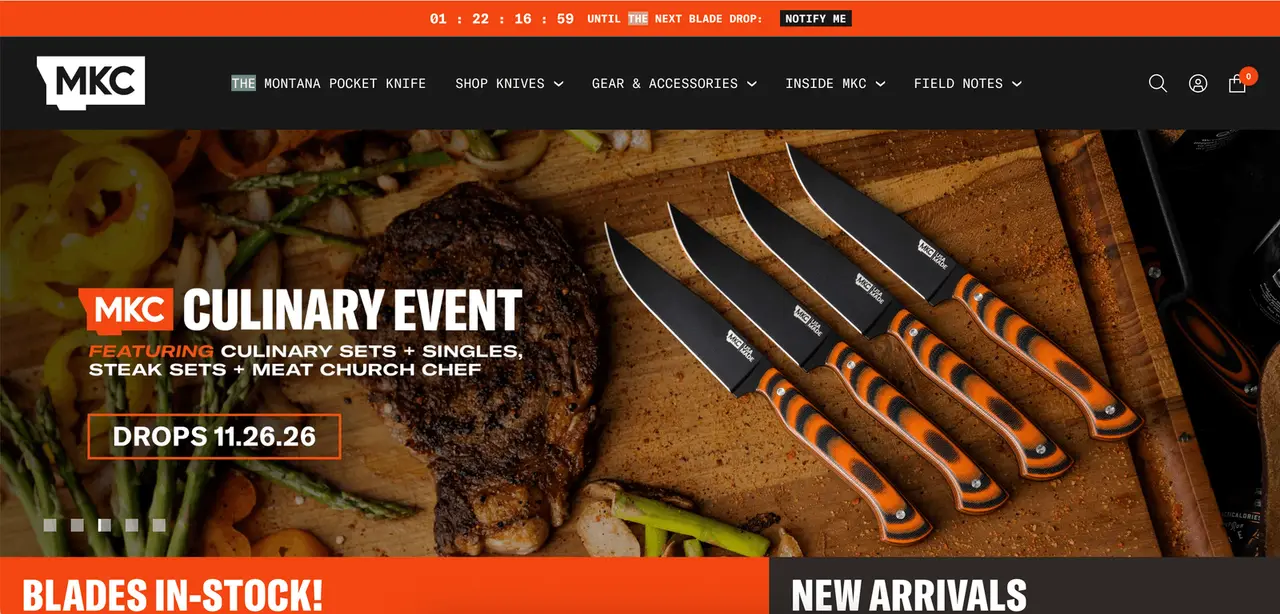
The strategy raises a question for Shopify merchants: Can a store sell through Black Friday without offering 30% or 40% off?
The answer depends on what gives customers a reason to buy now. For MKC, that reason is product scarcity and an audience already familiar with its launch model. For other stores, the financial case against deep discounts is worth examining first.
Montana Knife Company is selling at full price throughout Black Friday
On November 24, 2026, Kurt Elster, founder of Shopify agency Ethercycle, published an episode of The Unofficial Shopify Podcast featuring Brandon Horoho, co-founder and CMO of Montana Knife Company.
The episode outlined MKC's Black Friday and Cyber Monday strategy:
- No knife discounts: Every product remains at its regular price.
- One drop per customer group: Different product launches are scheduled throughout Black Friday week.
- Four emails on drop day: Subscribers receive four messages before the product goes live.
- A plain-text onboarding email: New subscribers are taught how the drop system works.
- Three more weeks of activity: The campaign continues beyond Black Friday with additional product drops.
The financial target is ambitious. Brandon set a goal of generating $4 million over four days.
For context, MKC reported $1.7 million in sales over Black Friday weekend in 2025 without discounting its knives.
These figures need to be distinguished: $1.7 million is a reported past result, while $4 million is a target for this year's campaign, not confirmed revenue.
There is also an important disclosure. Ethercycle is an MKC client, and Kurt's team built the landing page for the brand's folding knife, The Montana. The podcast is therefore a useful first-hand account, but not an independent assessment of MKC's performance.
Source: The Unofficial Shopify Podcast, MKC's BFCM Plan: Drops, Not Discounts
What does MKC have that most stores do not?
The most important part of MKC's strategy is not the decision to avoid discounts. It is the demand behind that decision.
Brandon describes a business where product restocking can be harder than launching something new. MKC has built an audience that understands its drop system and knows that products may sell out before the next release.
Three conditions help explain why the strategy works.
1. Customers already understand the buying process.
MKC does not need to introduce the concept of limited product drops from scratch. Its existing customers know when launches happen and how to buy.
The company even sends a plain-text email to explain the process to new subscribers.
2. New products give customers a reason to return.
Instead of repeatedly promoting the same products with lower prices, MKC schedules different drops for different customer groups.
Each launch creates another purchase opportunity without requiring a storewide markdown.
3. Demand can exceed available inventory.
MKC's business model is built around limited production and frequent sellouts. Its official FAQ explains that most knives are released in limited quantities, with new drops typically happening every few weeks or months for individual models.
Source: Montana Knife Company FAQ
This creates an important distinction.
A store with more customers than available inventory has little reason to lower prices to stimulate demand. A store with excess inventory and weak demand is in a very different position.
The lesson is not that every Shopify store should stop discounting. It is that a brand needs an alternative source of purchase urgency before removing the price incentive.
A 40% Black Friday discount can cost much more than 40% of your profit

For stores that do not have MKC's level of demand, there is still a strong reason to reconsider blanket discounts: the impact on contribution margin.
Consider a product selling for €370.
In a calculation shared by an ecommerce operator, a 40% discount reduces the contribution left per order from €170 to just €22.
| Scenario | Revenue | Contribution per order |
|---|---|---|
| Full price | €370 | €170 |
| 20% discount | €296 | €96 |
| 40% discount | €222 | €22 |
<em>Illustrative calculation based on the figures shared by @ctomecom. The example assumes the same €200 in underlying costs per order.</em>
<em>Chart takeaway: A 40% price cut reduces contribution from €170 to €22, a decline of approximately 87%.</em>
Why does the impact become so severe?
Because many costs do not fall when the selling price falls:
- Product manufacturing or purchasing costs remain largely unchanged.
- Shipping and fulfillment still need to be paid.
- Payment processing fees may decrease slightly, but do not disappear.
- Advertising costs do not automatically decline with the product price.
The store therefore has less money left to cover customer acquisition and operating expenses.
This is particularly important for merchants relying heavily on paid advertising. A campaign that looks profitable at full price may become unprofitable after a discount, even if order volume increases.
Additional industry data supports the need to calculate beyond revenue.
In its analysis of more than 1,900 stores and 413,000 orders during BFCM 2025, AdScale found that order-level discounts represented 14.2% of gross sales during BFCM, compared with 6.8% in October. Average order value was also 3.3% lower.
The data does not establish that discounts caused a decline in profit. It does show how much more revenue was being absorbed by promotions during the peak shopping period.
Additional source: AdScale, Black Friday Break-Even ROAS Analysis, November 3, 2026
A deeper discount also raises the advertising return required to break even. Sellers should calculate their break-even ROAS using the actual revenue remaining after discounts and variable order costs, rather than relying on their usual ROAS target.
Stores that keep their prices need to replace the discount with something else
MKC is not the only brand experimenting with alternatives to percentage-based promotions.
Several businesses are giving customers a different reason to purchase during Black Friday.
Fayt: Replace discounts with a $100,000 prize campaign
Australian fashion brand Fayt launched Change Your Fayt, a campaign offering $100,000 in prizes instead of its usual Black Friday promotion.
The prizes include a $50,000 cash grand prize, 30 additional $1,000 cash prizes and store gift cards.
The structure gives customers a purchase incentive without reducing every product's selling price. However, whether the campaign will be more profitable than a traditional sale remains to be seen.
Sources: Inside Retail | Fayt official campaign FAQ
Pest2Kill: Turn a $50 discount into a $50 donation
Australian pest control company Pest2Kill replaced its usual $50 Black Friday discount with a $50 donation to Women's Community Shelters for every eligible residential booking.
The company said the donation costs it approximately the same as the discount it would otherwise have offered.
This gives customers a reason to choose the brand while connecting the purchase to a charitable cause.
Source: SmartCompany, Black Friday Fatigue: Why Some Small Businesses Are Ditching the Discounts
Mia Fratino: Sell one product for a cause
Australian cashmere label Mia Fratino has traditionally closed its online store during Black Friday and Cyber Monday.
For 2026, the brand is making an exception by offering one special product from November 27 to 30, with 100% of its profits going to the Mia Fratino Foundation.
Source: Mia Fratino, A Different Kind of Black Friday
These examples use different approaches, but they share one principle: customers receive a reason to purchase that does not depend entirely on a lower product price.
The economics are different for each approach. A giveaway has a fixed prize budget, a donation has a per-order cost, and a free gift has a product and fulfillment cost. None should be treated as free marketing.
More emails do not automatically mean better email marketing
MKC's four-email drop-day sequence may look aggressive to other Shopify merchants. But the strategy needs to be understood alongside the brand's existing email relationship with customers.
Kurt Elster also shared advice from email expert Jimmy Kim, who warned against suddenly multiplying email volume by two or three times during the week before Black Friday.
These recommendations are not necessarily contradictory.
MKC has an established drop model. Its subscribers receive frequent product announcements and understand why those messages arrive. A store that normally sends one email a week cannot necessarily switch to four emails a day without consequences.
Google's official email sender guidelines recommend increasing sending volume gradually, avoiding sudden spikes and maintaining a consistent sending rate.
Google recommends keeping the spam complaint rate below 0.1% and avoiding rates of 0.3% or higher.
Sources: Jimmy Kim's BFCM email recommendations, via Ethercycle | Google Email Sender Guidelines
The practical distinction is between a high sending frequency that subscribers expect and a sudden increase that surprises an unprepared audience.
Sending more emails is not a strategy on its own. Each message needs a reason to exist, and the audience needs to be prepared to receive it.
Before choosing your Cyber Monday offer, check these three things
Most Shopify stores do not have MKC's product scarcity, demand or established customer behavior. That does not mean they must automatically offer 30% or 40% off.
It means they need to identify which alternative can generate purchases at the lowest cost to their margins.
Check 1: Are customers already waiting for your products?
Look at sell-through rates, waitlists, back-in-stock signups and repeat purchase behavior.
If demand consistently exceeds available inventory, a discount may be unnecessary. If inventory is sitting unsold, the MKC approach may not translate to your store.
Check 2: Can you give customers another reason to buy now?
Consider a product launch, limited bundle, gift with purchase, loyalty reward or charitable contribution.
Calculate the actual cost of each incentive. A free gift is not automatically cheaper than a discount, especially when additional shipping or fulfillment is involved.
Check 3: Is your email audience prepared for more frequent messages?
Review your historical sending frequency, engagement, unsubscribe rate and spam complaint rate.
If you want to increase email volume for BFCM, start preparing your audience before the peak period instead of suddenly increasing sends at the last minute.
One calculation to make before Cyber Monday
Take your best-selling product and calculate how much contribution remains per order at each proposed discount.
Contribution per order = Net revenue after discount − Variable order costs
Include product cost, shipping, fulfillment, packaging, payment fees and any other costs that change with the order.
Then compare that figure with your advertising cost per order.
If a promotion leaves too little contribution to cover acquisition costs, generating more orders may simply mean losing money faster.
The right Black Friday strategy is not necessarily the one that generates the most revenue. It is the one that gives customers a compelling reason to buy while leaving enough money in the business to make those sales worthwhile.
Ask AI next
- What's a step-by-step way to calculate break-even ROAS for a planned Cyber Monday discount?
- What's a low-cost discount alternative for a small store without MKC's built-in demand?
- Beyond the US and Australian examples mentioned, is the shift away from Black Friday discounts spreading elsewhere?
- What tools can automatically calculate per-order contribution margin for BFCM planning?
- When will Montana Knife Company disclose whether it actually hit its $4 million Black Friday target?