All stories · Article
To find out why customers return items, read the notes
A return-reasons chart can be accurate for months and still leave a store with nothing to fix.
Share: WhatsApp · Telegram · X · Facebook · LinkedIn · Email
At one women's activewear brand, the chart said the same thing every quarter: mostly "size too small" and "changed my mind." It took someone reading what customers typed in the comment box, then a call to the factory, for the brand to learn that the pattern had changed in a new production run and nobody had told them.
A reason dropdown on a return form tends to lump different problems into the same bucket. You can see the type of problem, but not where to look.
In late September and mid-October 2026, an agency that builds automations for ecommerce brands and a clothing seller each told this story on r/ecommerce. Both found their lead in the customer notes.
Since January 2026, Shopify has suggested return reasons based on product type. A more detailed dropdown still doesn't replace reading what customers write themselves, whether that's a note in the returns app or an email to support.
"Size too small" is accurate, but not enough to act on
The activewear brand in the agency's story assumed its return rate was simply what apparel does. It used a returns app with a reason dropdown and a comment box, and the founder looked at the reasons chart roughly once a quarter.
While automating the brand's exchanges, the agency pulled about five months of comments plus the support emails about returns, none of which anyone had read, and grouped them by product and variant.
On one best-selling top, there was a whole cluster of notes from repeat buyers, along the lines of "tighter than my last one" or "my usual M doesn't fit anymore." These customers had ordered their usual size and it didn't fit. The founder called the factory and found out the pattern had changed starting with the spring run. The size chart on the website still reflected the old measurements, so anyone who trusted it picked the wrong size.
The agency's verdict on "size too small" was that it was "accurate, and completely useless," because it didn't say which run or why. The reason a customer picks tells you the category of problem. The words they write point to what to check.
At the activewear brand, a large share of the "changed my mind" notes said the color looked nothing like the photos, and most of them were about one sage shade. The photographer had warmed up the images, so on the website the color read as green, while in person it was closer to gray. The brand reshot that color outdoors on an overcast day.
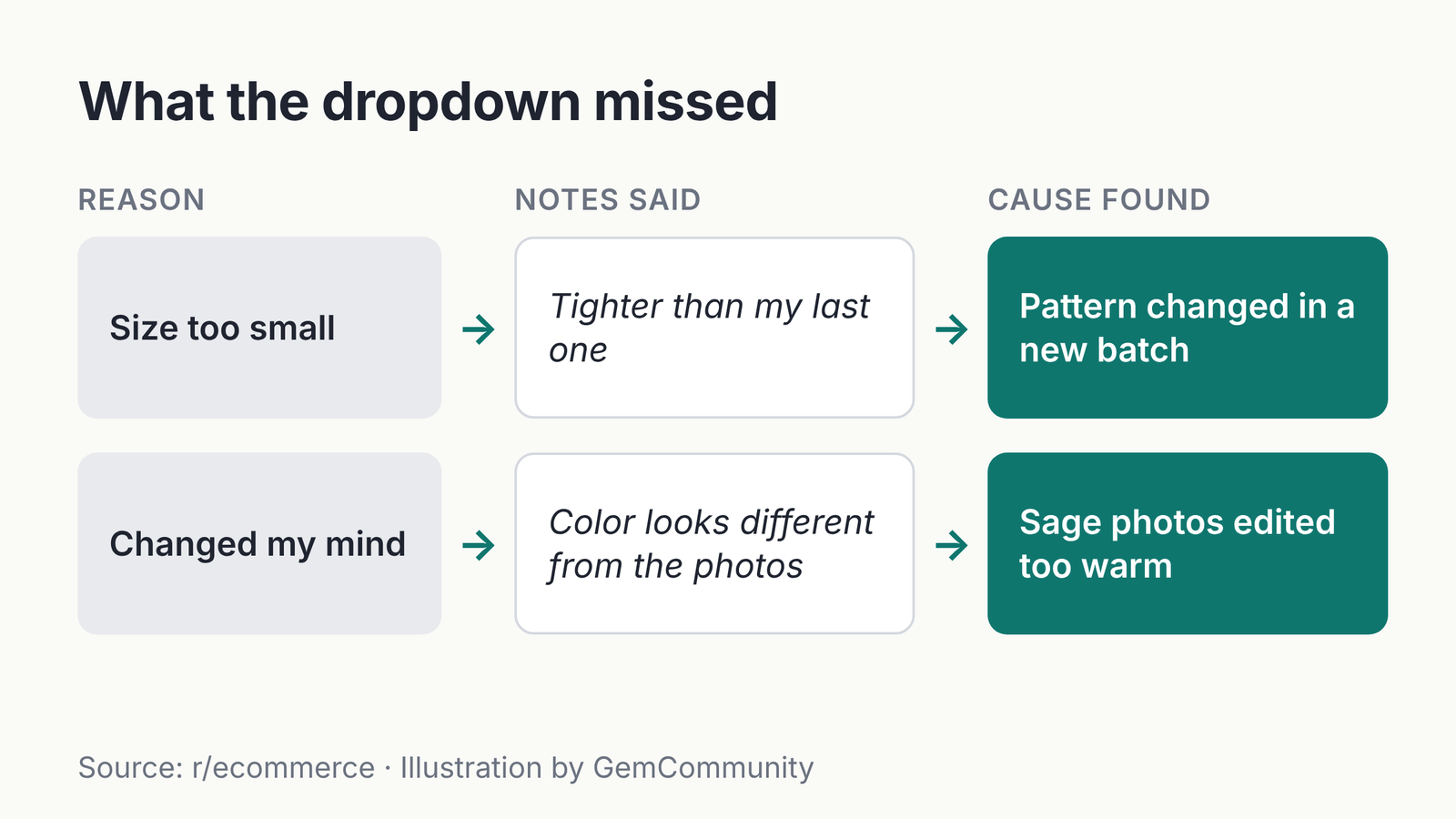
A more detailed dropdown can still lump several problems together
With Shopify's change, when you process a return you'll see reasons suggested for the product type instead of a generic list, such as Too big or Too small for clothing. The feature is on automatically with no setup, and customers see the same options when they request a return themselves (self-serve returns) or through the Shop app.
Even so, we'd argue "Too small" is the same kind of answer as "size too small" at the activewear brand. It names the right category, but not the run or the detail. The announcement also lists only a few example reasons. It doesn't say whether there's a separate option for a cut that looks different from the photos, and it doesn't mention the comment box.
The clothing seller's form shows the lumping more clearly. It had a "did not fit" option but no separate option for a cut that looked different from the photos, so several kinds of complaints landed in one place. Reading the notes, the seller found three different kinds of complaints, and each one pointed to a different thing to check:
| What customers wrote in the note | What to check |
|---|---|
| The garment was too tight | Measurements and size chart |
| They expected an oversized cut from the photos | Product photos and description |
| A tight sleeve or a troublesome zip, even though the overall shape was fine | Product design and quality |
Notes as described by the clothing seller on r/ecommerce. The "What to check" column is our suggestion, based on how the seller handled each group.
In other words, if you only count how often customers pick "did not fit," you won't know where to start looking. The three groups aren't clean either, because a sleeve complaint can be both a sizing issue and a design issue.
How to read return notes to find what to check
Reading notes takes effort, but returns aren't cheap either. In a thread asking what brought return rates down, one r/ecommerce member pointed out that each return usually costs more than the refund, between return shipping, handling, and items that can't be resold. At the activewear brand, the fixes turned out to be within the brand's reach: updating a size chart, reshooting one color.
Return notes are messy, full of typos and half-finished sentences, and the agency argues this is exactly the kind of data AI sorts well. The clothing seller also used an AI tool for a first grouping, but removed customer details beforehand and reviewed the draft table by hand.
When you read the results, don't jump to conclusions either.
The clothing seller filed "runs small" notes under sizing as a reason to recheck the measurements, not as proof the size chart was wrong. Notes about the zip went to product inspection.
The chart tells you the category, the notes tell you where to look
Next time the chart says "size too small" or "changed my mind" like it does every quarter, try filtering the returns with that reason by product and variant, then read the notes from the group that stands out most.