All stories · Hot News
OpenAI launches GPT-6.2: What Astra and Sol mean for Ecommerce
OpenAI launched GPT-6.2 Astra and GPT-6.2 Sol on November 17, introducing two models designed for different types of work. Astra targets complex professional tasks, while Sol is built for everyday workflows.
Share: WhatsApp · Telegram · X · Facebook · LinkedIn · Email

OpenAI@OpenAISome of you have been asking very politely. Some of you have just been asking.
GPT-6.2 Astra and Sol are now available.
Super efficient and built to perform where it counts—the real world.
https://t.co/qr2iP0GpfX https://t.co/jLCyVIws2YNov 17, 2026 · View on X
The release brings stronger benchmark results, lower costs for certain workloads, and improvements in how AI handles complex tasks. But for ecommerce businesses using AI to create marketing content, another question matters just as much: can these models follow a brand's voice consistently?
Here's what changed, what early users are saying, and what Shopify sellers should consider before switching.
GPT-6.2 Astra and Sol: Two models for different workloads
OpenAI is positioning the two models around different needs:
| Model | Primary focus | Intended use |
|---|---|---|
| GPT-6.2 Astra | Complex professional work | Scientific research, legal work, coding, spreadsheets, documents, and advanced design |
| GPT-6.2 Sol | Everyday work | Writing, coding, multistep workflows, and general productivity |
Both models became available on November 17 through ChatGPT Work and Codex for eligible Plus, Pro, Enterprise, and Edu users. Developers can also access them through the OpenAI API.
For Enterprise and Edu workspaces, an administrator may need to enable access.
Source: OpenAI's official announcement
The distinction is important. OpenAI is not presenting Astra and Sol as interchangeable models. Astra is designed for demanding projects, while Sol aims to deliver strong performance at a lower operating cost for everyday work.
Better benchmarks, lower costs
The main selling point of GPT-6.2 is the combination of improved performance and greater token efficiency.
GPT-6.2 Astra
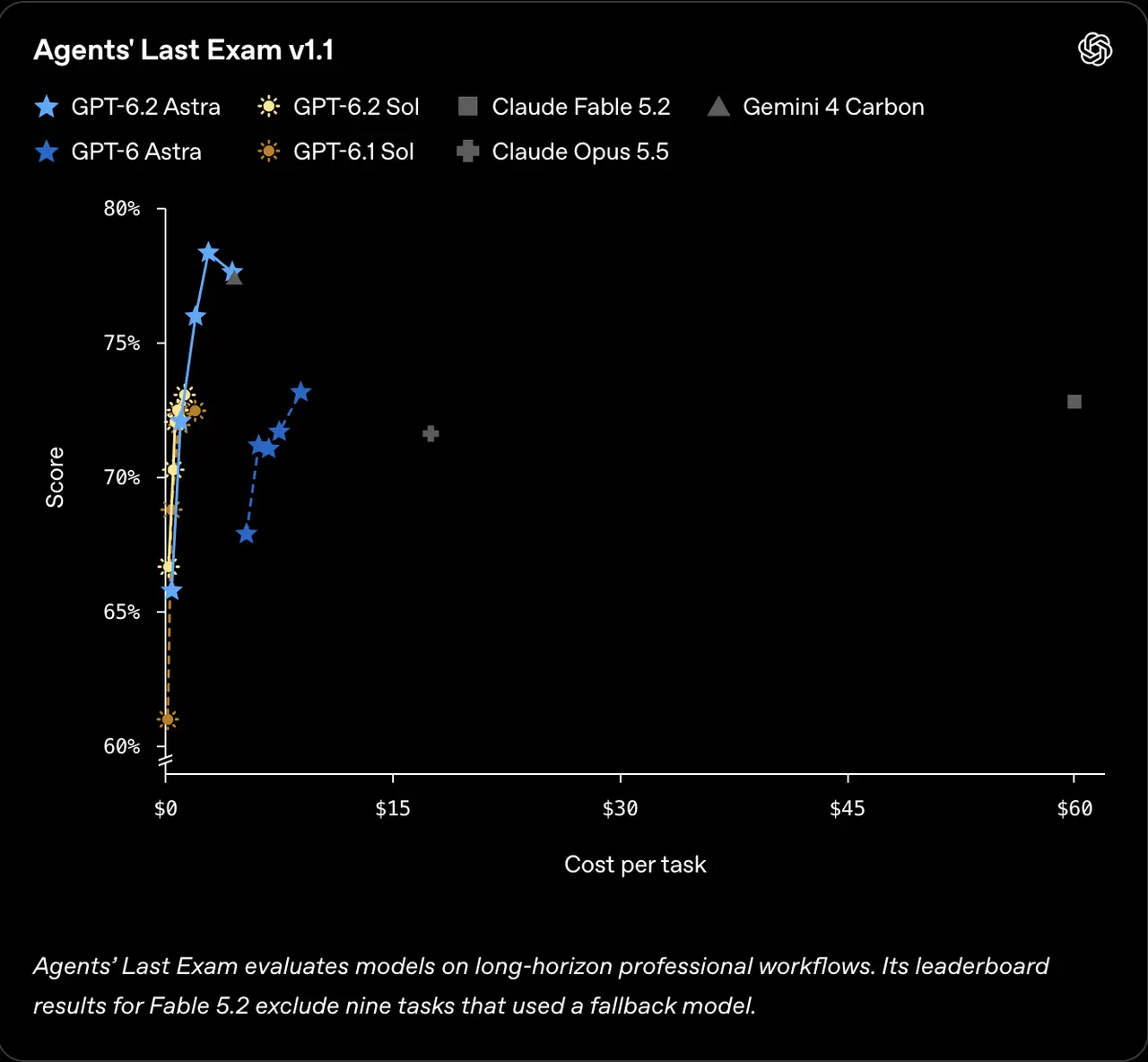
OpenAI reports that Astra scored 5.2 points higher than GPT-6 Astra on Agents' Last Exam, a benchmark measuring multistep professional work. It achieved this result at less than one-third of the predecessor's cost per task.
Other reported improvements include:
- A 9-percentage-point gain over GPT-6 Astra on Terminal-Bench-Science 0.1.
- More than doubling Claude Fable 5.2's pass rate on Harvey's legal benchmark, at approximately one-sixth of the cost.
- A 6.2-percentage-point improvement over GPT-6 Astra on OpenAI's internal GDPval v2 benchmark, while using 22% fewer output tokens.
These are figures reported by OpenAI, based on the evaluations it cites. They should be read in the context of each benchmark's methodology rather than treated as a universal measure of model quality.
GPT-6.2 Sol
Sol is positioned as a more economical option for everyday work.
On Cognition's FrontierCode 2.0, it came within 0.5 points of Astra when both models operated at maximum reasoning, at approximately one-fifth of the cost.
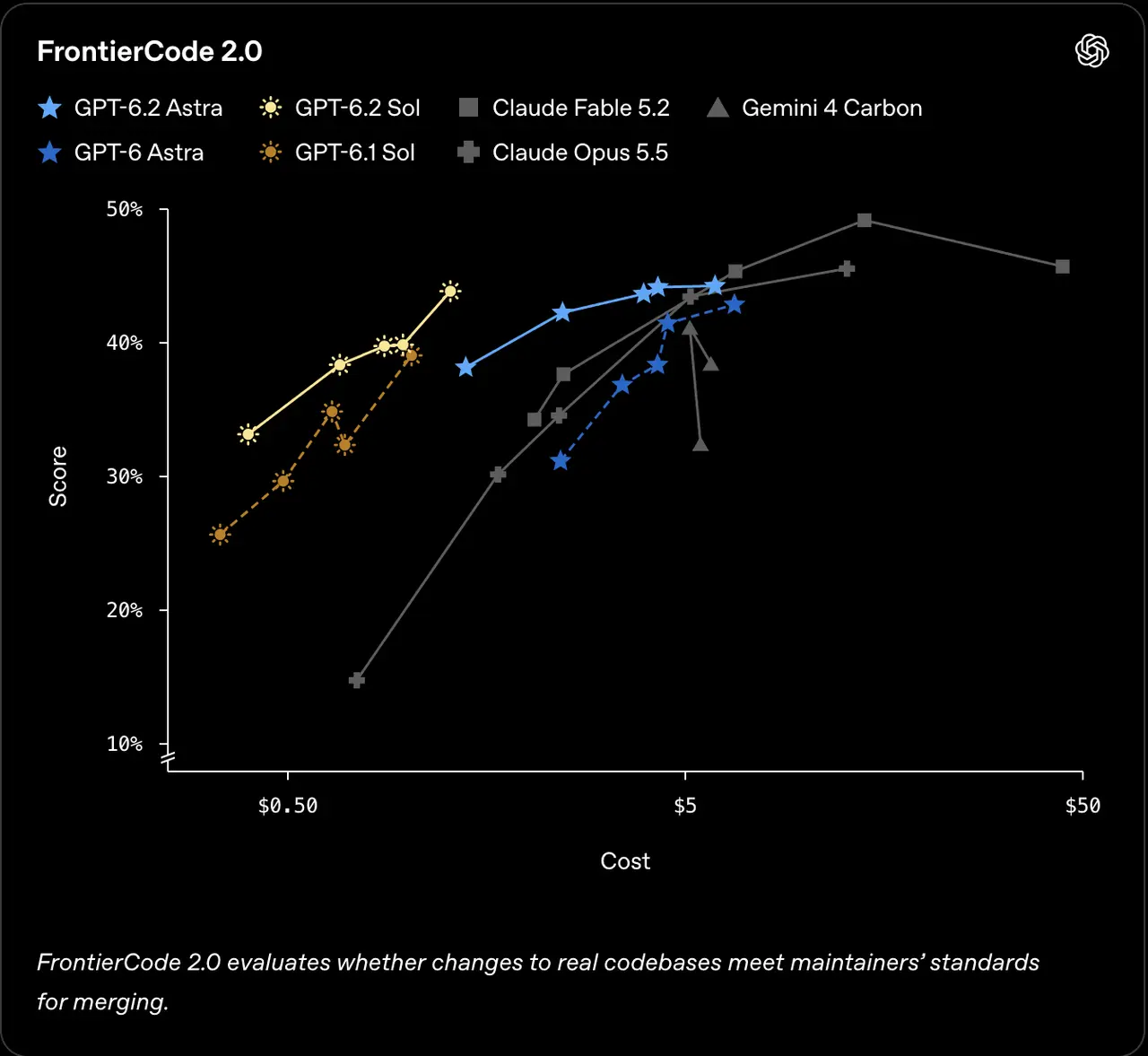
OpenAI also reports improvements on LifeVal, its benchmark for challenging everyday tasks, and GDPval v2.
Source: OpenAI's benchmark results
What about API pricing?
The pricing changes are particularly relevant for businesses using AI at scale.
| Model | Input / 1M tokens | Cached input / 1M | Output / 1M |
|---|---|---|---|
| GPT-6.2 Astra | $8 | $0.40 | $40 |
| GPT-6 Astra | $10 | $1 | $50 |
| GPT-6.2 Sol | $2 | $0.10 | $10 |
| GPT-6.1 Sol | $2 | $0.10 | $10 |
Astra's input and output token prices are 20% lower than GPT-6 Astra's. Its cached-input price is 60% lower.
Sol retains the same API token prices as GPT-6.1 Sol.
It is worth distinguishing token pricing from the cost of completing a task. A model can consume fewer tokens or require fewer rounds of revision, reducing the total cost even when its per-token price remains unchanged.
Source: OpenAI API pricing and launch announcement
What are early users saying about GPT-6.2?
The launch has not received uniformly positive reactions from AI power users.
Some early testers have questioned Astra's writing style and controllability, despite its strong reasoning capabilities.
Dan Shipper, CEO of Every, discussed his team's experience testing the models. Among the concerns raised were:
- Overly compressed writing: Some explanations were so concise that important context became difficult to follow.
- A recognizable default style: Different outputs could sound too similar, even when the creative direction changed.
- Limited creative variation: Producing genuinely distinct concepts sometimes required more guidance and iteration than expected.
Developer Theo Browne also discussed difficulties getting Astra to produce sufficiently varied creative outputs.
These reports are individual experiences, not independent benchmark results. They also should not be generalized to every task or treated as proof that Sol has the same problems.
The distinction matters because OpenAI specifically describes Sol as a model that writes clearly and naturally and is intuitive to collaborate with. Whether that translates into consistent brand-voice performance is a separate question.
Additional source: VentureBeat's coverage of early tester feedback, November 17, 2026
What does GPT-6.2 mean for Shopify sellers?
For ecommerce businesses, the release creates two practical opportunities: improving AI-assisted workflows and potentially reducing the cost of producing content at scale.
More efficient content production
Sol's lower operating cost makes it worth evaluating for recurring tasks such as:
- Writing product descriptions.
- Generating ad copy variations.
- Drafting email campaigns.
- Summarizing customer feedback.
- Creating first drafts of FAQs and support content.
Astra may be more relevant when the task involves combining information from multiple sources, analyzing spreadsheets, preparing complex reports, or building more sophisticated digital experiences.
However, stronger performance on professional benchmarks does not automatically translate into better marketing copy.
Brand voice remains a separate challenge
A product description can be accurate and grammatically correct while still sounding generic.
An advertising model can understand the product benefits but fail to produce sufficiently different creative angles for testing.
For a brand, these are not minor editorial issues. They affect how customers recognize, understand, and respond to its messaging.
The benchmarks OpenAI highlighted measure professional, scientific, legal, coding, and other task-specific capabilities. They do not establish that GPT-6.2 can consistently follow a Shopify store's brand guidelines.
That gap is where businesses need their own testing.
Should you switch your marketing workflow to GPT-6.2?
Not immediately. Before replacing your current model, run the same real brief through both systems and compare the results.
Focus on four areas:
1. Brand voice consistency
Give the model your brand guidelines and ask it to write an ad. Then request revisions.
Does it retain the same tone, vocabulary, and personality, or does the writing drift toward generic AI language?
2. Creative variation
Ask for five ad concepts targeting the same audience but using different messaging angles.
Check whether the hooks, customer motivations, and creative directions are genuinely different.
3. Explanation quality
Use a product that requires some explanation.
Does the model preserve the information customers need to understand the product, or does it compress the explanation until important context disappears?
4. Factual accuracy
Compare every product claim with your source information.
Check for invented benefits, unsupported performance claims, or altered product specifications.
The aim is not simply to identify which model produces the most polished first draft. It is to find out which one requires less editing while remaining accurate and consistent with your brand.
Start with Sol, then evaluate Astra
For everyday ecommerce marketing tasks, Sol is a sensible first model to test.
OpenAI positions it as a clear, natural-writing model designed for everyday collaboration. Its API token pricing is unchanged, and its performance on FrontierCode 2.0 comes close to Astra at approximately one-fifth of the cost.
Astra is worth testing when workflows involve complex reasoning, research, data analysis, or professional document production.
Neither model should be selected solely because of its benchmark ranking. The right choice depends on the task, the quality of the output, and the amount of human editing required.
The takeaway
GPT-6.2 is an important release for businesses adopting AI. Astra pushes professional-work performance further, while Sol offers a more economical option for everyday workflows.
For Shopify sellers, however, the real opportunity is not simply using a smarter model. It is building a more efficient content workflow without sacrificing brand voice, creative variety, or product accuracy.
Test Sol first. Compare it with your current model using a real brief, and let the results determine whether GPT-6.2 deserves a place in your marketing workflow.
Ask AI next
- Why does GPT-6.2 Astra produce more generic, compressed writing despite scoring higher on professional benchmarks?
- What prompt structure or brand-guideline format actually keeps Sol's tone consistent across multiple revisions?
- What tools can automatically score brand-voice consistency and creative variation across different AI models' outputs?
- Has OpenAI responded to the 'essentially unusable' feedback from early testers, and are fixes or updates planned?
- Are competing models like Claude or Gemini matching GPT-6.2's pricing and benchmark gains for ecommerce content work?