All stories · Article
Universal Cart, UCP, WebMCP: which of these changes has already reached your Shopify store?
In the US, shoppers can now add a product to their cart straight from Google search results, pick a size, and pay with Google Pay without ever opening the merchant's site.
Share: WhatsApp · Telegram · X · Facebook · LinkedIn · Email
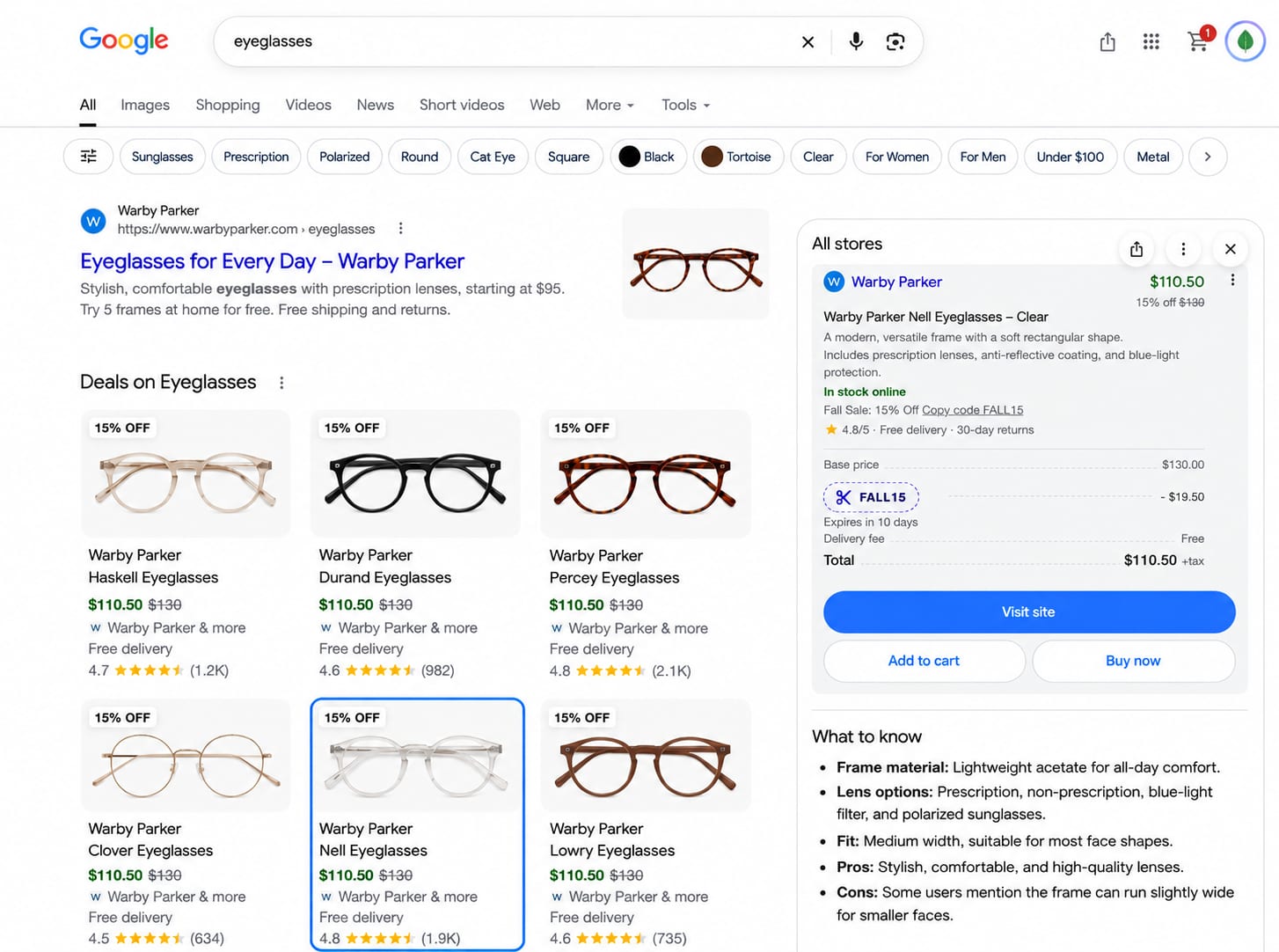
That feature is called Universal Cart. Almost every conversation about it also brings up two other names, UCP and WebMCP. The three tend to get lumped together as "the new protocol," but they are different kinds of things, and only two of them have actually reached Shopify stores.
Universal Cart, UCP and WebMCP side by side
| Name | What it is | Where it stands |
|---|---|---|
| Universal Cart | A Google feature for shoppers | Live in the US, in Google Search including AI Mode, and in the Gemini app |
| UCP (Universal Commerce Protocol) | The open protocol underneath, which lets agents browse products and pay | Launched by Google in January; Newegg and Macy's have integrated it |
| WebMCP | A proposed web standard that lets a page declare its own tools for agents to call | Shopify has had it on by default for every Liquid store since August 5, 2026 |
Universal Cart pulls products from several merchants into a single checkout in Google Wallet, and tracks prices, promotions and restock timing on its own.
The product data comes from the Shopping Graph, Google's index of more than 60 billion listings. The feature is open in the US with Ulta Beauty, Walmart, Wayfair and some Shopify merchants, and Google says the checkout runs on UCP.
That's where UCP comes in: it is the pipeline underneath, not the screen. What role the merchant keeps when an order flows through that pipeline already has a concrete answer. Newegg integrated UCP and remains the merchant of record on the order, while also supplying its catalog data to Google.
WebMCP runs the other way, and this is the part many sellers don't realize they already have. Shopify has turned on WebMCP tools for every Liquid store, with nothing to install or configure, and added checkout support starting September 28, 2026.
Agents can call commands such as search_catalog, update_cart and proceed_to_checkout.
complete_checkout is the exception: it only runs after the shopper confirms, and when an order needs 3D Secure verification, control goes back to the shopper. For now, agents can only use WebMCP in Chromium-based browsers, through an origin trial.
The paths differ, but both read your structured product data, not the copy on the page. Price, stock status, variants and category names are what an agent uses to compare options and close the order. A well-written product description does nothing for you at that step.
What Shopify sellers should do:
- If you sell in the US, start with your Merchant Center data. Once Google is tracking prices and restocks on its own and alerting shoppers, a wrong price or stock status in your feed shows up exactly where the customer is making a choice, with no window left to fix it.
- Measurement comes next. Open your own store's GA4 and check how many sessions and orders LLM channels actually bring in before you decide whether to keep or drop your ChatGPT optimization work. Someone else's numbers can't stand in for yours.
- The theme is the part few people think about. Since agents call the storefront's standard actions, a heavily customized theme that handles the cart its own way may behave differently from what the agent expects. You can test this today: add and edit items in the cart and watch how the store responds.
For agencies: split AI search into three layers when clients ask
When a client asks "what do we need to optimize for AI search," the question actually bundles three separate layers:
- Visibility and getting cited,
- Catalog data,
- And agent actions.
For Liquid stores specifically, an agency's value isn't in installing WebMCP, because Shopify has already turned it on. The work that's left is feed data, measurement, and checking whether the theme uses the storefront's standard actions correctly.
The big question still open
When shoppers check out on Google's interface instead of your site, who owns the relationship with that customer for the second order, and who collects a fee on each one? There are no public figures on fees yet, and the sources don't even agree on which parties jointly govern UCP. That's the part worth watching.
The part you control is much clearer. Whether an order comes from Google Search, from an agent running in the shopper's browser, or from your own site, all three draw on the same product data. Getting that data right is work that doesn't depend on which protocol comes out on top.