All stories · Article
Shopify brings checkout to AI agents: fix your product data first
On October 28, 2026, Shopify put Shop Pay checkout inside AI agents like Meta's Muse and Claude Duet. The connection is in place, and product data is the part your store has to supply.
Share: WhatsApp · Telegram · X · Facebook · LinkedIn · Email
Two independent audits found plenty of gaps in that data. In an audit by SEO consultant Mert Erkal, only 5 of 23 Shopify product pages listed a GTIN, the number printed under a barcode.
Getting into Shopify Catalog does not give agents enough product detail
When a shopper asks an agent for a product, the agent reads from Shopify Catalog. That is where Shopify pools product data from its stores, and Shopify's Fall '26 Edition announcement names ChatGPT, Copilot, Meta and Instinct among the agents that use it.
The bar for getting in is low. Shopify's catalog requirements ask for a title, at least one image, a price above zero and a product URL, plus a Starter plan or higher and an account in good standing; GTIN and specs are not on the list.
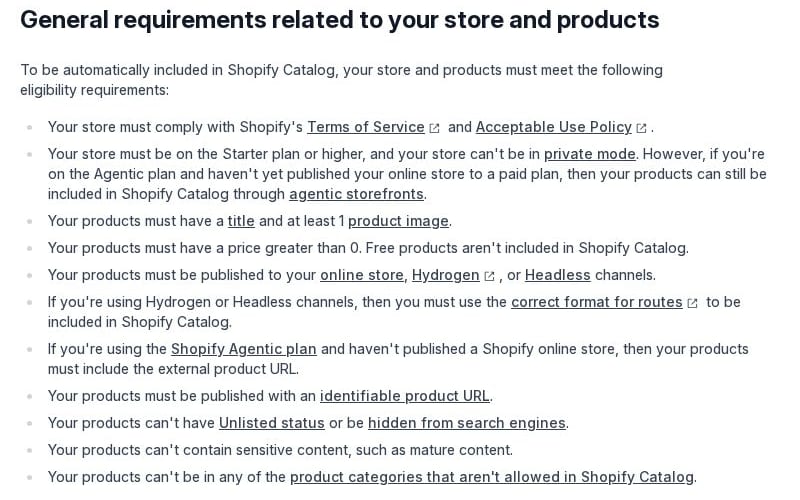
The general requirements for Shopify Catalog cover a title, an image, a price and a product URL, with no GTIN, on help.shopify.com, captured in October 2026.
So a product can be in Shopify Catalog and still lack the details an agent needs to answer a shopper.
Independent audits find product pages missing the data agents need
Both audits point to the same gap: pages are written for shoppers, while the fields machines read are often left empty.
| Audit | Sample | Finding |
|---|---|---|
| Mert Erkal | 25 US Shopify stores | 22 ready for agents, but only 5 of 23 pages had a GTIN |
| Eric Sheinkop | 300 product pages, 13 categories | 60% scored 70+ of 100 for shoppers, 19% for AI |
Erkal founded the SEO consultancy Stradiji and noted that Shopify did the agent-readiness work for those stores. Erkal looked for the GTIN in each page's schema, the hidden structured data that search engines and agents read.
Mert Erkal@merterkalWe checked 25 US Shopify stores. 22 are ready for AI agents. Shopify did that for them. Only 5 of 23 product pages have a GTIN in schema. The AI plumbing is on. The product data isn't. Score your store in 5 minutes:👇
https://t.co/KWoh6H7oHGOct 28, 2026 · View on X
Sheinkop is co-founder and CEO of The Desire Company, a firm that makes expert-driven product content. Sheinkop's team scored each page twice, once for shoppers and once for AI, and the AI score looked for machine-readable data, clear explanations of use, images and video an AI can read, and expert evidence.
"Most of the pages we audited were built to rank in search and convert shoppers."
Eric Sheinkop, on LinkedIn
Which data gaps are most common, and which stores do they hurt most?
3 Bird, a Dutch software development firm, lists four common gaps you can look for on your own pages:
- Prices in images or behind JavaScript, where an agent may not see them
- Sales copy instead of specs, with no size, material or numbers
- No compatibility details, such as which models a product fits
- Vague stock status, which leaves an agent unsure whether an item is available
A store selling one simple, familiar product may have less to fix. Neither audit splits results by product type, so treat this as a reasoned guess.
Fix the data in your Shopify admin before paying for AI-only tactics
3 Bird says most of these fixes take hours. The three steps below are in the order worth doing them.
1. Check Catalog eligibility and the Knowledge base
The eligibility view in your admin shows whether your store qualifies for Shopify Catalog and links to what needs fixing. Next, open Sales channels > Agentic > Knowledge base and review the facts Shopify drafted from your storefront, such as return windows, shipping destinations and gift services.
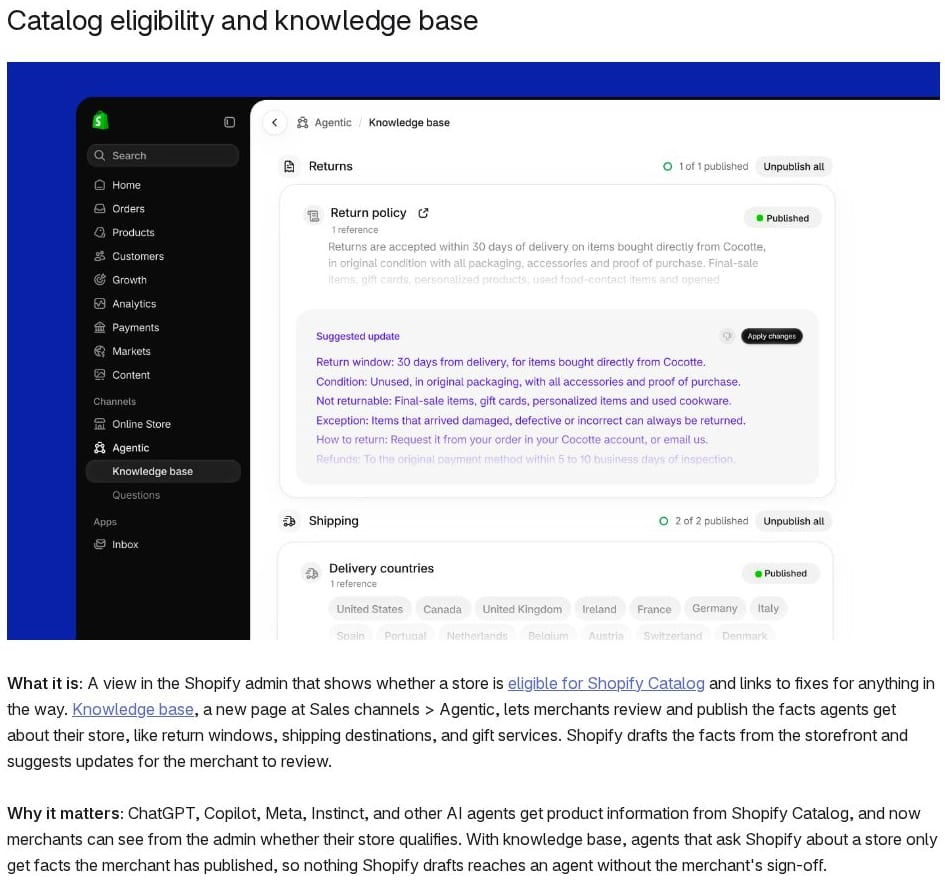
Shopify's Fall '26 page shows the Knowledge base, where you approve the facts agents get, on www.shopify.com, captured in October 2026.
2. Fill the empty product fields
The new channel mapping page, announced in Shopify's changelog, previews the product data sent to each sales channel. Each field shows a coverage percentage, so you can see what is missing.
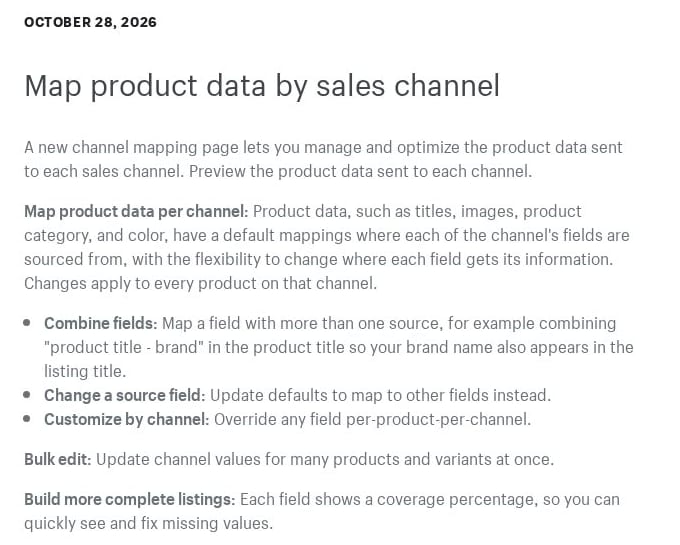
The channel mapping page shows how complete each product field is, on changelog.shopify.com, captured in October 2026.
3. Set llms.txt aside, at least for Google
An llms.txt file is a text file some sites add to describe their content to AI models. Semrush, the SEO software company, summarized Google's official guide for its AI search features, which says site owners can skip llms.txt, AI-only rewrites and schema built only for AI.
The guide covers Google Search only, so it does not say how ChatGPT or Muse choose products.
Complete product data does not guarantee more orders
Both audits measure how complete pages are, and neither counts orders. On X, the account RiseMore (@risemoreai) passed on one solo founder's self-report after listing an app in ChatGPT's app directory. Signups rose from about 7 a day to more than 50, and 22 people reached the paywall, yet none bought.
For now, fill in your product data first, and ask anyone selling an llms.txt package which platform it is built for before you pay.
Sources
- an audit by SEO consultant Mert Erkal · x.com
- Shopify's Fall '26 Edition announcement · shopify.com
- Shopify's catalog requirements · help.shopify.com
- Sheinkop's team · linkedin.com
- 3 Bird · linkedin.com
- announced in Shopify's changelog · changelog.shopify.com
- Semrush · x.com
- @risemoreai · x.com