All stories · Article
Shopify Hydrogen 2026-10 becomes a library: what agencies should tell clients
On October 14, Shopify moved Hydrogen 2026-10 to general availability: https://shopify.dev/changelog/blog/hydrogen-2026-10-is-now-available.
Share: WhatsApp · Telegram · X · Facebook · LinkedIn · Email
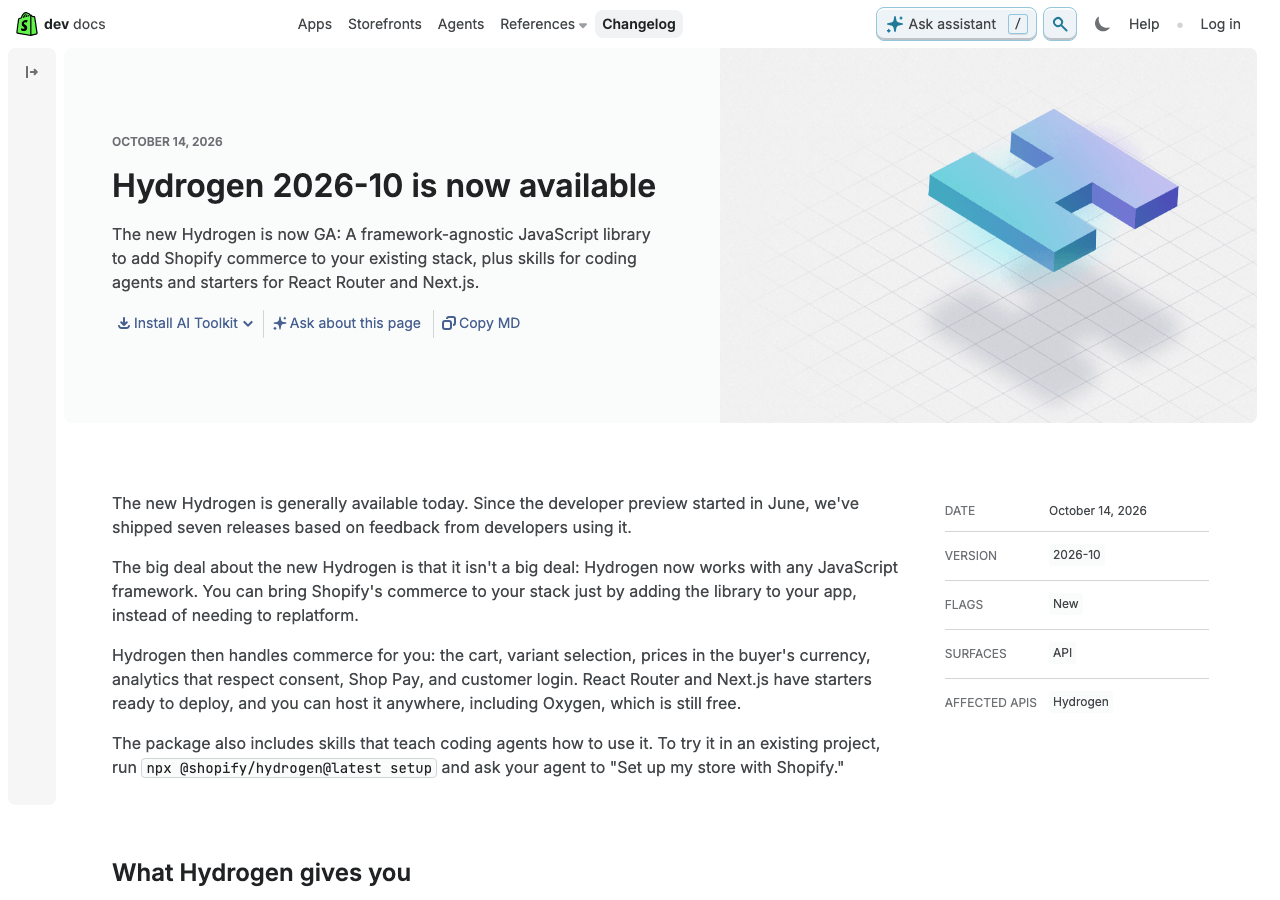
Hydrogen is now a library you can plug into any JavaScript framework. The old version was a framework built on React Router, so using its cart or analytics meant building the whole storefront on it.
Hydrogen handles commerce, the dev team handles the rest
What makes this option matter is how Shopify has redrawn the split of work between Hydrogen and the dev team. According to Shopify, the dev team only needs to add the library to the app it already has, "instead of needing to replatform":
- Hydrogen handles commerce: cart, variants, collection filters, predictive search, Markets, analytics, Shop Pay, customer accounts.
- The dev team's framework handles the rest: routing, data loading, rendering. Design is entirely up to the dev team.
Shopify also explains why Hydrogen takes on these pieces: they're "harder to get right than they look." The cart has to stay correct when a shopper taps "Add to cart" twice, prices have to match the buyer's country and currency, and analytics have to respect consent choices while still getting data back to Shopify.
That cart isn't only there for shoppers clicking buttons. Hydrogen uses the same standard storefront actions as Liquid themes, so compatible apps, the storefront UI and AI agents can all work on one cart.
In browsers that support WebMCP (a proposed web standard that lets a page register tools for AI agents to call directly), a shopping agent can find products and update the cart, and once the buyer confirms, Shopify Checkout can submit the order. Shopify says developers "don't have to build anything" for this.
The dev team's share of the work also comes with a head start. Shopify ships starters for React Router and Next.js, lets you host the storefront anywhere, keeps Oxygen free, and includes 20 skills that teach coding agents to build a storefront, from the home page through cart and accounts, then test the result on their own.
Whether to go headless still comes down to apps, content and who maintains it
The new library takes over the pieces above. But when two people who had worked on Hydrogen projects talked about what it cost them, both pointed to apps, content and maintenance, not commerce code.
In late July, while Hydrogen was still a framework, member Hardeep, whose team has shipped both theme and Hydrogen projects, listed three pain points of adopting Hydrogen in a discussion thread on Shopify Community:
- Some Shopify apps don't work on Hydrogen out of the box, so you end up rebuilding them
- Content management can get harder because it takes more planning
- Deployment and monitoring eat up more developer time.
Hardeep's team only picks Hydrogen when the answer to a single question is "yes":
"Are there any business requirements that can't reasonably be satisfied by a Shopify theme?"
Another member of the thread, who had evaluated Hydrogen for a few projects, said it pays off most clearly in four cases:
- Product configurators, where shoppers pick and combine product options and see the result change on the page instantly.
- Complex B2B portals.
- Multiple brands running on one shared backend.
- Integrations with external systems that need deeper control over the storefront than Liquid usually allows.
The same member also raised what running the store looks like after launch.
With a theme, many store owners can handle day-to-day updates themselves. With Hydrogen, you usually need a developer on hand for new features, upgrades and integrations.
The GA release only touches some of these pain points. The announcement says "compatible apps" share the cart with the storefront, but it doesn't name which apps are compatible, and it says nothing about content editing.
So for clients on a theme, we think the first question is still whether they have a business problem the theme can't solve. Framework and hosting come after that.
What agencies should tell each type of client
The business-problem question is where the conversation starts with theme clients. Clients already on Hydrogen, or with a custom-built site, need a different read:
Release 2026-10 changes how an agency brings Shopify into a storefront: from rebuilding the whole site to adding a library. In our view, whether a client should go headless is still decided by apps, content and who maintains it, so the first thing worth asking is still whether their theme already does what they need.