All stories · Hot News
Shopify will block EU shipping labels for items without product IDs from November 1, 2026
Share: WhatsApp · Telegram · X · Facebook · LinkedIn · Email
From November 1, 2026, Shopify won't sell a Shopify Shipping or Managed Markets label for an EU-bound order if an item lacks the product IDs the EU requires for parcels under €150, according to the Shopify Changelog post of October 24, 2026.
Shopify fills in most of the data itself. What's left is one barcode decision per variant.
The rule covers parcels sent from outside the EU to consumers in the EU, according to Shopify's Help Center page on EU product identifiers. Shipments to VAT-registered businesses are out of scope, says Passport's EU PID guide.
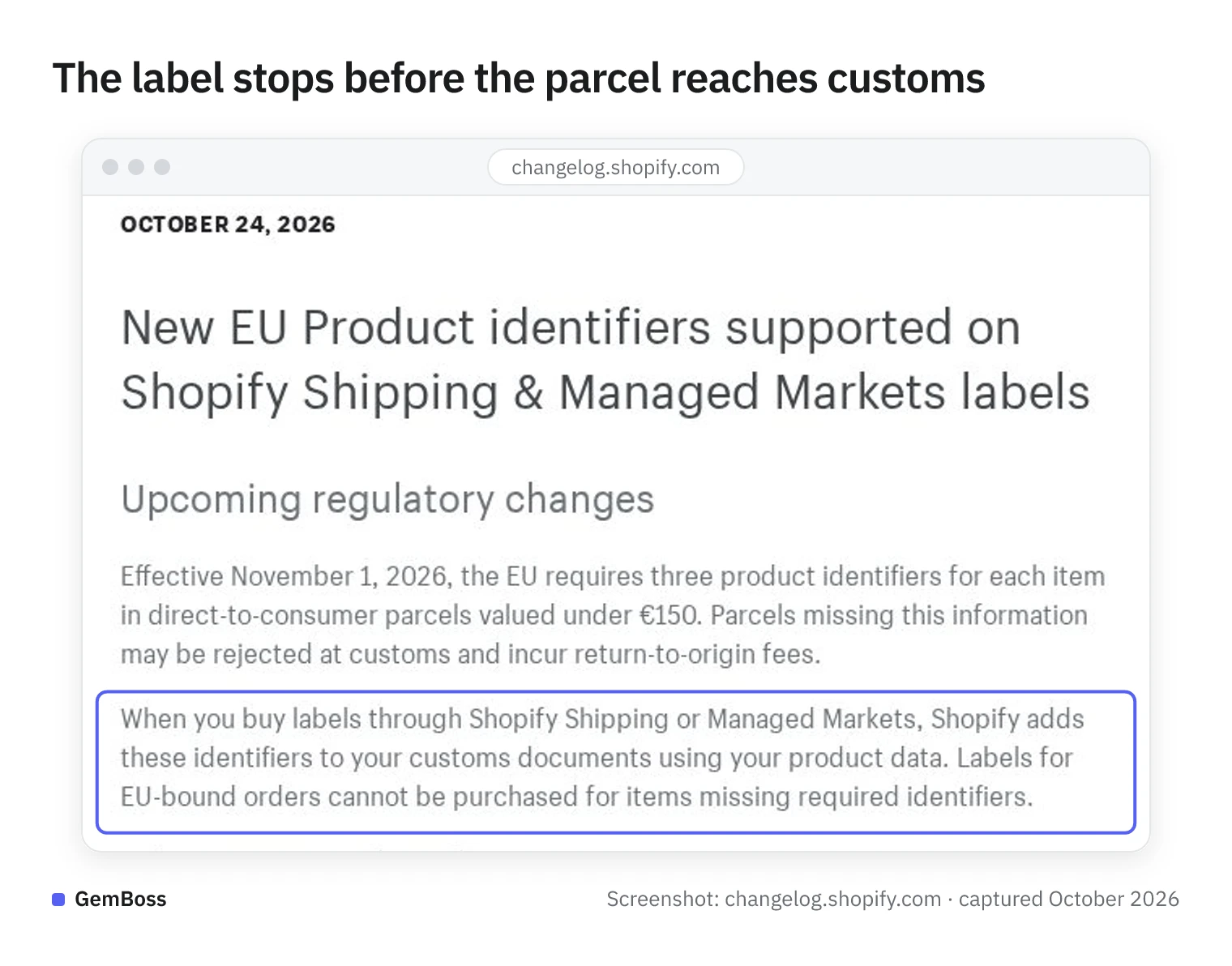
*Screenshot of *Shopify Changelog*, captured October 2026.*
Your EU orders stall in your admin before they reach the border
The EU has accepted these identifiers on a voluntary basis since July 1, 2026, with no penalties, according to Passport. From November 1, 2026, they are mandatory.
Shopify's changelog states the customs risk plainly: parcels missing the data "may be rejected at customs and incur return-to-origin fees."
For stores that buy labels inside Shopify, the stop comes earlier. Shopify won't sell the label for an item that lacks a required identifier.
The order sits in your fulfillment queue, and the problem shows up at the packing table instead of at the border.
A seller posting on r/ecommerce on October 15, 2026 read the rule as needing the manufacturer's code for every product, down to the apparel blank.
Their verdict: "it's insanely laborious to hunt these all down and update a large product catalog."
If you buy labels in Shopify, much of that hunt isn't needed.
Three identifiers, and Shopify already fills one
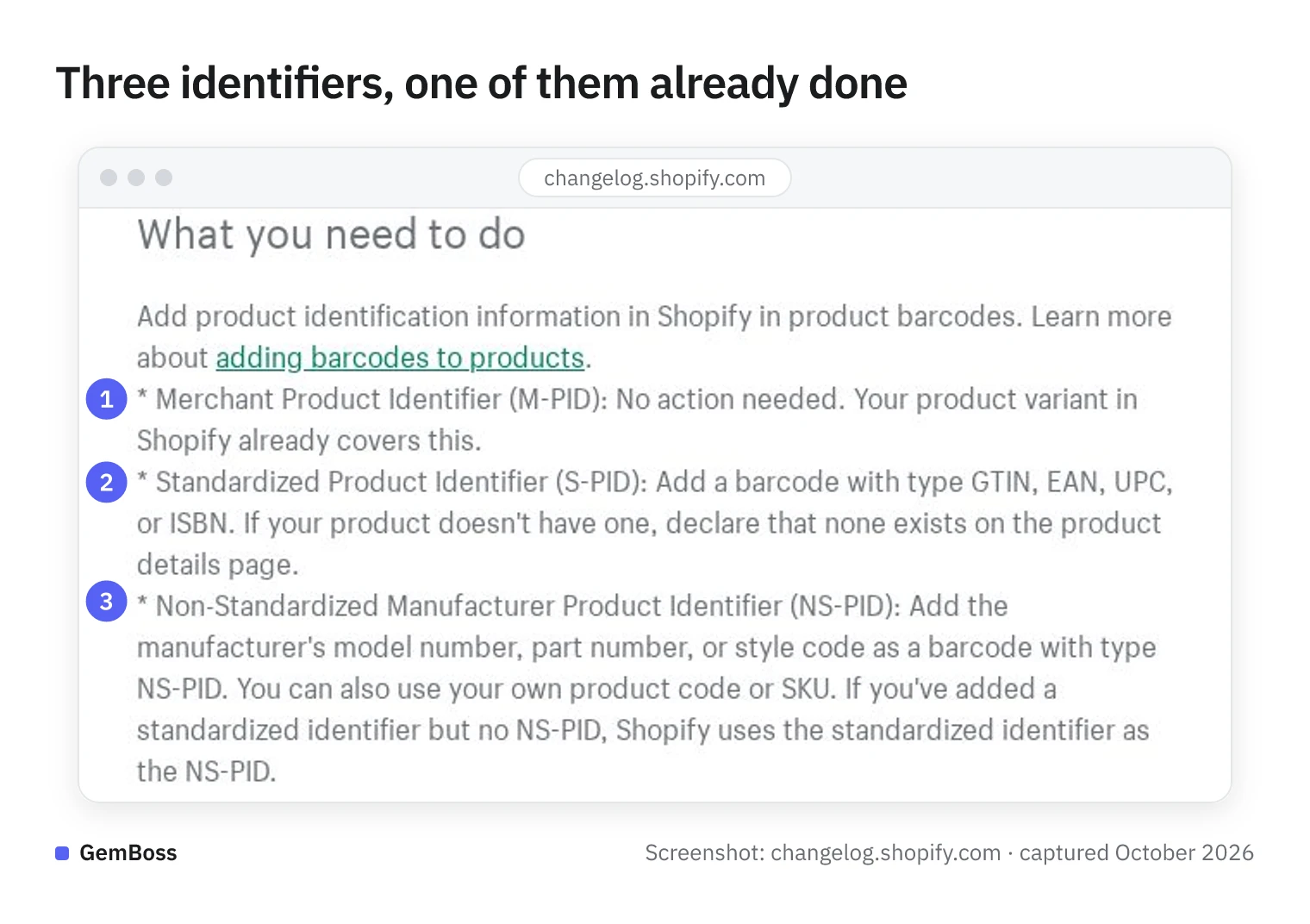
*Screenshot of *Shopify Changelog*, captured October 2026.*
A DEV Community study of 1,071 Shopify stores, published October 23, 2026, found that 50.3% of products had at least one variant with no SKU.
On Shopify labels, that gap doesn't leave the M-PID empty, because Shopify uses the variant ID.
For S-PID, the "none exists" declaration sits in the More details card of the Shipping section. It goes on the product page for products without variants, or on each variant page, per the Help Center.
Customs calls this declaration Y081.
Per Shopify staff answers relayed by the DEV Community author, an untyped barcode holding a valid GTIN still counts as the S-PID. Setting the type is still the safer move.
For NS-PID, Shopify's changelog says you can also use your own product code or SKU. If a variant has a standardized code but no NS-PID, Shopify uses that code as the NS-PID.
FlavorCloud's EU identifier setup guide is stricter: it treats your own code as fine only when you make the product yourself.
Passport adds a catch: Shopify currently won't accept the same value in both the S-PID and NS-PID fields.
Zenstores advises keeping your current barcode first and adding the NS-PID after it, because sales channels and apps read the first barcode.
Don't fill gaps with made-up values. FlavorCloud warns that an invented code, or a SKU copied into the standardized field, makes a false customs declaration.
What to do before November 1, 2026
Three items in Shopify's changelog shape the work: two tools and one hand-off.
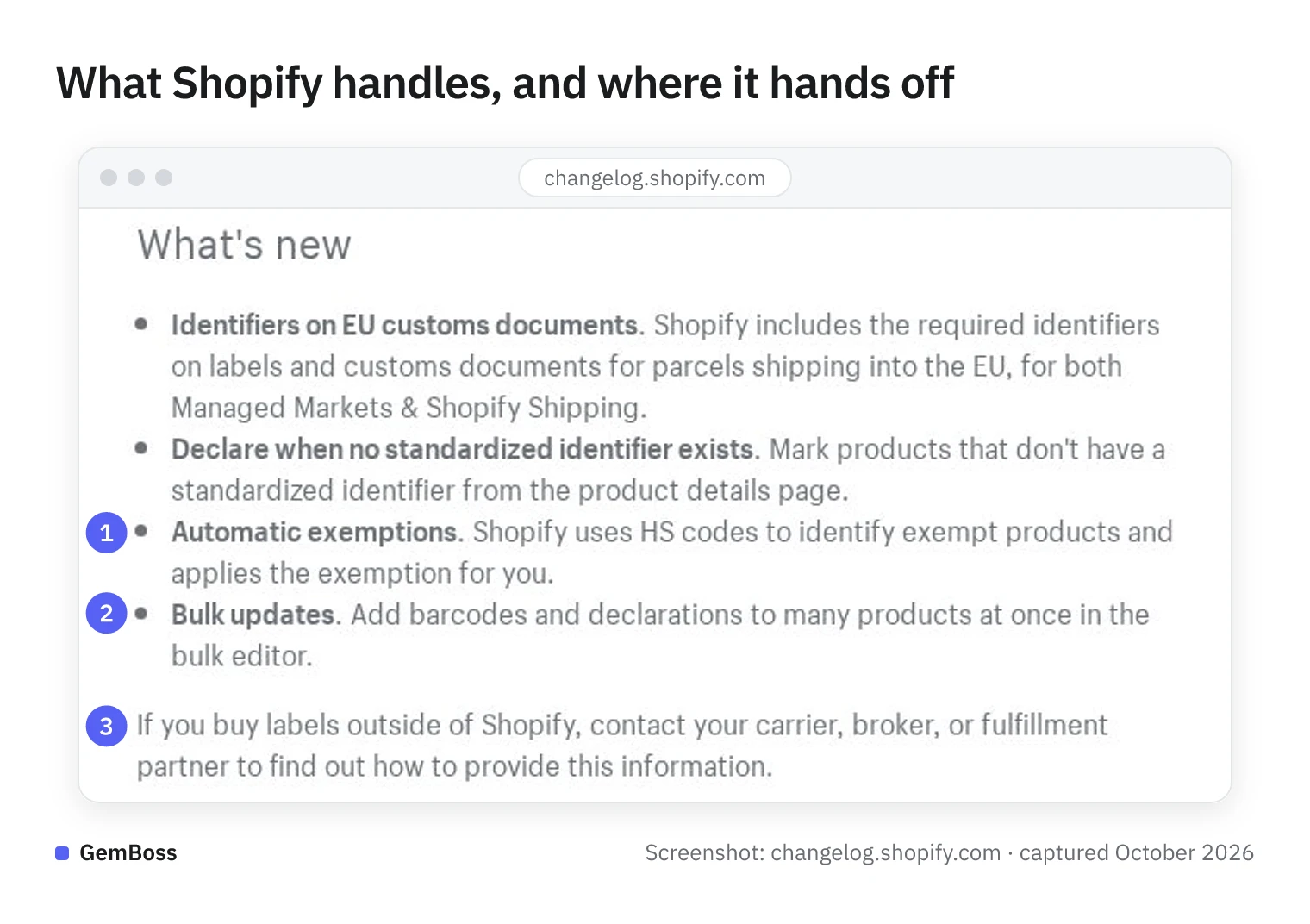
*Screenshot of *Shopify Changelog*, captured October 2026.*
- Automatic exemptions. Shopify uses HS codes to identify exempt products and applies the exemption for you.
- Bulk updates. The bulk editor adds barcodes and declarations to many products at once.
- Labels bought elsewhere. Ask your carrier, broker or fulfillment partner how to provide the data.
For outside labels, the Help Center says the identifiers must reach your carrier through your current method. Zenstores, for example, uses each variant's SKU as the M-PID.
Who can skip this?
Parcels above the threshold are out. Shopify's changelog says the rule covers parcels valued under €150.
Passport, citing the European Commission's guidance updated October 5, 2026, puts the line at €150 or less in intrinsic value.
Intrinsic value excludes shipping and insurance shown separately, and taxes. In Passport's example, a €140 order with €15 of separately listed shipping is still under the line.
The threshold applies per parcel, not per order.
B2B shipments to VAT-registered EU businesses are also out, per Passport. So are parcels that don't ship into the EU from outside it, per the Help Center.
A separate change starts the same day: a €2 EU handling fee per item on distance sales of any value, according to Passport.