All stories · Article
Boosting AOV before Black Friday: do bigger orders actually bring more profit?
When every ad click costs you money, why not make that click work harder? Encouraging customers to add an extra item, upgrade to a larger bundle, or hit the free shipping threshold will drive up your average order value (AOV).
Share: WhatsApp · Telegram · X · Facebook · LinkedIn · Email
But ahead of Black Friday on November 27th, there’s a crucial question to ask: do bigger orders actually mean higher profits? You have about five weeks left to test and review the numbers before peak season hits full swing.
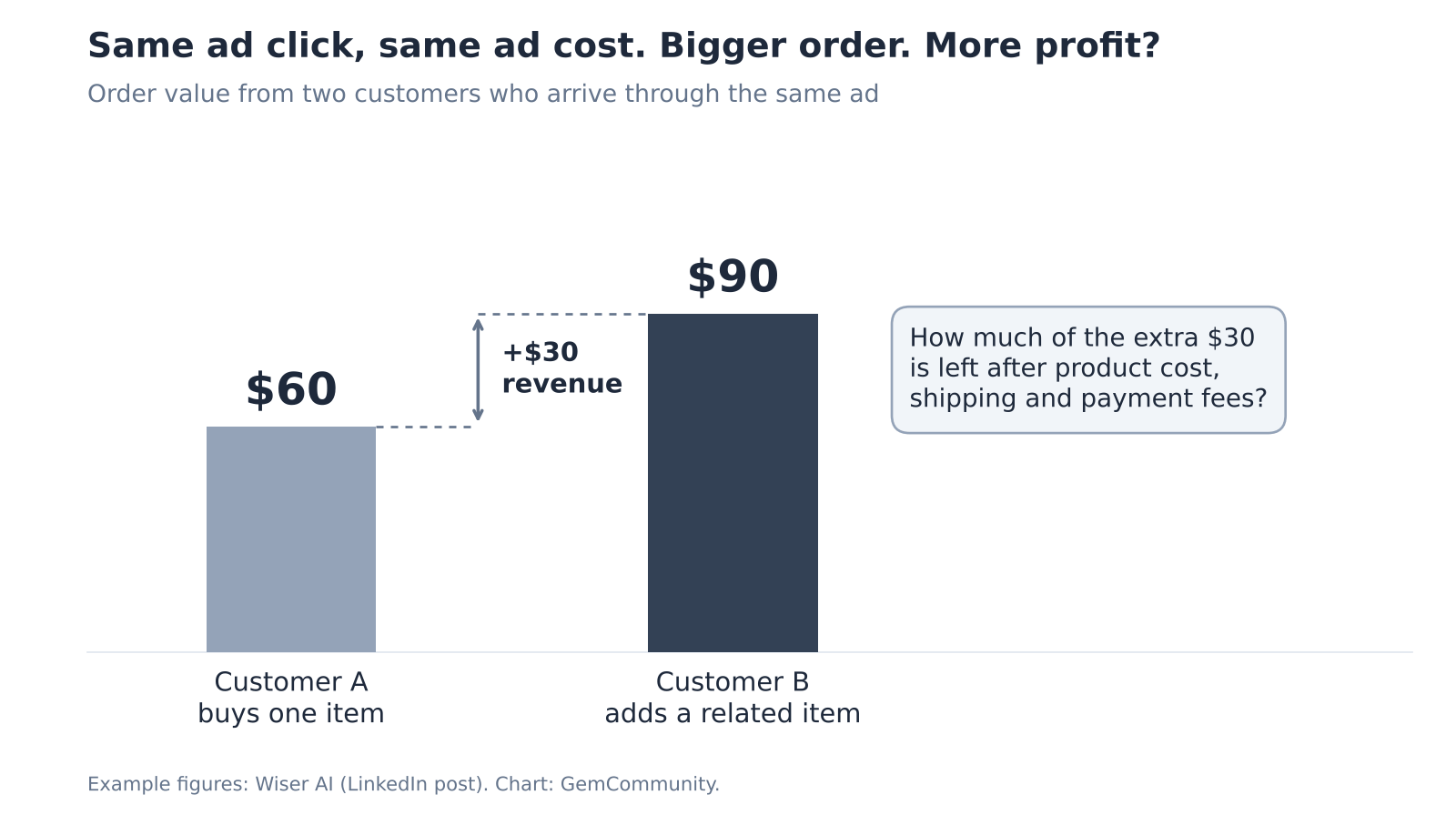
Wiser AI, in a post inviting sellers to book a demo to set up upsell offers before Black Friday, shared an example of two customers clicking the exact same ad: one spends $60, while the other adds a related item and spends $90. The ad spend remains identical, but the revenue from the second order is $30 higher.
However, that math stops at top-line revenue. To know if the $90 order is genuinely better than the $60 one, you need to deduct COGS, shipping fees, and payment processing fees from both, then compare what's left against the ad spend incurred.
3 high-impact places to test order value tactics
1. Post-purchase upsells
Rebuy, a post-purchase offer app provider, points out that after a customer completes their initial order, pitching an additional offer carries zero risk to the primary checkout. Pre-purchase offers, on the other hand, can distract shoppers or add extra steps that trigger cart abandonment. With their tool, shoppers can accept a post-purchase offer in one click without re-entering payment details.
According to stats shared by Rebuy showcasing their client Polyvinyl Record Co., offering a post-purchase "mystery vinyl" from a catalog of over 400 releases yielded a 15% conversion rate.
2. Tweaking the free shipping threshold
Matt Beswick notes that many stores set their free shipping threshold lower than their current AOV. The result? Below-average orders still get free shipping. He suggests testing a threshold positioned just above your existing AOV to give shoppers a clear incentive to add another item to their cart.
That said, look at your customer mix before adjusting your shipping rules. A commenter on Matt's post highlighted that a low free shipping threshold gives first-time buyers peace of mind on their initial order, as new shoppers are often hesitant to commit heavily to an unfamiliar brand. Returning customers who are already willing to spend more, however, might place fewer orders over time while still claiming free shipping if the bar is set too low.
3. Placing bundles alongside single items
Gary Culaev shared a redesigned product page for Gorilla Games, a store selling party card games. On their old layout, customers could only purchase individual decks. The updated PDP lets shoppers choose single decks or pre-configured bundles directly within the buy box, watch a quick product video, unlock tiered discounts up to 40%, and see a free shipping progress bar. The goal was to raise the average units per order from 1 to 1.4.
AOV went up—but did profit per order follow?
Two different commenters across separate posts raised this exact concern. One, commenting on a post about Shopify upsell strategies, suggested evaluating profit per order right alongside AOV, since heavy discounting and product bundles can quickly squeeze profit margins. Another commenter on Gary Culaev's post advised monitoring whether a 40% discount tier actually drives higher item volume or just inflates discount amounts, as those two metrics can diverge rapidly.
To map AOV directly against order-level costs, a LinkedIn guide outlines a straightforward formula: take the total order value and subtract COGS, shipping costs, and payment processing fees. The result is your contribution margin before ad spend and overhead.
In the post's example, an $80 order carries $32 in COGS, $9 in shipping fees, and $3 in merchant processing fees, leaving a pre-ad profit of $36 per order. That $36 is your break-even acquisition cost limit. Dividing $80 by $36 gives a break-even ROAS (revenue divided by ad spend) of roughly 2.2x.
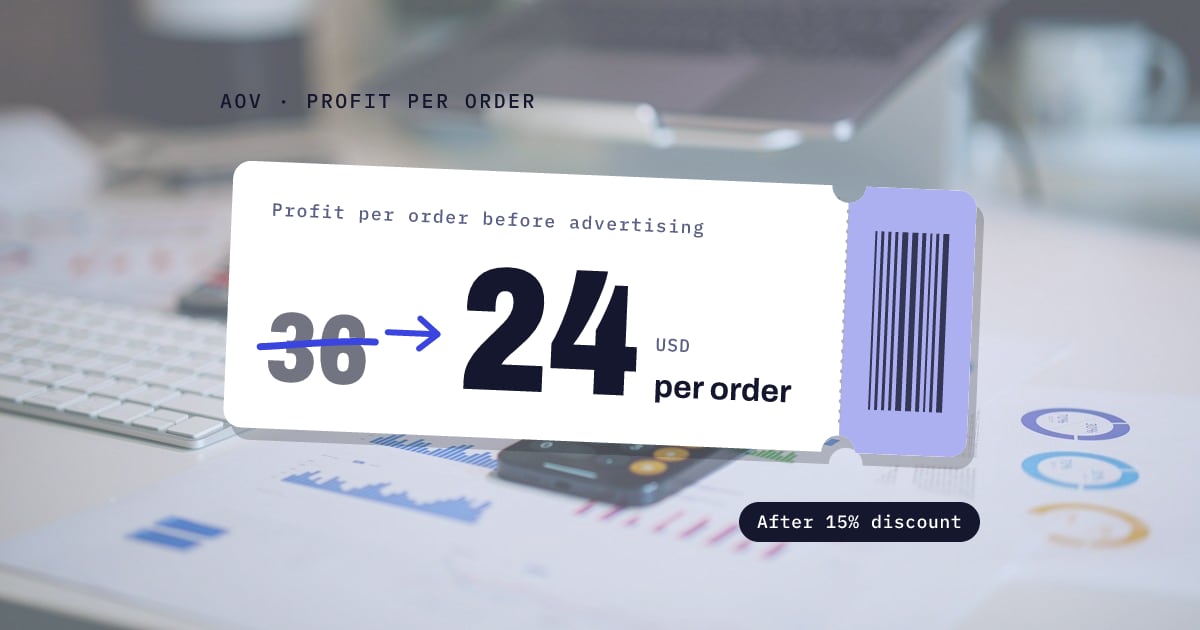
Now suppose you offer a 15% discount on that same cart while keeping all underlying costs fixed. The customer pays $68, leaving you with just $24 before ad spend. Your break-even ROAS jumps to 2.8x. That 15% discount wiped out a third of your remaining margin.
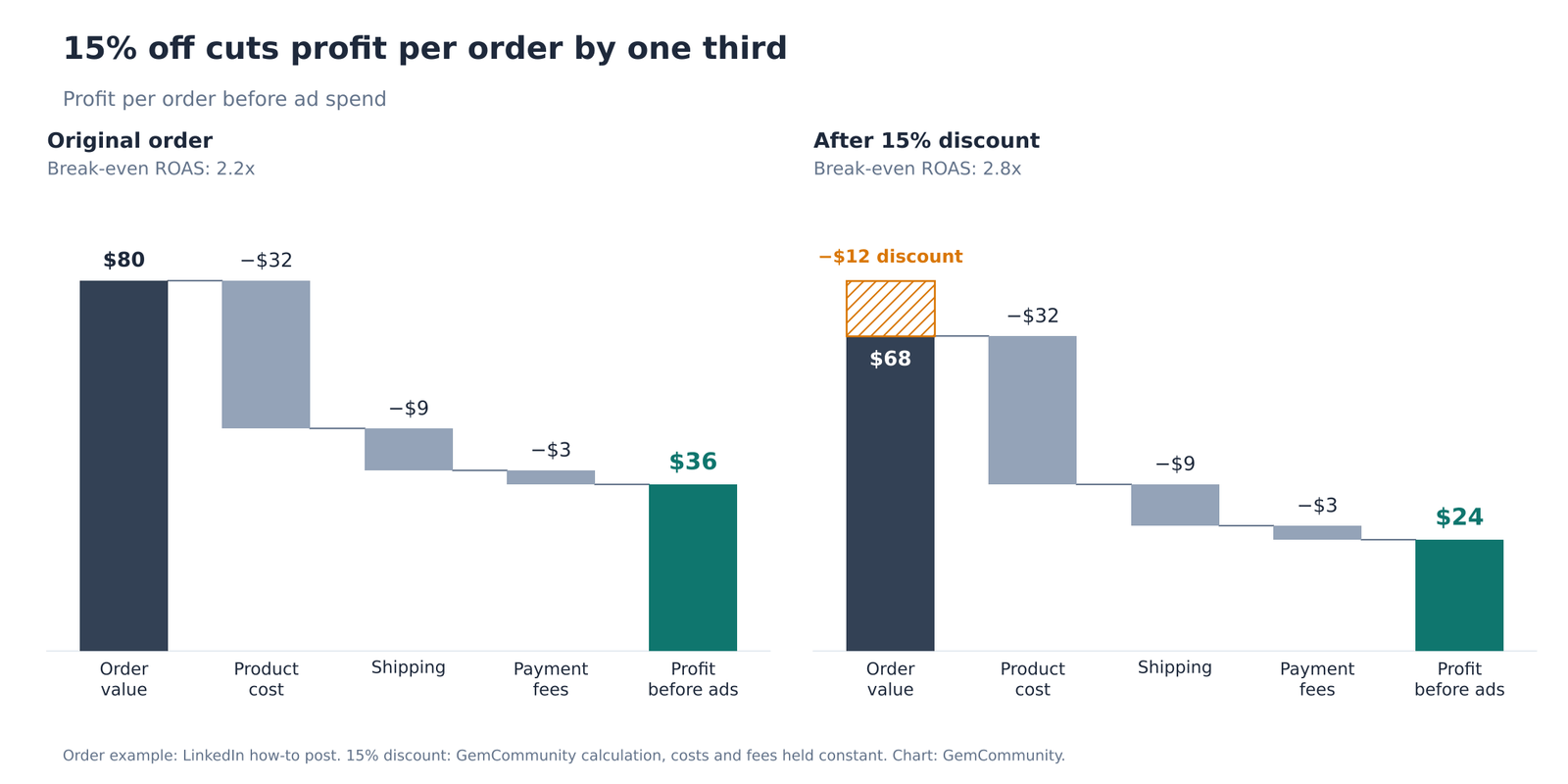
So when running bundles or tiered discounts, don't just measure whether customers buy more items. Check if the added volume actually offsets the discount given.
In a Meta ads audit post, the author noted a case where reported platform ROAS looked great at 4.2x. But after subtracting COGS and logistics costs from net revenue and comparing that to ad spend, his custom efficiency metric showed just 0.9x. Measured this way, the order margin didn't even cover the cost of ads.
Don't overlook your operational capacity
Even if unit economics look healthy, a store can quickly hit a wall if order velocity outpaces fulfillment capacity. Laura Holyer, who runs a paid media agency, shared a case study of a client whose year-over-year revenue jumped 30% and AOV rose 40%, all while maintaining ROAS and profitability.
The catch? All products were made to order, and their production facility approached a breaking point right before peak season. They had to pivot ad budgets to different product lines, pause active campaigns, and reschedule promotions to avoid massive shipping delays.
A 3-item bundle consumes three inventory units per order, meaning popular bundles can drain stock far faster than anticipated. Delayed shipments and negative customer reviews carry hidden costs that don't show up in basic contribution margin math.
Action items before Black Friday
Instead of turning on every offer type at once, focus on these four steps:
- Calculate your pre-ad profit and break-even ROAS for a few top-selling products using the $80 order framework above.
- Pick one lever to test first (post-purchase upsells, free shipping thresholds, or product bundles) rather than enabling all three, so you can isolate what actually drives results.
- Set a minimum acceptable profit margin per order, then compare it against live performance after running ads for a few days; if your setup allows, run A/B tests as suggested by the community.
- Audit inventory levels and fulfillment capacity to ensure your operations can handle higher units-per-transaction.
To bring it back to the $60 vs. $90 scenario from the beginning: a $90 order is only a win if—after factoring in COGS, shipping, processing fees, and discounts—it generates more net profit than the $60 order for the exact same ad spend. Work out those numbers first before turning on your offer campaigns.