All stories · Article
TikTok has labeled more than 3 billion AI videos. What advertisers should check before reusing AI creatives
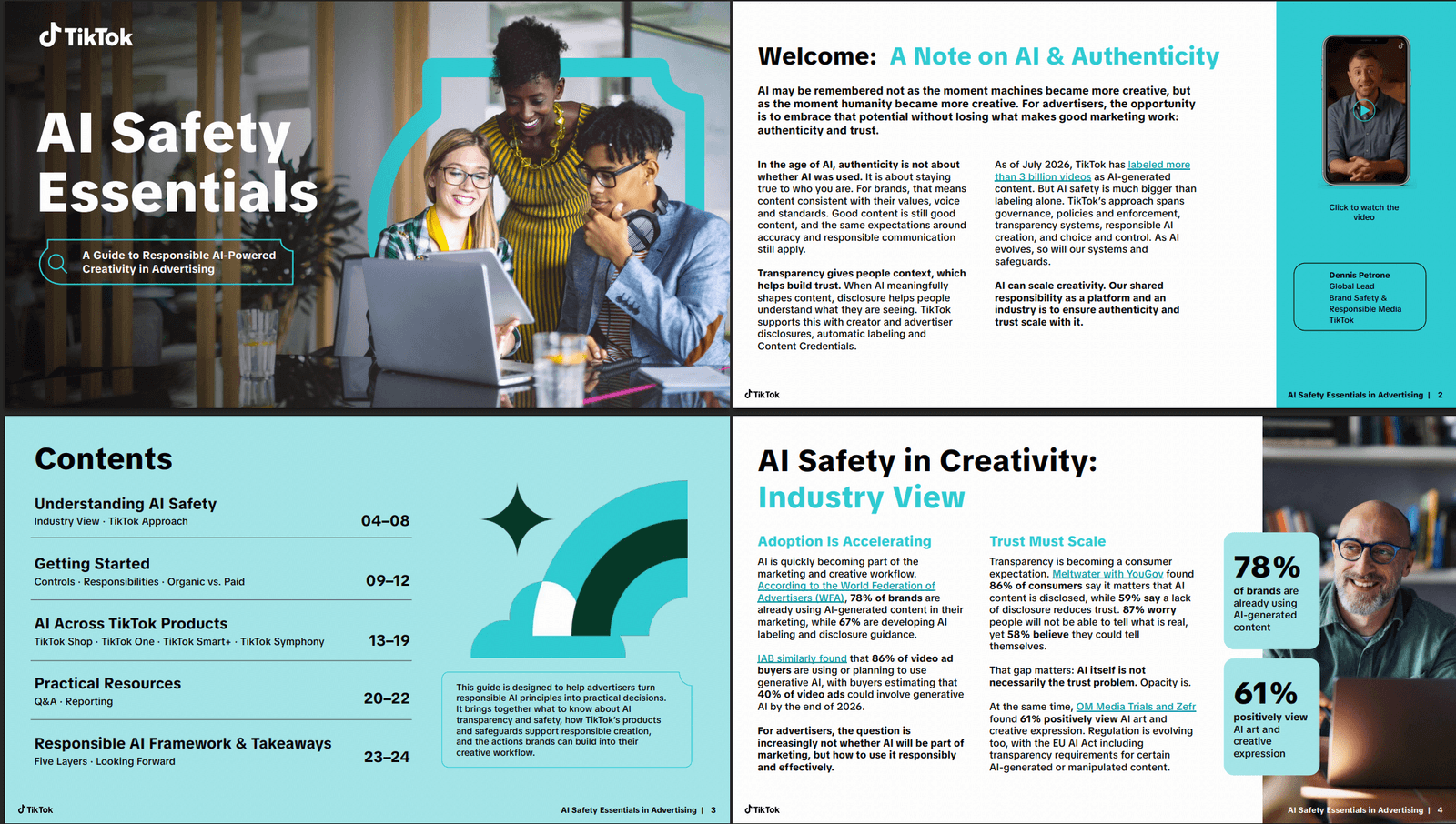
TikTok has labeled more than 3 billion videos as AI-generated, according to figures cited in its new AI Safety Essentials guide, with the count dating back to July 2026.
Share: WhatsApp · Telegram · X · Facebook · LinkedIn · Email

The platform is now putting greater emphasis on responsible AI-powered creativity in advertising, including transparency, disclosure and brand safety.
On October 28, 2026, TikTok introduced its AI Safety Essentials guide at the APAC Responsible Media Forum in Singapore. The guide is part of a broader effort to help advertisers use AI without compromising authenticity and audience trust.
For Shopify sellers, the practical question is not simply whether they use AI to produce ads. It is whether the finished creative contains AI-generated or significantly modified content that needs disclosure, and whether the disclosure remains in place when the same asset is reused across platforms.
AI Safety Essentials guide at the APAC Responsible Media Forum
Not every AI-edited product image needs a label
TikTok's disclosure rules distinguish between minor technical edits and content that AI creates or significantly changes.
Under its advertising policy, ads containing completely AI-generated content or content significantly modified by AI must carry an AIGC label or a clear disclosure. However, minor adjustments are exempt.
What needs a label, and what does not?
| Creative task | TikTok AI disclosure |
|---|---|
| Removing or replacing a product photo's background | Not required |
| Adjusting lighting, brightness or color saturation | Not required |
| Reducing image noise | Not required |
| Generating an entirely new product scene | Required |
| Creating a virtual model wearing or using a product | Required |
| Producing an AI-generated customer review video | Required |
| Using AI voice cloning to make someone say something they never said | Required |
| Significantly changing a real person's appearance or actions with AI | Required |
For example, a seller can use AI to remove the background from an existing product photo without automatically triggering the disclosure requirement. But if the seller generates a realistic-looking customer to demonstrate or review the product, the resulting AI-generated content needs to be disclosed.
The distinction is important: AI involvement alone does not determine whether a label is required. What matters is the nature and extent of the AI-generated content or modification.
If the seller is unsure whether an edit is significant, TikTok recommends taking a cautious approach and applying the label.
Sources: TikTok Advertising Policies: Misleading and False Content · TikTok AI Safety Essentials for Advertisers.
The AI creative formats brands are buying often fall into the disclosure category
AI-generated advertising has made it easier to produce multiple creative variations without arranging a new shoot for every concept.
Three formats are particularly relevant to Shopify sellers:
AI UGC videos
These videos imitate customer-generated content. An AI-generated person appears to share a product experience or review, even though no real customer filmed the video.
Virtual models and product demonstrations
AI creates a person wearing, holding or using a product. These assets can be useful for demonstrating product concepts, but sellers must ensure the visuals accurately represent the actual product.
Fully generated product scenes
AI creates the setting, model, lighting and product presentation rather than simply editing an existing photograph.
When these formats are entirely AI-generated or significantly modified, they fall within TikTok's advertising disclosure requirements.
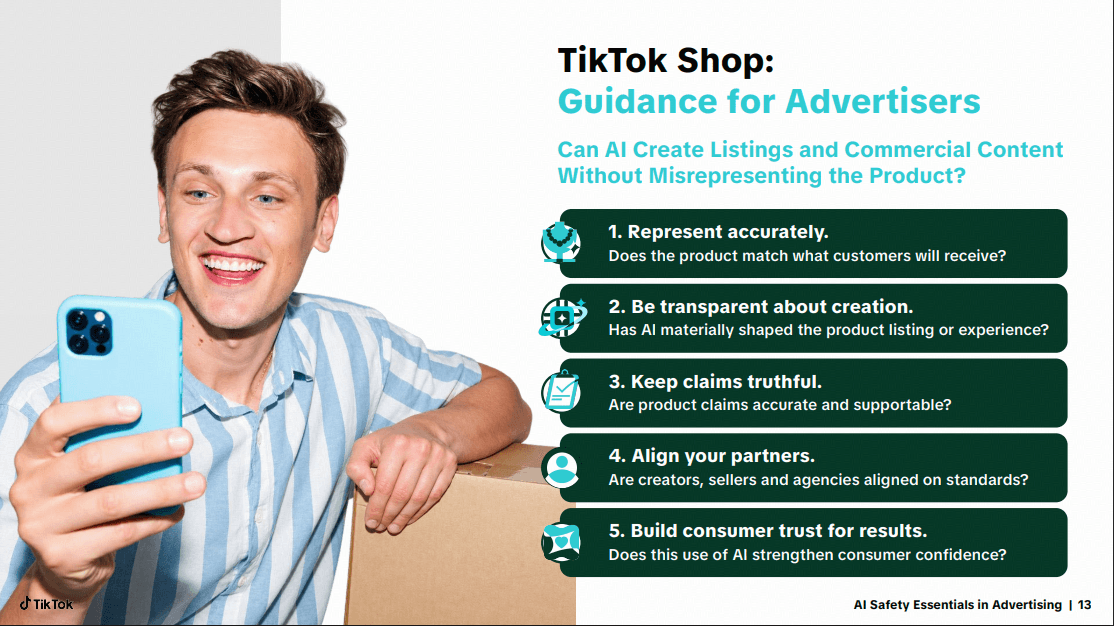
There is another issue beyond labeling: accuracy.
A virtual model should not make a product appear to have a different size, color, material or function. An AI-generated demonstration should not imply results or capabilities the real product cannot deliver. A fictional AI customer should not be presented as a genuine customer giving an authentic testimonial.
TikTok Shop's AI-Generated Content Restrictions and Requirements also emphasizes accurate product representation and prohibits misleading AI-generated product demonstrations.
In other words, disclosing AI use does not make misleading product claims acceptable.
Reusing the same creative on Meta and TikTok creates a disclosure gap
Many advertising teams produce one batch of creative and distribute it across Meta, TikTok and other channels.
That workflow can create a problem: a creative that has been prepared for one platform is not automatically ready for another.
Meta and TikTok have different approaches to AI transparency. Meta uses AI information labels for certain content it identifies as AI-generated, while TikTok has explicit disclosure requirements for qualifying AI-generated advertising content.
Sellers should therefore review each platform's requirements separately rather than assume that a label or disclosure on one platform satisfies the other.
Sources: Meta's approach to labeling AI-generated content · TikTok Advertising Policies.
Three TikTok settings sellers should check
1. The AI disclosure toggle in Ads Manager
For qualifying non-Spark ads, TikTok provides an option called "This ad contains AI-generated content" during ad creation.
The advertiser should enable it before submitting the ad for review.
2. Campaign duplication resets the setting
This is an easy detail to miss when scaling campaigns.
TikTok states that creating a new campaign, including duplicating an existing campaign, resets the AI disclosure toggle. Even if the original creative was correctly labeled, the new campaign must be checked again.
3. Spark Ads require disclosure on the original post
Spark Ads run through an existing organic TikTok post. The AI disclosure must therefore follow the Community Guidelines requirements for that post. The Ads Manager toggle for non-Spark ads does not apply.
TikTok also says that after submitting an ad, the disclosure toggle cannot be changed or switched off unless the advertiser changes the image or video.
Source: TikTok Business Help Center: Add Disclaimers to Ads.
An AI label does not override other advertising restrictions
For beauty, wellness, fitness and supplement brands, disclosure is only one part of compliance.
TikTok separately restricts product-effect before-and-after comparisons that could create a false or distorted impression of results.
For example, adding an AI label does not make an exaggerated demonstration of a skincare product's effects acceptable.
The same principle applies to testimonials, endorsements and product demonstrations: the content must still be accurate and must not mislead viewers.
Source: TikTok Advertising Policies.
What Shopify sellers should do before their next TikTok campaign
Use this checklist before uploading or duplicating creative:
| Check | What to do |
|---|---|
| AI-generated scenes | Identify fully generated scenes, virtual people and AI UGC videos. |
| Minor edits | Separate background removal, lighting and color adjustments from significant AI modifications. |
| Product accuracy | Verify that AI has not changed the product's actual appearance, material, features or performance. |
| Ads Manager | Enable the AI disclosure toggle for qualifying non-Spark ads. |
| Duplicated campaigns | Check the disclosure setting again after every duplication. |
| Spark Ads | Review the AI disclosure on the original organic post. |
| Other ad restrictions | Check testimonials, product claims and before-and-after comparisons separately. |
The takeaway: TikTok's AI labeling efforts are no longer just a creator-side issue. With more than 3 billion AI videos labeled and a dedicated AI safety framework for advertisers, brands need to treat AI disclosure as part of their creative production and campaign-launch process.
The goal is not to label every image touched by AI. It is to identify content that genuinely requires disclosure, represent products accurately and make sure the right label is in place on every TikTok placement.
Frequently asked questions
Does using AI to remove a product photo's background require a label?
No. TikTok explicitly lists removing or modifying backgrounds as an insignificant AI edit under its advertising policy.
Does duplicating a TikTok campaign preserve the AI disclosure setting?
No. TikTok resets the AI disclosure toggle when a new campaign is created, including through duplication. Check the setting before submitting the new campaign.
Ask AI next
- What happens to a TikTok ad or ad account when AI-generated content runs without the required disclosure?
- How do I add the AI-generated content label to an organic TikTok post before running it as a Spark Ad?
- Where do I disclose AI-generated creative in Meta Ads Manager, and does Meta require it for ecommerce ads?
- Which countries' advertising laws ban AI-generated customer testimonials even when the ad carries an AI label?
- Does TikTok's AI-generated label lower click-through or conversion rates compared with unlabeled ads?