All stories · Article
Where should AI-written emails start?
Before you ask AI to write your automated emails (flows), two decisions come first: which emails to write, and what the AI should base them on.
Share: WhatsApp · Telegram · X · Facebook · LinkedIn · Email
The most persuasive wording is usually already sitting in your customers' reviews, support messages and survey answers. On October 17 and 20, a marketing advisor to tech companies and an email marketer for ecommerce brands both made this point on X.
Chase Dimond | Email Marketing Nerd 📧@ecomchasedimondYour customers already wrote your best ads. The AI prompt that finds them is in the reply.
A few tips before you run it:
- Support emails and post-purchase survey answers work too. Paste them in with the reviews.
- Take out names and email addresses before you paste anything in.
- Spot-check every quote against the original review before you use it.
- Use what you find everywhere: ads, product pages, landing…Oct 20, 2026 · View on X
For a small store, that changes how AI fits into email automation. In our view, the job AI is best suited for is finding, collecting and reorganizing what customers have already said about your product, not inventing copy from scratch.
Pick four automated emails before you ask AI to write anything
Know which email you're writing before you open an AI tool. Oku Cobham, who writes and builds Klaviyo emails for small ecommerce brands, suggests that a store with room for only four automated emails should start with these:
- Welcome email: a new subscriber is paying more attention to you now than they ever will again, so this is where you say who you are and why your products are worth the money.
- Abandoned cart email: sent a few hours later, it puts the exact product the customer picked back in front of them.
- Post-purchase email: thank them, tell them what happens next, and show them how to get the most out of the product.
- Win-back email: sent to people who haven't bought in a while, with a real reason to come back.
All four fire on their own whenever a customer takes a specific action, so they keep running in the weeks when you have no time to write anything. Replying to a comment under the post, Oku made this point:
In Oku's view, most small stores only think about the first order, so the follow-up emails never get built.
In another comment, Oku noted that most sellers want to send big campaigns first. So write these four emails first, then move on to newsletters and mass discount sends.
Give AI your customer reviews instead of letting it make things up
Once you know which emails you need, the next job is gathering raw material. Chase Dimond, a partner at an ecommerce email marketing agency, shared a prompt for mining customer reviews for ad copy.
Step 1 decides the quality of the whole prompt: give the AI exactly what customers wrote, and tell it to add nothing beyond those words.
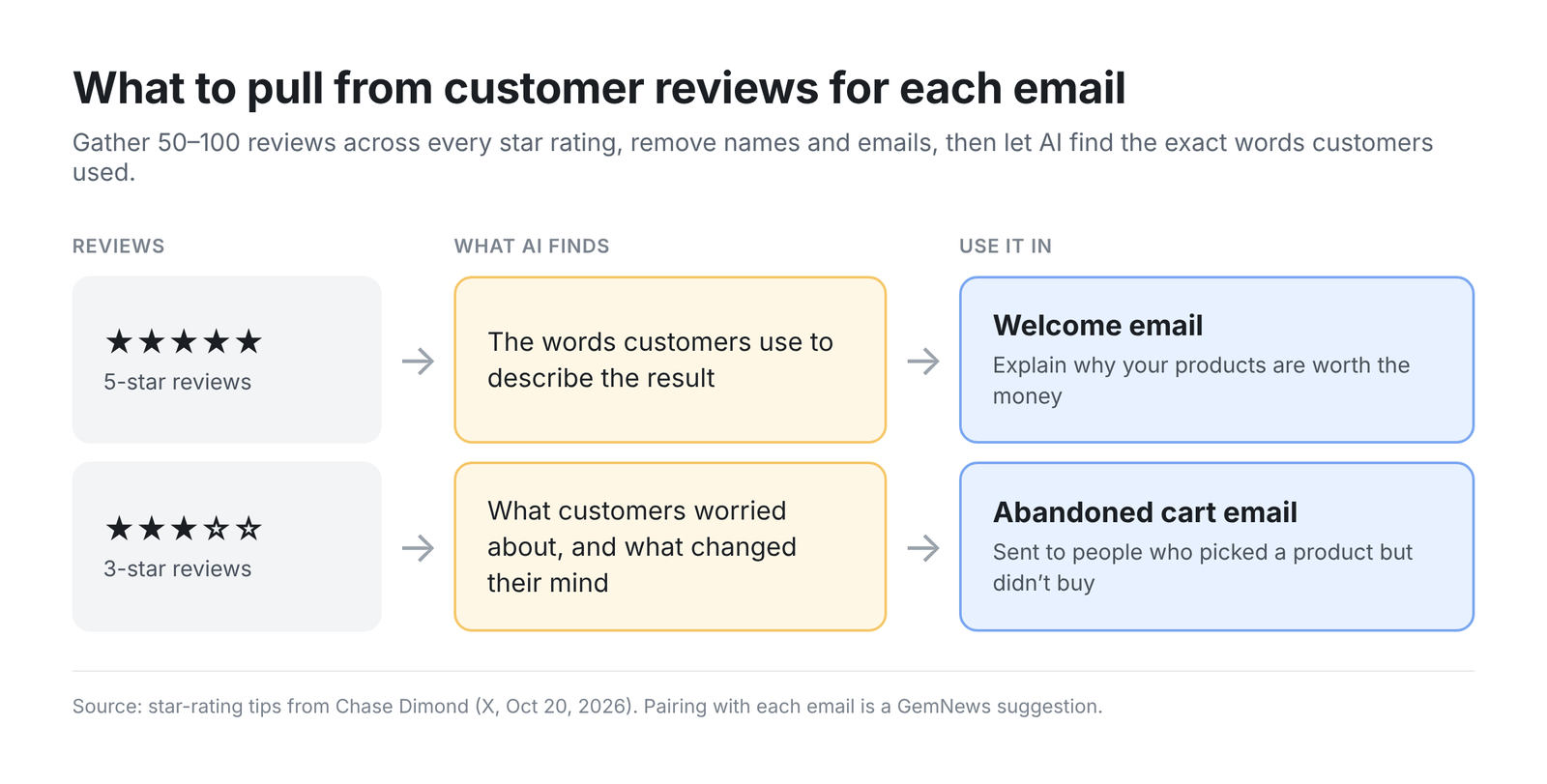
To have enough to work with, Chase recommends collecting 50–100 reviews across every star rating. Five-star reviews give you the language of results. Three-star reviews show what customers doubted and why they bought anyway. One- and two-star reviews surface the objections your ads need to answer.
The prompt was written for ads, and Chase suggests using the output on product pages, landing pages and the homepage too.
It also works for your automated emails if you swap step 5 for something like "write a subject line and opening paragraph for the welcome email from exactly these phrases". Result language suits the welcome email, where you need to explain why the product is worth the money. Hesitations and what changed customers' minds suit the abandoned cart email, since its readers have already picked a product but haven't bought it.
Chase flags two things before you run it: strip customer names and email addresses before pasting anything into an AI tool, and check every quote against the original review before you use it. Support emails and post-purchase survey answers can go in alongside the reviews.
If you, or the agency running your email, already use Claude Code or other AI agents, take a look at Marketing Skills, a free skill set from Corey Haines, who runs a conversion optimization agency. It includes an "emails" skill for building lifecycle email automations and a "customer-research" skill for synthesizing customer research.
Automated emails only work when someone watches and tests them
Once the four emails are live, the part AI can't do for you is checking whether they're doing their job.
Mark Mei, a retention marketer for ecommerce brands, described an electronics brand doing about $500,000 a month in revenue that he took on in Q3 2026. At that point, email brought in only about $40,000 a month, roughly 8% of revenue. Campaigns went out irregularly, the automated flows had been switched on years earlier and left alone, and the brand had no way to measure what email actually contributed.
Over 4 months, his team rebuilt how the channel ran: a dedicated email team, weekly planning meetings, all 12 essential flows turned on and A/B tested in Klaviyo, email revenue attribution, and automated weekly reporting.
By his account, email revenue climbed to about $380,000 a month while total revenue passed $1.2 million, so email made up about 32%. This was a brand selling $500,000 a month with a full email team built around it, so a small store shouldn't expect a similar jump. What's worth taking is how he explained the result:
"What people forget is that the channel itself was never broken. The SYSTEMS around it were."
Every change on Mark's list sits in operations, not in the email copy. In our view, AI helps you write better emails, but send schedules, measurement and testing still need a person watching them. For a small store, the manageable version might be one session a week to see how the four automated emails are performing, testing one change at a time. For example, swap the abandoned cart subject line for a phrase taken from a three-star review, then compare it with the old one.
Start with one product and one email
If you only have a few hours this week, pick one best-selling product, collect 50–100 reviews across every star rating, strip out customer names and emails, and run the prompt above. Use the phrases customers repeat most to write the welcome email first. The other three can come later, along with one session a week to see how they're doing.