All stories · Article
When AI gets your store wrong, the fix starts on your product pages
AI assistants get stores wrong because they can only repeat the product data a brand exposes, and fixing that data is the merchant's job.
Share: WhatsApp · Telegram · X · Facebook · LinkedIn · Email
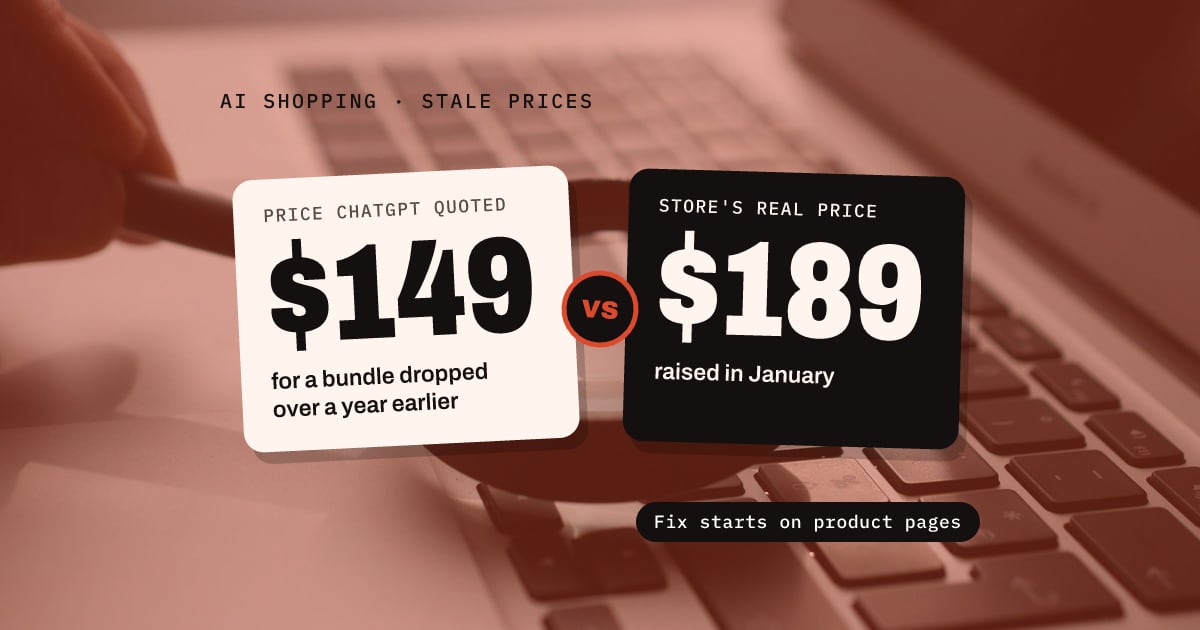
A seller on r/ecommerce found ChatGPT steering a customer toward a bundle the store had dropped more than a year earlier, quoting an old $149 price the store had raised to $189 in January.
Three ways AI gets stores wrong
The discontinued bundle is the first of three patterns.
The same Reddit seller ran the question through Perplexity and Claude. One gave yet another price. The other never mentioned the store and named two competitors instead. Three assistants gave three different answers, and none matched the real store.
The second pattern is a wrong price or a wrong policy. @AbhinavPanse described the moment after a store celebrates being recommended: "Then you notice it quoted the wrong price and promised returns on a final-sale item." That one sentence holds two separate errors, a number and a promise.
Abhinav Panse@AbhinavPanseAI recommends your product. You celebrate.
Then you notice it quoted the wrong price and promised returns on a final-sale item.
What should merchants check after AI mentions them? I wrote about that: https://t.co/oC8BkuE4eLOct 12, 2026 · View on X
The third pattern is a catalog with nothing in it to match. @yannis1kiefer pulled their catalog and found half the product titles still read "best seller", with no size or material. Titles like that leave a shopping agent nothing to compare a real shopper's question with.
None of these cases involved a chatbot installed on a store's own site. They came from ChatGPT, Perplexity, Claude and shopping agents. An on-site assistant answers from the same kind of product data, though, so it inherits the same gaps.
A wrong answer can lose the order, not just the upsell
AI pushes shoppers in both directions. In a Semrush survey of 2,338 US adults reported by MarTech, about 58% of AI users had bought something a chatbot recommended. About the same share had decided against a purchase because of what a chatbot told them.
The second number deserves more attention. Among people who use chatbots while shopping online, nearly 81% have dropped a purchase based on AI guidance, according to MarTech.
That changes the math for stores hoping AI will suggest add-ons and lift AOV. A missed upsell costs a little order value. A stale price or a returns promise the store never made could cost the whole sale.
Retail Dive covered a separate survey finding that some shoppers regret following AI's purchase advice. Being recommended is only good news when the recommendation is right.
AI only knows what a brand shows it
An assistant does not know on its own which items are still for sale, what they cost today, or what a given customer bought before. It knows what it can read.
@pravinfernandes asks whether an AI chatbot can recommend the right product if it can't see a customer's past service history. The post is about large retailers in India moving from fragmented data silos to one unified data foundation. Under Armour is the example: a company that connected its data to automate daily reporting, tune product margins and run agentic AI workflows safely. The post ends on "AI does not operate in isolation." Trusted AI, it adds, needs data that is trusted, governed and connected.
That is enterprise infrastructure, far from a mid-size Shopify store. @yourlio makes the same point at the scale of a single product page. Shoppers ask about ingredients, who a product suits and how to use it, and an assistant has to draw those answers from clear product information. Where that information is missing, the assistant should say so.
Their example contrasts a bare search for "Acne serum." with a shopper describing sensitive, acne-prone skin and wanting to manage breakouts without drying it out. The detailed question only pays off if the product page can answer it.
What to check and fix this week
The fix lives on the product pages and in the catalog, and the brand controls both. Five checks cover the failures above.
- Ask the assistants yourself. Put your own product questions to ChatGPT, Perplexity and Claude. The Reddit seller saw none of the errors in Google Analytics or Search Console and only learned about them when a customer wrote in.
- Check every price and policy an assistant quotes. @AbhinavPanse asks what merchants should check once AI starts naming them. Start with the two things the example got wrong, price and returns, and compare both with the live page. Final-sale items need the closest look.
- Rewrite empty titles. A title that is only a sales label gives an agent nothing to match. Add the size and material a shopper would actually ask about.
- Answer the basics on the page. For skincare brands, @yourlio suggests saying who each product is for, describing the concern it addresses, and making usage instructions and precautions easy to find.
- Clear out discontinued products. Remove them, or mark them plainly as no longer sold, so the pages an assistant reads match what the store actually stocks.
Then pick one best-selling product page and, as @yourlio suggests, answer the three questions customers ask most often before they buy. One page, three answers, written by the store instead of guessed by a model.
Sources
- https://www.reddit.com/r/ecommerce/comments/1wnbg86/chatgpt_is_recommending_a_product_we_discontinued/
- https://x.com/AbhinavPanse/status/2109522945706193329
- https://x.com/yannis1kiefer/status/2102654725883658684
- https://martech.org/ai-is-telling-consumers-not-to-buy-your-product/
- https://www.retaildive.com/news/shoppers-burned-bad-ai-purchase-recommendations/831013/
- https://www.linkedin.com/posts/pravinfernandes_snowflake-retail-ai-activity-7515267757135773696-GBYo
- https://www.linkedin.com/posts/yourlio_shopify-conversationalcommerce-ecommerce-activity-7514956663670472704-PAJ4