All stories · Case study
Your replenishment flow may be targeting the wrong customers
A reorder email sent on the same day to every customer will inevitably reach some people too late and others too early. But timing may not be the only problem.
Share: WhatsApp · Telegram · X · Facebook · LinkedIn · Email

If your flow starts counting from the wrong event or includes customers who have never purchased the product, even a perfectly written reminder can miss its target.
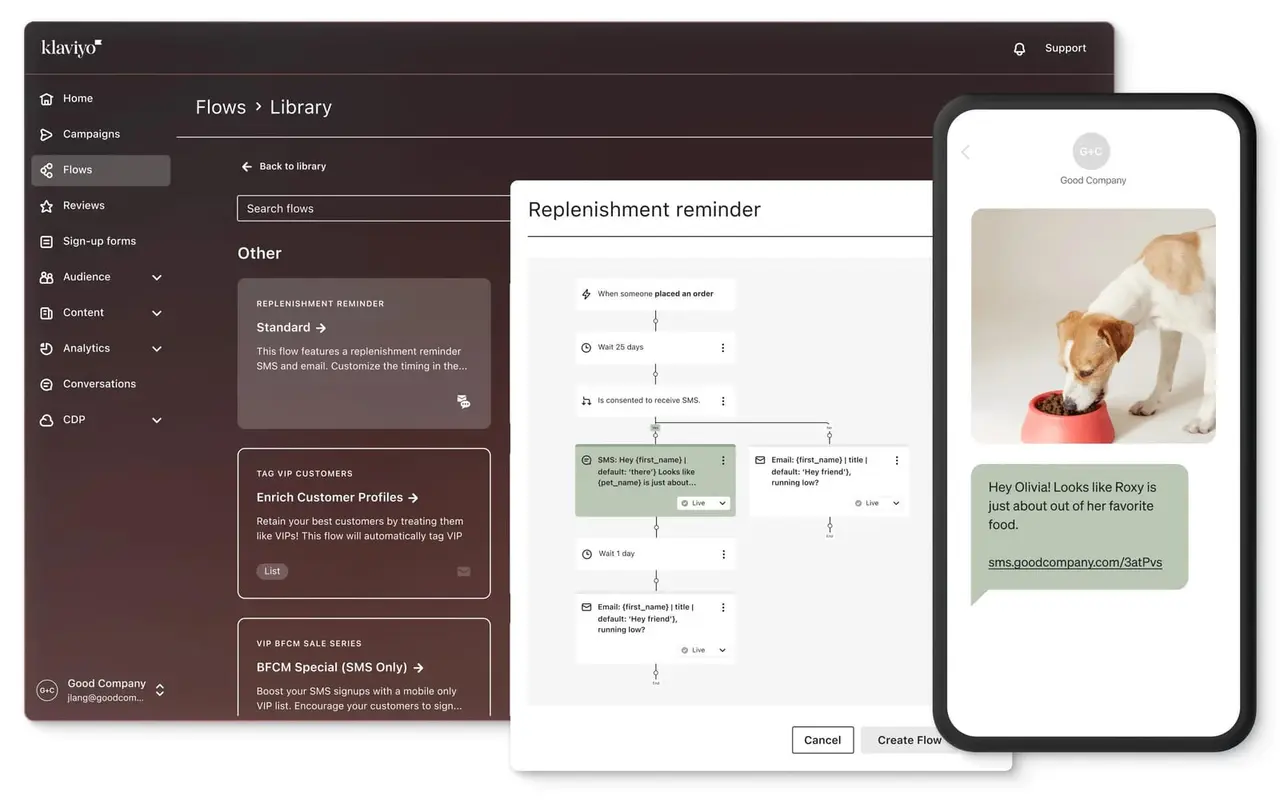
In an audit of a beauty brand's Klaviyo account, email marketer Tarik ABIDA found a replenishment email sent to 72 recipients that generated one click and zero orders. The flow had been counting 76 days from signup, rather than from the customer's purchase. With Black Friday approaching on November 27, Shopify merchants should check the structure of their reorder flows before spending more time testing subject lines or discounts.
One reorder date, wrong in both directions
Imagine three customers buying the same protein powder.
- Customer A runs out after 21 days.
- Customer B runs out after 35 days.
- Customer C runs out after 46 days.
If all three receive a reorder reminder on day 30, the timing is already wrong for everyone: nine days too late for A, five days too early for B, and 16 days too early for C.
This is an illustration shared by email marketer Chase Dimond in a November 19 post promoting rePete, a reorder prediction tool from Bold Commerce. The numbers are hypothetical, not results from a store's order data. But they make the underlying problem clear: there is no single reorder date that works for every customer.
A separate discussion in the Klaviyo community raises the same issue. A customer with a 60-day buying cycle may receive a reminder a month before they are ready to buy again.
The point is not that every store needs sophisticated AI prediction. It is that a store should understand its own buying cycles before choosing when to send a reminder.
Source: Chase Dimond on X · Klaviyo Community discussion
Where does your reminder start counting?
The more serious problem may be hidden inside the flow itself.
In an audit shared by Tarik ABIDA, a beauty brand's "Time to refill" email was triggered 76 days after signup. It reached 72 people, received one click and generated no orders. The same account's flows recorded an unsubscribe rate of 1.41%, compared with a reported benchmark of 0.35%.
The timing logic created an obvious mismatch. Someone who purchased on day 60 after signing up could receive a replenishment reminder just 16 days after buying. Someone who had signed up but never purchased could receive the same message.
That is not a copywriting problem. It is a trigger and audience problem.
Changing the subject line, adding urgency or offering a discount will not fix a flow that starts counting from the wrong event or sends to people who have not bought the product.
These figures come from one account audit shared by the marketer, not an industry-wide study. They should be read as a specific example of a broken flow, not a universal performance benchmark.
Source: Tarik ABIDA's Klaviyo audit on LinkedIn
Three checks before you touch the copy
Before rewriting your emails, inspect three parts of the flow.
1. Does the flow start from an order or a signup?
A replenishment reminder should normally be triggered by a relevant purchase event, not simply by someone joining your email list.
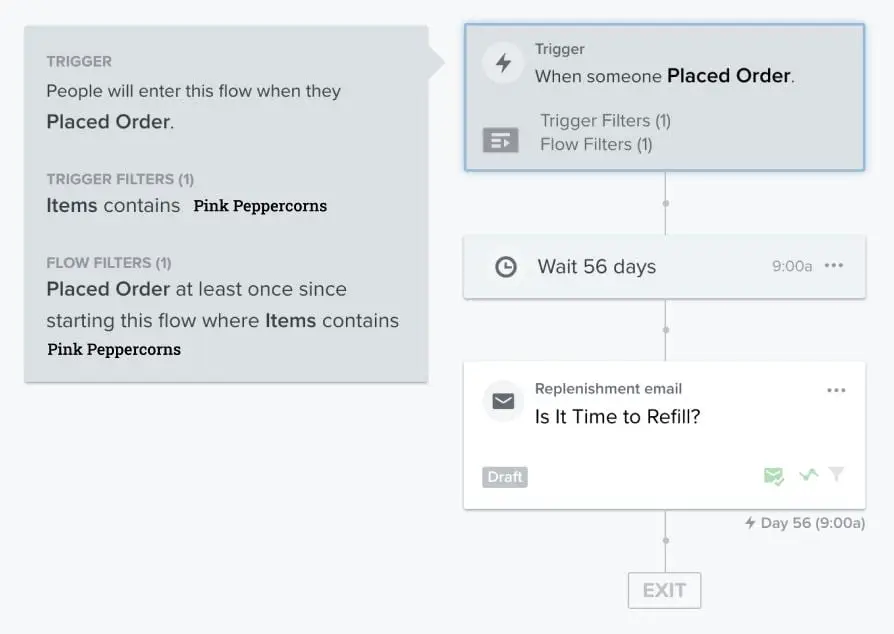
Klaviyo's official guide recommends using the Placed Order metric as the trigger. For a product-specific flow, it also recommends adding a trigger filter for the relevant product.
2. Are customers who have already reordered being excluded?
A customer who buys again while waiting for a reminder should not continue receiving messages telling them to restock.
Klaviyo recommends a profile filter checking whether someone has placed an order zero times since entering the flow. For product-specific reminders, the filter should check purchases of that product, rather than unrelated orders.
The flow should also distinguish between first-time and returning customers where the messaging or incentive needs to differ.
3. Is the delay based on the product's actual buying cycle?
Start with your own order data. Look at the time between purchases for the same product, rather than applying an arbitrary 30-day delay to every customer.
Klaviyo gives a practical example: for a product with a 30-day supply, a first reminder around day 25 may give the customer time to reorder before running out.
For more individualized timing, Klaviyo also supports flows triggered by the predictive profile property called "Expected Date of Next Order." Its documentation explains how to use that date as a flow trigger.
The important distinction is that a predicted next-order date is not the same as a fixed delay applied to everyone. It depends on having suitable purchase history and predictive data available.
Source: Klaviyo, How to create a replenishment flow · Klaviyo Academy, AI repeat purchase flow
What a split fixes, and what it doesn't
A conditional split can prevent the wrong customer from receiving a reminder. It can separate people who have already purchased from those who have not, or distinguish first-time buyers from repeat customers.
But a split alone does not correct the timing. The flow still needs the right starting event and a delay that reflects the product's buying cycle.
There is also a limit to what better timing can achieve.
Email marketer Michael Galvin argues that a reminder sent on day 45 cannot turn an occasional-use product into a habitual purchase. If customers do not yet have a reason to use the product regularly, the problem may begin much earlier, with the advertising, product page or post-purchase education.
That is worth considering when a store acquires a large number of first-time customers during Black Friday. For those buyers, a useful product guide or usage email two to four days after delivery may be more valuable than an immediate attempt to sell another unit. This is a strategic hypothesis, not a proven universal rule.
The next step is straightforward: open your replenishment flow and check when the clock starts, who receives the reminder, and where the delay comes from.
A single day-30 reminder cannot serve customers who finish the same product in 21, 35 and 46 days. And no subject line can repair a clock that started ticking before the customer even bought.
Ask AI next
- How do I fix a replenishment flow that's already live before Black Friday without disrupting current subscribers?
- How can I calculate my own product's average repurchase cycle from Shopify order data to set the right delay?
- How does Klaviyo's 'Expected Date of Next Order' property actually calculate its estimate?
- What alternatives to rePete or Klaviyo's native prediction exist for forecasting Shopify reorder timing?
- What flow metrics should I track after fixing the trigger to confirm the mismatch is resolved?